

Rural Community Emergency Preparedness Guide
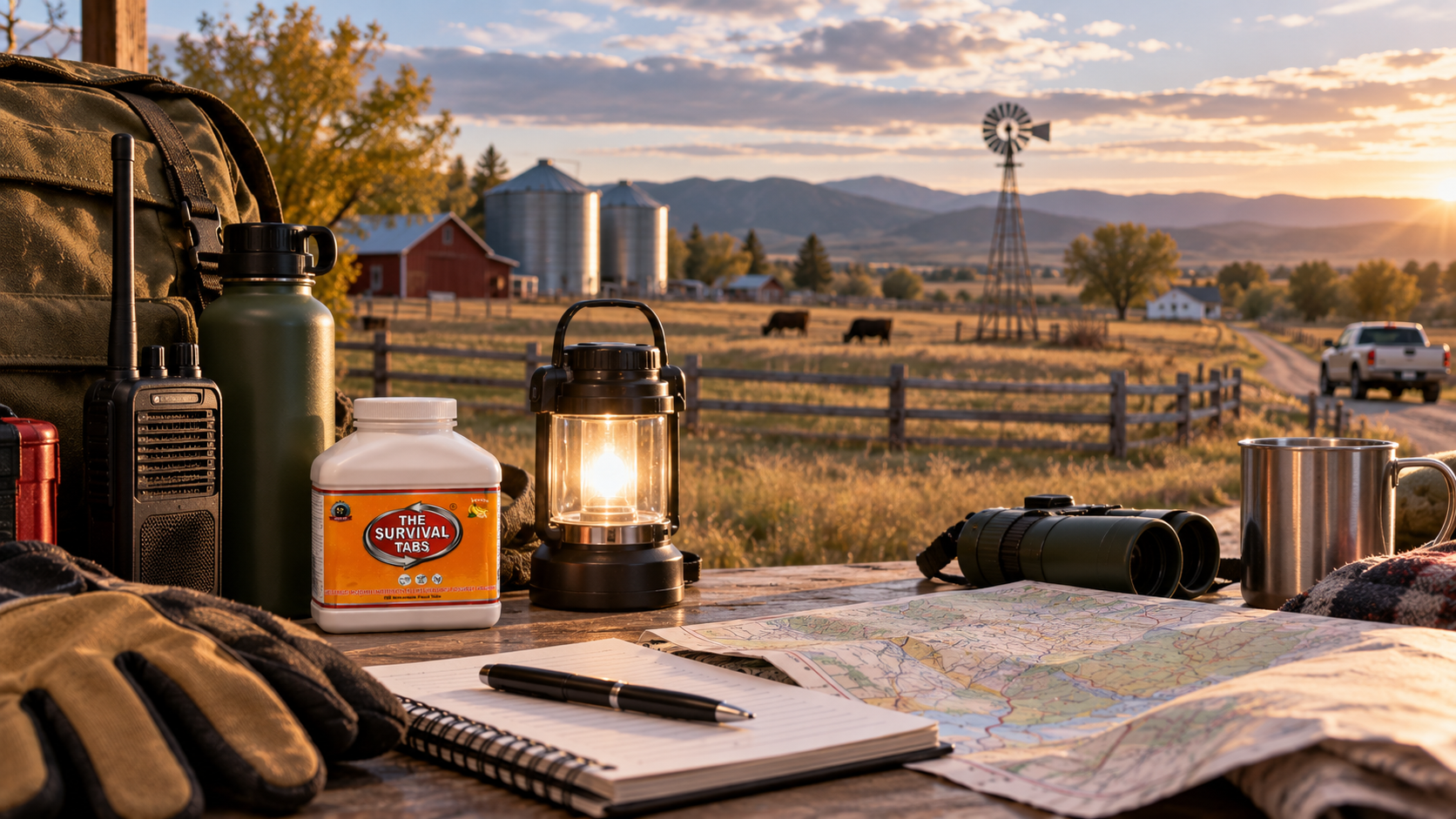
A practical framework for communities facing long distances, limited infrastructure, agricultural risks, and slower access to outside help.
Production version: 1.0
Important safety and scope note
This guide supports community preparedness. It does not replace instructions from emergency managers, fire departments, law enforcement, public health agencies, utilities, veterinarians, road authorities, or medical professionals.
Call 911 for an immediate threat to life or property where 911 service is available. Know in advance what to do if voice service, text-to-911, or cellular coverage is unavailable in your area.
Do not enter closed roads, floodwater, wildfire evacuation zones, damaged structures, downed-power-line areas, or agricultural facilities affected by hazardous materials or animal disease.
Volunteers should work within their training, authorization, protective equipment, and local incident-management structure.
Why rural preparedness needs its own plan
Rural communities often have strong relationships, practical skills, local knowledge, and a tradition of helping neighbors. Those strengths are valuable, but they do not eliminate infrastructure and distance challenges.
A rural plan should account for the actual time required to reach homes, farms, schools, clinics, shelters, and isolated roads—not an assumed urban response time.
* Long travel distances for ambulances, fire apparatus, utility crews, veterinary help, and public works.
* Cellular dead zones, limited broadband, and dependence on a small number of towers or backhaul routes.
* Few alternate roads when a bridge, culvert, mountain pass, ferry, or low-water crossing closes.
* Volunteer fire departments and emergency medical services with limited staffing during widespread incidents.
* Private wells, septic systems, propane, heating oil, generators, and other household systems that need separate contingency plans.
* Livestock, poultry, working animals, feed, fencing, barns, irrigation, and agricultural chemicals.
* Older adults, people with disabilities, seasonal workers, visitors, and households without reliable transportation.
* Longer power restoration times and limited access to fuel, pharmacies, groceries, banking, and repair services.
The goal is not self-reliance without limits. The goal is a coordinated local system that can protect life, communicate clearly, use resources responsibly, and request outside help early.
1. Define the planning area
Begin with a practical service area rather than a vague idea of the community.
* List incorporated towns, unincorporated areas, tribal lands, special districts, and neighboring jurisdictions that share roads or services.
* Mark fire, EMS, law-enforcement, public-works, utility, school, clinic, hospital, veterinary, extension, shelter, and animal-control coverage.
* Identify seasonal population changes, tourism periods, farm labor cycles, hunting seasons, festivals, and weather-related access changes.
* Record the official authority responsible for alerts, evacuation orders, shelter decisions, road closures, public health notices, and disaster declarations.
Planning boundaries should reflect how people actually receive help. A mailing address, school district, fire district, EMS district, utility territory, and county boundary may not match.
2. Build a rural hazard and access profile
Use local hazard-mitigation plans, historical records, utility information, agricultural knowledge, and emergency-service experience to identify credible risks.
* Flooding, flash flooding, washed-out roads, damaged culverts, and isolated properties.
* Wildfire, smoke, wind-driven fire, evacuation bottlenecks, and livestock movement.
* Tornadoes, severe thunderstorms, high winds, lightning, hail, and winter storms.
* Extreme heat, drought, water shortage, crop loss, and livestock heat stress.
* Extended power, communications, fuel, or water-system outages.
* Hazardous-material releases from highways, rail lines, farms, fuel storage, or industrial sites.
* Animal disease, plant disease, food-supply disruption, and biosecurity restrictions.
* Earthquakes, landslides, coastal storms, volcanic hazards, or other locally relevant threats.
For each hazard, ask which roads, bridges, homes, farms, medical routes, shelters, utilities, and communications systems could fail at the same time.
Create an access map
* Primary and alternate routes to every populated area.
* Bridges, culverts, low-water crossings, steep grades, seasonal roads, gates, and weight restrictions.
* Locations that routinely lose cellular or radio coverage.
* Turnaround points and roads unsuitable for large emergency vehicles.
* Households likely to become isolated by snow, fire, floodwater, fallen trees, or debris.
* Potential helicopter landing areas only when identified and managed by authorized responders.
Do not publish sensitive household information on an open map. Keep operational maps under appropriate local control and follow privacy requirements.
3. Establish leadership and legal authority
A rural preparedness group should support—not replace—official emergency management and response agencies.
* Name a lead local agency or recognized coordinating body.
* Document who can issue public warnings, recommend evacuation, open facilities, request mutual aid, and approve public information.
* Use written roles for government, nonprofit, faith, agricultural, school, business, and volunteer partners.
* Clarify liability, insurance, background checks, privacy, accessibility, animal control, donations, and volunteer-management requirements.
* Set a process for transferring coordination to official incident leadership when an emergency begins.
Avoid informal chains of command built around popularity, property ownership, equipment, or social status. Emergency roles should be lawful, transparent, trained, and accountable.
4. Build redundant warning and communication systems
No single channel will reach every rural resident. Use overlapping methods and test them under poor conditions.
* Local emergency alerts and Wireless Emergency Alerts where available.
* NOAA Weather Radio and local broadcast radio.
* Landlines, mobile phones, text messages, email, and official social-media accounts.
* Public-safety radio systems operated by authorized agencies.
* FRS, GMRS, amateur radio, satellite devices, or other tools used within applicable licensing, operating, and training requirements.
* Door-to-door notification only when authorized, conditions are safe, and volunteers have identification, supervision, and a check-in plan.
* Physical notice boards, sirens, church bells, vehicle loudspeakers, or other locally approved low-tech methods.
Do not assume text-to-911 is available. Verify local capability and teach residents to make a voice call when possible, provide a precise location, and follow local instructions.
Write a communications plan
* Primary and backup contact methods for each partner.
* Plain-language message templates for evacuation, sheltering, road closure, boil-water advisories, wildfire smoke, and shelter opening.
* A schedule for status updates even when there is no new information.
* Translation, captioning, relay, large-print, and other accessible communication needs.
* Rumor-control procedures and a single source for confirmed public information.
* A paper contact list and printed maps for use when networks fail.
Predictive analytics, mobile apps, NG911 features, and mapping platforms may help, but availability and capability vary. Treat them as tools to verify locally—not universal solutions.
5. Plan for medical access and continuity
Rural medical planning should begin before transportation and communications fail.
* Identify clinics, hospitals, pharmacies, dialysis centers, urgent-care sites, air-medical contacts, and veterinary services serving the area.
* Map normal and alternate ambulance routes, including seasonal limitations and bridge restrictions.
* Encourage households to maintain current medication lists, clinician contacts, allergies, diagnoses relevant to emergency care, and device information.
* Plan backup power for medically necessary equipment with the equipment supplier, clinician, utility, and qualified electrician as appropriate.
* Create confidential, consent-based procedures for residents who may need evacuation assistance or wellness checks.
* Arrange trained first-aid, CPR, AED, and bleeding-control capabilities where appropriate, without assigning untrained volunteers to medical treatment.
Do not store or circulate personal medical information in an unsecured community spreadsheet. Collect only what is necessary, obtain consent, restrict access, and follow applicable law.
6. Protect people with access and functional needs
Inclusive planning is a core safety requirement, not an optional section.
* Include people with disabilities, older adults, caregivers, people who use mobility or communication devices, and people with limited English proficiency in planning.
* Check whether shelters, transport vehicles, toilets, charging locations, and communication methods are accessible.
* Plan for service animals, mobility equipment, refrigerated medication, oxygen, hearing devices, and backup batteries.
* Use a voluntary assistance registry only with clear purpose, consent, security, maintenance, and deletion rules.
* Avoid labeling residents as helpless. Ask what support they use, what barriers exist, and what solutions they prefer.
7. Prepare roads, transportation, and evacuation
A rural evacuation can fail when one road closes or too many vehicles, trailers, and livestock loads enter the same route.
* Pre-identify primary, alternate, and last-resort routes with road authorities and emergency managers.
* Establish how closures will be reported and who can authorize barricades or traffic control.
* Identify residents without vehicles and accessible-transport needs.
* Plan staging areas outside hazard zones for buses, paratransit, livestock trailers, and responder equipment.
* Coordinate fuel priorities lawfully; do not create informal fuel seizures, checkpoints, or unauthorized traffic control.
* Set trigger points for early livestock movement when official guidance and conditions support it.
* Prepare for visitors who do not know local roads, flood crossings, wildfire zones, or winter restrictions.
Never drive around barricades or through floodwater. A familiar road can become deadly when water, fire, ice, debris, or structural damage is present.
8. Plan for power, fuel, wells, and septic systems
Many rural homes and facilities depend on electricity for water, heat, refrigeration, communications, medical devices, milking, ventilation, and animal care.
* List critical community loads and the power required to start and run them.
* Use qualified electricians for transfer equipment and permanent generator connections.
* Operate generators outdoors, far from doors, windows, and vents, and follow manufacturer and official safety guidance.
* Install and maintain carbon-monoxide alarms and smoke alarms.
* Store fuel legally and safely, away from ignition sources and living spaces, with appropriate containers and rotation.
* Plan drinking water when private wells lose power or may be contaminated.
* Know how prolonged outages affect septic pumps, lift stations, pressure systems, and wastewater treatment.
* Set priorities for refrigeration of food, medicine, vaccines, animal products, and other temperature-sensitive items.
Never backfeed a building through a receptacle. Never run an engine, charcoal device, or combustion heater in a home, garage, shed, barn, or other enclosed or partly enclosed space.
9. Prepare farms, livestock, and working animals
Animal and agricultural plans should be developed with owners, veterinarians, extension professionals, animal-control authorities, emergency managers, and relevant agricultural agencies.
* Maintain current animal inventories, identification, photographs, ownership records, health records, and emergency contacts.
* Identify evacuation destinations, shelter-in-place options, transport capacity, loading time, and alternate routes.
* Store and rotate appropriate feed, water, medication, bedding, fencing supplies, and generator fuel.
* Plan ventilation, cooling, heating, milking, watering, and manure management during power loss.
* Secure pesticides, fertilizers, fuels, compressed gases, and veterinary products against flood, fire, theft, and impact.
* Develop carcass-management and disease-reporting procedures with authorities before an incident.
* Protect responders from aggressive animals, unstable structures, electrical hazards, confined spaces, and contaminated water.
Do not release livestock onto public roads or move animals into restricted zones without coordination. Human life safety remains the first priority.
10. Create neighborhood and mutual-aid systems
Mutual aid works best when expectations are written before the emergency.
* Inventory organizations and capabilities, not private household valuables.
* Record equipment type, trained operators, limitations, fuel needs, insurance, and activation contacts.
* Use written agreements for shelters, transport, food service, generators, heavy equipment, animal facilities, and communications support.
* Define reimbursement, supervision, maintenance, damage, and return procedures.
* Create check-in and check-out systems so volunteers are not lost, duplicated, or sent into unsafe areas.
* Use buddy systems and accountability procedures for any authorized field activity.
Ownership of a tractor, chainsaw, radio, drone, boat, firearm, or medical kit does not automatically qualify someone for an emergency role.
11. Plan shelters and community facilities
A church, school, grange hall, fire station, library, fairground, or community center is not automatically a safe shelter.
* Have qualified officials assess hazard exposure, structural condition, fire protection, occupancy, sanitation, accessibility, backup power, and communications.
* Separate human sheltering, household pets, livestock, and hazardous materials as required by the approved plan.
* Plan potable water, toilets, hand hygiene, waste, food safety, medication refrigeration, charging, security, registration, and reunification.
* Post clear opening status. Do not allow social-media rumors to send residents to an unopened or unsafe facility.
* Identify alternate facilities if the preferred building is damaged, inaccessible, or inside the hazard area.
12. Maintain household readiness
Community systems are stronger when households can manage an initial period safely while official help is prioritized.
* Emergency contacts and an out-of-area contact.
* Official alert enrollment and a battery-powered or hand-crank radio.
* Water, shelf-stable food, medications, sanitation supplies, lighting, batteries, and seasonal clothing.
* Plans for infants, older adults, disabilities, dietary needs, pets, livestock, and service animals.
* Paper maps, local road knowledge, vehicle readiness, and a safe fuel plan.
* Copies of identification, insurance, prescriptions, property records, animal records, and key account information stored securely.
* Cash in small denominations when electronic payments are unavailable, stored discreetly.
Households should adapt quantities and duration to local hazards, distance, weather, medical needs, and official recommendations.
13. Train volunteers without creating unofficial responders
Volunteers need defined tasks, training, supervision, protective equipment, and permission.
* Use established programs such as locally sponsored CERT where available.
* Train for communications, shelter support, logistics, damage reporting, animal support, and preparedness education; use traffic support only when authorized.
* Maintain credentials, emergency contacts, limitations relevant to assignment, and training records securely.
* Set clear no-go tasks: firefighting, law enforcement, forced entry, structural rescue, hazardous-material response, medical treatment beyond training, and work near downed power lines.
* Provide psychological first-aid awareness and referral pathways without asking volunteers to act as counselors.
14. Exercise the plan
A plan that has never been tested is a draft, not a capability.
1. Start with a discussion-based tabletop exercise using one realistic local hazard.
2. Test alerts in areas with weak coverage and confirm who was missed.
3. Walk or drive alternate routes only under normal, safe conditions and with permission.
4. Practice opening a shelter, setting up accessible registration, and maintaining privacy.
5. Test generator startup, fuel procedures, well contingencies, radios, and paper forms with qualified personnel.
6. Include farms, schools, clinics, utilities, volunteer departments, businesses, faith groups, and residents with access needs.
7. Record gaps, assign owners and deadlines, update the plan, and retest.
Exercises must not surprise the public, block roads, imitate real alerts without safeguards, or place people or animals at risk.
15. Respond with discipline
* Follow official warnings, evacuation orders, road closures, and incident instructions.
* Activate only the functions authorized by the local plan.
* Protect responder and volunteer accountability.
* Share confirmed information in plain language and correct false information promptly.
* Request outside assistance early when local capacity may be exceeded.
* Document decisions, resource requests, costs, donations, damage, and unmet needs.
* Maintain accessible communication and continue checking isolated areas only through safe, authorized methods.
Local initiative is valuable, but improvised operations can obstruct responders, expose private information, and create new casualties.
16. Recover and improve
Recovery begins while response is still underway and may last much longer than the visible emergency.
* Identify safe reentry requirements and communicate them clearly.
* Coordinate debris, damaged wells, septic systems, spoiled food, animal mortality, fencing, roads, bridges, and agricultural losses with the responsible authorities.
* Track disaster-assistance deadlines and use official sources to verify eligibility.
* Support residents without reliable internet, transportation, documentation, or English proficiency in accessing official services.
* Preserve records for insurance, grants, reimbursements, and after-action review.
* Review what worked, what failed, who was missed, and which assumptions were wrong.
* Update contacts, maps, agreements, training, supplies, and maintenance schedules.
Rural preparedness planning checklist
* Planning area and responsible jurisdictions defined.
* Local hazards, isolated locations, and access bottlenecks mapped.
* Official authorities and partner roles documented.
* Redundant warning and communication methods tested.
* Medical, pharmacy, accessibility, and transportation continuity planned.
* Power, fuel, well, septic, and refrigeration dependencies assessed.
* Farm, livestock, working-animal, and agricultural-chemical plans coordinated.
* Mutual-aid agreements and volunteer boundaries written.
* Shelter facilities assessed and alternate sites identified.
* Household preparedness education available in accessible formats.
* Exercises completed and corrective actions assigned.
* Recovery contacts, documentation, and assistance pathways prepared.
Frequently asked questions
Should a rural community expect to manage alone for several days?
Households and organizations should prepare for locally realistic delays, but the community should not assume it must operate without government or professional support. Coordinate with emergency management, request help early, and follow official instructions.
Can a community publish a map of residents who need help?
Public disclosure can create privacy and safety risks. Use a voluntary, consent-based, access-controlled system designed with legal, emergency-management, disability-access, and privacy guidance.
Is satellite communication a complete solution for dead zones?
No. Satellite devices can be useful but depend on equipment, subscriptions, power, sky view, user training, and service conditions. Maintain additional communication methods.
Should farmers evacuate livestock whenever people evacuate?
Animal movement depends on hazard, timing, routes, destination capacity, official instructions, and human safety. Plan early with emergency managers, veterinarians, agricultural agencies, and animal authorities.
Can volunteers clear roads after a storm?
Only when authorized and appropriately trained, equipped, insured, and supervised. Downed power lines, unstable trees, floodwater, traffic, hazardous materials, and damaged structures can make road work deadly.
How often should the plan be reviewed?
Review contacts and critical procedures at least twice a year and after exercises, incidents, infrastructure changes, major staffing changes, or new hazards. Test time-sensitive information more often.
Publication and professional review requirements
Before publication or operational use, this guide should be reviewed by qualified rural emergency-management, fire/EMS, public-safety communications, accessibility, public-health or clinical, veterinary/agricultural, utility, transportation, environmental-health, privacy/legal, and volunteer-management professionals as relevant to the community.
Local law, codes, licensing, radio rules, shelter standards, animal-health requirements, and emergency authorities vary. Local official guidance controls.
Official sources
Ready.gov — Emergency Alerts: https://www.ready.gov/alerts
Ready.gov — Community Emergency Response Team (CERT): https://www.ready.gov/cert
Federal Communications Commission — 911 and E911 Services: https://www.fcc.gov/general/9-1-1-and-e9-1-1-services
Federal Communications Commission — Text-to-911: https://www.fcc.gov/consumers/guides/what-you-need-know-about-text-911
USDA National Agricultural Library — Disaster Planning with Animals: https://www.nal.usda.gov/animal-health-and-welfare/disaster-planning-animals
USDA — Disaster Resource Center: https://www.usda.gov/about-usda/disaster-resource-center
Related Survival Tabs Knowledge Center articles
ST-KC-035 — Community Emergency Preparedness Guide
ST-KC-036 — How to Find State Emergency Management Resources
ST-KC-037 — Emergency Power Guide
ST-KC-028 — Emergency Radio and Communication Guide
ST-KC-021 — Family Emergency Preparedness Guide
ST-KC-023 — Emergency Medication and First Aid Kit Guide