

Off-Grid Emergency Preparedness Guide
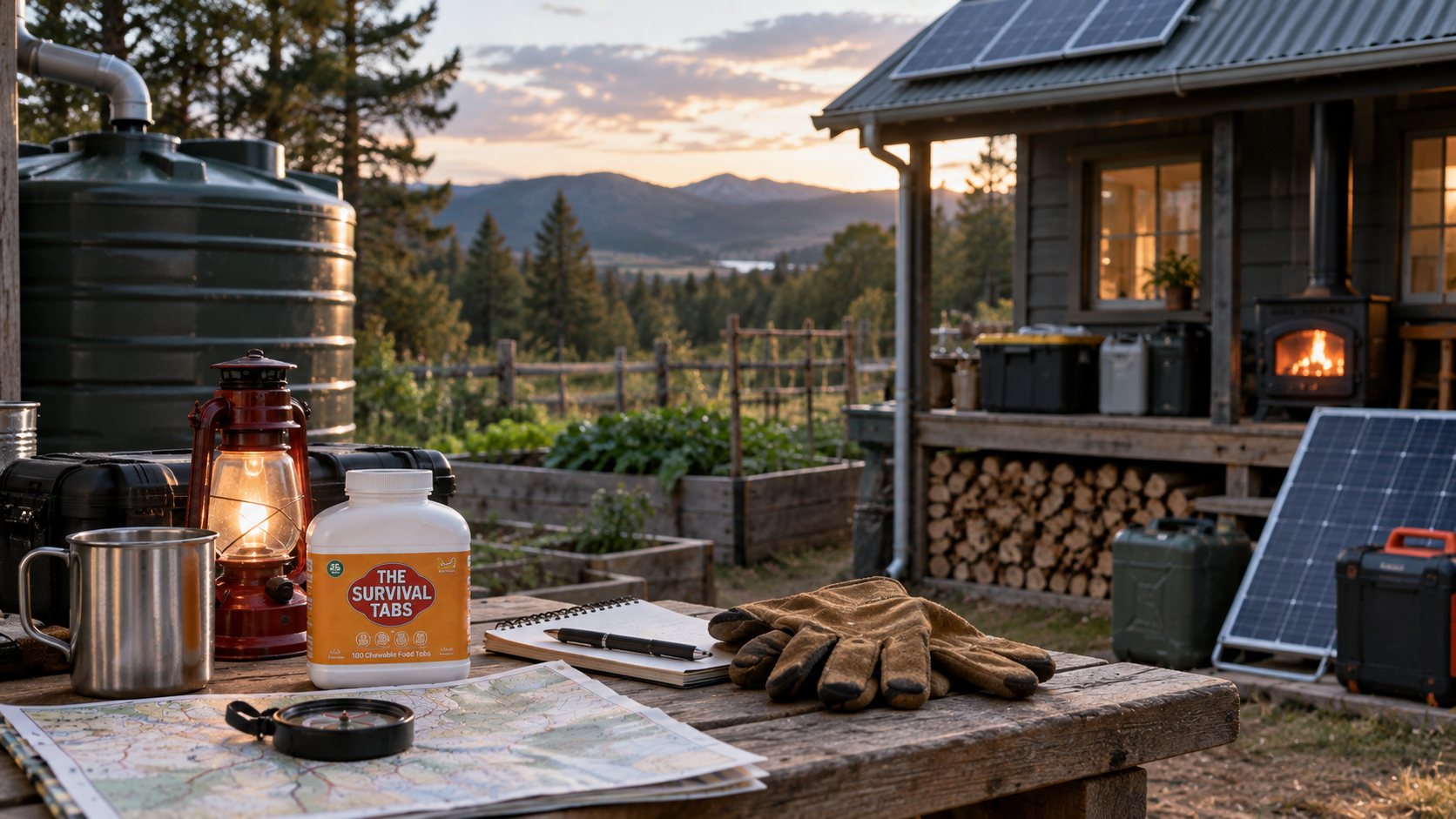
A calm, safety-first system for maintaining essential household functions when utilities, access, and supply chains are unreliable.
Quick Answer
A safe off-grid emergency plan is a documented set of limited, maintainable systems for water, food, sanitation, power, temperature control, communication, medical continuity, transportation, and evacuation. The strongest plan reduces demand early, protects life-safety loads, keeps independent reserves, and leaves before hazards exceed the site's capability.
Core priorities
- People and medical needs before equipment.
- Safe drinking water and sanitation before convenience loads.
- Fire, carbon-monoxide, electrical, structural, and contamination controls before self-sufficiency claims.
- Multiple communication and evacuation options before isolation.
- Maintenance, testing, and professional boundaries before expansion.
- Calm education before fear-based marketing.
Purpose and Scope
Off-grid emergency preparedness is the ability to keep essential household functions operating safely when normal utilities, roads, vendors, or communications are unreliable. It is not a promise of total independence.
- Use an all-hazards approach rather than planning for one imagined scenario.
- Plan for interruption, degradation, contamination, equipment failure, and evacuation.
- Treat every system as having limits, maintenance needs, and failure modes.
- Keep official alerts and local emergency instructions above personal routines.
- Build redundancy for critical functions without creating unsafe complexity.
- Document who can operate, inspect, isolate, and shut down each system.
- Define clear triggers for professional help, sheltering elsewhere, or evacuation.
Record decisions, owners, dates, and unresolved professional questions in the household continuity plan.
Start With Household Needs
A workable plan begins with people, animals, location, climate, and the functions that cannot safely stop.
- List every resident, regular visitor, caregiver, pet, and service animal.
- Record mobility, sensory, communication, cognitive, dietary, and medical needs.
- Identify medication, refrigeration, oxygen, charging, and other electricity dependencies.
- Estimate water needs for drinking, food, hygiene, sanitation, and animals separately.
- Note seasonal heat, cold, wildfire, flood, storm, and access hazards.
- Identify who can safely lift, carry, drive, communicate, and perform inspections.
- Review the assessment whenever the household or site changes.
Record decisions, owners, dates, and unresolved professional questions in the household continuity plan.
Hazard and Site Assessment
Off-grid capability does not make an unsafe site safe. Location hazards can overwhelm even well-maintained systems.
- Check official flood, wildfire, landslide, avalanche, coastal, and severe-weather information.
- Identify overhead trees, unstable slopes, drainage paths, confined spaces, and access limits.
- Map primary and alternate routes without assuming a road will remain open.
- Keep emergency vehicle access and address visibility in mind.
- Review local codes, permits, land-use rules, fire restrictions, and water requirements.
- Separate living areas from fuel, batteries, chemicals, waste, and machinery.
- Reassess after storms, construction, fire, erosion, or major vegetation change.
Record decisions, owners, dates, and unresolved professional questions in the household continuity plan.
Continuity Levels
Use staged operating levels so the household reduces demand before systems reach unsafe failure.
- Normal mode uses routine conservation, inspections, rotation, and preventive maintenance.
- Watch mode begins when forecasts, supply warnings, or equipment trends show rising risk.
- Conservation mode protects drinking water, medical power, refrigeration, and communications.
- Emergency mode stops nonessential loads and starts documented backup procedures.
- Evacuation mode secures systems only when doing so is safe and leaves promptly.
- Recovery mode isolates damaged components until qualified inspection is complete.
- Record who can declare each operating level and how everyone is notified.
Record decisions, owners, dates, and unresolved professional questions in the household continuity plan.
Emergency Water Planning
Water planning must address quantity, source reliability, container safety, contamination, treatment limits, and conservation.
- Keep a separate emergency reserve in food-grade containers even when a well or rain system exists.
- Protect stored water from heat, sunlight, chemicals, pests, and floodwater.
- Label drinking, non-potable, treatment-pending, and wastewater containers clearly.
- Follow public-health instructions during boil-water, do-not-drink, or do-not-use advisories.
- Do not assume clear water is safe or that one filter removes every contaminant.
- Do not treat chemically contaminated water with boiling or household filtration.
- Set a minimum drinking-water threshold that triggers resupply or relocation.
Record decisions, owners, dates, and unresolved professional questions in the household continuity plan.
Wells, Pumps, and Stored Water
Private wells and pumps can fail because of power loss, drought, flood, mechanical damage, or contamination.
- Know how the pump, pressure tank, controls, and backup power are intended to operate.
- Keep manufacturer manuals, installer contacts, and safe shutdown instructions available.
- Never enter a well, cistern, tank, or other confined space.
- Protect wellheads and storage openings from runoff, animals, chemicals, and physical damage.
- After flooding or suspected contamination, follow local testing and disinfection guidance.
- Avoid unqualified pump, pressure-vessel, electrical, or plumbing repairs.
- Maintain a reserve that does not depend on the pump working.
Record decisions, owners, dates, and unresolved professional questions in the household continuity plan.
Rainwater Boundaries
Rainwater can support non-potable resilience where legal and properly designed, but collection does not automatically make water drinkable.
- Confirm local rules, permitted uses, plumbing separation, and backflow requirements.
- Use suitable roofing, screening, covered storage, overflow control, and mosquito prevention.
- Keep potable and non-potable lines, outlets, and containers unmistakably separated.
- Do not use a universal first-flush formula without system-specific professional guidance.
- Treat bird, rodent, ash, chemical, roofing, and wildfire contamination as serious hazards.
- Do not enter tanks for cleaning or repair.
- Use qualified water professionals when potable use is proposed.
Record decisions, owners, dates, and unresolved professional questions in the household continuity plan.
Food Continuity
Food reserves should fit the household, available water and fuel, storage conditions, nutrition needs, and realistic rotation habits.
- Build layers of familiar foods rather than one large purchase of unfamiliar products.
- Include no-cook foods for periods when heat, water, or ventilation is limited.
- Check labels for allergens, serving sizes, preparation needs, and storage instructions.
- Protect food from heat, moisture, pests, fuels, chemicals, and floodwater.
- Keep manual opening tools and accessible packaging available.
- Discard food affected by unsafe temperatures, damaged packaging, pests, chemicals, or floodwater.
- Use Survival Tabs only as a compact supplemental emergency-food option, never as a sole diet.
Record decisions, owners, dates, and unresolved professional questions in the household continuity plan.
Refrigeration and Cold Chain
A refrigerator or freezer is a limited thermal reserve, not a guaranteed storage system during an outage.
- Keep appliance doors closed and use thermometers to support decisions.
- Know which medications require temperature control and obtain a clinician-approved backup plan.
- Prioritize power for medically necessary refrigeration when the system is designed for it.
- Do not connect improvised wiring or overload an inverter, battery, extension cord, or generator.
- Separate raw foods from ready-to-eat foods and prevent leaking packages.
- When safety is uncertain, follow official discard guidance rather than tasting food.
- Clean and dry appliances safely after spoilage or contamination.
Record decisions, owners, dates, and unresolved professional questions in the household continuity plan.
Cooking Without Grid Power
Cooking choices must match ventilation, weather, fire restrictions, fuel availability, and equipment instructions.
- Prefer no-cook meals when combustion cannot be used safely.
- Operate grills, camp stoves, and other combustion appliances only where approved and intended.
- Never use charcoal, grills, generators, or outdoor heaters inside a home, tent, garage, or carport.
- Keep flames and hot surfaces away from fuels, batteries, tents, dry vegetation, and children.
- Maintain safe food temperatures and avoid partial cooking followed by long holding.
- Store fuels in approved containers and locations away from living spaces.
- Stop cooking when wind, wildfire restrictions, ventilation, equipment damage, or supervision makes it unsafe.
Record decisions, owners, dates, and unresolved professional questions in the household continuity plan.
Sanitation and Hygiene
Sanitation planning protects health when water, sewer, septic, or waste collection is disrupted.
- Store soap, hand-cleaning supplies, toilet paper, menstrual products, diapers, and waste bags.
- Plan an accessible toilet option for every household member.
- Keep human waste away from water sources, food areas, gardens, and flood paths.
- Follow local public-health rules for temporary waste storage and disposal.
- Do not mix household chemicals or improvise disinfectant concentrations.
- Protect caregivers with gloves and hand hygiene when handling bodily waste.
- Relocate when sanitation cannot be maintained without contaminating people or water.
Record decisions, owners, dates, and unresolved professional questions in the household continuity plan.
Septic and Wastewater Systems
Septic resilience depends on water use, soil conditions, tank condition, power, and professional maintenance.
- Know whether pumps, alarms, controls, or lift stations need electricity.
- Reduce wastewater flow when power, drainage, or treatment capacity is uncertain.
- Do not open, enter, or lean over septic tanks or wastewater pits.
- Keep vehicles, structures, and heavy loads off the drain field.
- Treat surfacing sewage, backups, odors, or alarm conditions as stop-use warnings.
- Use licensed septic professionals for inspection, pumping, electrical, and structural work.
- Prevent children and animals from entering contaminated areas.
Record decisions, owners, dates, and unresolved professional questions in the household continuity plan.
Electrical Load Planning
Reliable off-grid power begins with an essential-load list and conservative energy budget.
- List each critical device, rated power, starting surge, daily operating time, and priority.
- Separate life-safety, medical, refrigeration, communication, lighting, and convenience loads.
- Do not assume a solar panel alone powers a home during an outage.
- Use system documentation to understand inverter, battery, charge-controller, and transfer limits.
- Avoid daisy-chained power strips, damaged cords, indoor generator connections, and backfeeding.
- Have qualified electricians design or modify fixed wiring and transfer equipment.
- Shut down nonessential loads before voltage, battery, fuel, or temperature limits are reached.
Record decisions, owners, dates, and unresolved professional questions in the household continuity plan.
Solar and Battery Systems
Solar and battery storage can improve resilience only when the system is correctly configured, protected, maintained, and operated within its design.
- Keep equipment labels, one-line diagrams, shutdown instructions, warranties, and installer contacts.
- Maintain clearances, ventilation, temperature limits, and fire separation specified by the manufacturer.
- Inspect for swelling, corrosion, leakage, overheating, unusual odors, damaged wiring, and fault codes.
- Do not open, modify, bypass, mix, or rebuild battery packs without qualified authorization.
- Keep conductive tools, children, water, combustibles, and unauthorized users away from equipment.
- Treat fire, smoke, hissing, rapid heating, or damaged lithium batteries as an emergency.
- Arrange professional inspection after flooding, lightning, fire, impact, or repeated faults.
Record decisions, owners, dates, and unresolved professional questions in the household continuity plan.
Generators and Fuel
Generators are outdoor equipment and can create deadly carbon monoxide, fire, shock, and backfeeding hazards.
- Operate a portable generator outdoors and far from doors, windows, and vents as directed by official guidance.
- Use working carbon-monoxide alarms in appropriate household locations.
- Never run a generator in a home, garage, basement, tent, carport, or partially enclosed shelter.
- Do not connect a generator directly to household wiring without approved transfer equipment.
- Let equipment cool before refueling and keep ignition sources away.
- Store only appropriate quantities of fuel in approved containers and legal locations.
- Stop use for damaged cords, fuel leaks, unstable operation, flooding, exhaust intrusion, or alarm activation.
Record decisions, owners, dates, and unresolved professional questions in the household continuity plan.
Heating and Cooling
Temperature control is a life-safety function in extreme heat or cold, especially for vulnerable residents.
- Identify safe rooms, insulation, shading, ventilation, clothing, bedding, and hydration measures.
- Monitor indoor temperature and the condition of infants, older adults, and people with health risks.
- Use only heaters approved for the location and fuel, with required clearances and ventilation.
- Never heat a home with a gas oven, grill, charcoal device, or improvised flame.
- Do not use a combustion heater inside a tent unless explicitly designed and approved for that use.
- Pre-plan cooling centers, warming centers, shelters, transportation, and pet options.
- Leave before conditions exceed the household's safe capability.
Record decisions, owners, dates, and unresolved professional questions in the household continuity plan.
Fire Safety
Remote living can delay emergency response, making prevention, detection, access, and early evacuation especially important.
- Install and maintain smoke and carbon-monoxide alarms appropriate to the building.
- Keep extinguishers suitable for identified hazards and ensure trained adults can access them.
- Maintain defensible space and vegetation only according to local wildfire guidance.
- Keep driveways, gates, addresses, and water access usable for emergency responders.
- Do not conduct unpermitted burning, hazardous fuel production, or improvised firefighting.
- Create two ways out where feasible and practice evacuation without delaying for possessions.
- Call emergency services early; household tools do not replace the fire department.
Record decisions, owners, dates, and unresolved professional questions in the household continuity plan.
Communications
Off-grid plans need multiple communication methods because cellular, internet, power, and roads can fail together.
- Maintain a written household communication and reunification plan.
- Keep battery-powered alert reception and charging backups appropriate to local hazards.
- Store key phone numbers, addresses, medical contacts, utilities, neighbors, and authorities on paper.
- Use text messages when networks are congested and official guidance recommends it.
- Understand licensing and range limits before relying on amateur or other radio services.
- Schedule check-ins and escalation steps for missed contact.
- Do not publish sensitive household inventories, routes, medical details, or system locations publicly.
Record decisions, owners, dates, and unresolved professional questions in the household continuity plan.
Transportation and Access
A resilient home still needs a safe way to obtain help, move vulnerable people, and evacuate before routes close.
- Maintain vehicles, mobility equipment, fuel within legal limits, maps, and seasonal supplies.
- Keep gates, paths, ramps, and emergency access clear.
- Identify alternate transportation for non-drivers and people using mobility devices.
- Plan for livestock, pets, and service animals without delaying human evacuation.
- Monitor official road closures, weather, fire, flood, and evacuation information.
- Avoid driving through floodwater, smoke-obscured roads, unstable slopes, or closed areas.
- Leave early when travel will become harder or emergency services recommend evacuation.
Record decisions, owners, dates, and unresolved professional questions in the household continuity plan.
Medical and Accessibility Continuity
Medical resilience must be planned with clinicians, pharmacists, device providers, and caregivers before an emergency.
- Maintain an updated medication and equipment list without changing treatment independently.
- Ask providers about refill timing, temperature limits, backup power, consumables, and failure actions.
- Keep accessible instructions in formats household members can use.
- Protect medication and records from heat, moisture, theft, and unauthorized access.
- Plan backup caregivers and transportation without sharing private details unnecessarily.
- Test alarms, chargers, mobility devices, hearing technology, and communication aids routinely.
- Relocate or call for help when medical needs exceed the site's safe capability.
Record decisions, owners, dates, and unresolved professional questions in the household continuity plan.
Children, Older Adults, and Caregivers
Plans should reduce uncertainty, preserve routines where possible, and avoid assigning unsafe responsibilities.
- Give children age-appropriate roles that do not involve fuels, batteries, chemicals, weapons, or structural work.
- Keep child-specific food, water, medication, comfort items, identification, and reunification information.
- Plan supervision around water, tanks, generators, fires, machinery, and animals.
- Account for reduced heat or cold tolerance and mobility among older adults.
- Provide respite and backup plans for caregivers.
- Use plain-language, visual, translated, or assisted communication as needed.
- Practice short drills without fear-based scenarios.
Record decisions, owners, dates, and unresolved professional questions in the household continuity plan.
Pets, Service Animals, and Livestock
Animal planning requires water, feed, shelter, restraint, medication, identification, transport, and evacuation decisions.
- Store species-appropriate food and water separately from human supplies.
- Maintain carriers, leads, records, medications, and accessible cleanup supplies.
- Protect animals from batteries, fuels, chemicals, contaminated water, heat, cold, smoke, and machinery.
- Do not substitute human medication or food as routine animal care.
- Identify veterinary contacts, boarding, shelters, and transport options in advance.
- Evacuate early when moving animals will take extra time.
- Do not risk human life by entering unsafe areas to retrieve animals.
Record decisions, owners, dates, and unresolved professional questions in the household continuity plan.
Security and Privacy
Preparedness security should emphasize locks, lighting, accountability, relationships, and information discipline—not confrontation.
- Maintain doors, windows, gates, lighting, and address visibility.
- Control keys, access codes, manuals, and system shutdown privileges.
- Keep valuable inventories, fuel quantities, medical information, and absence schedules private.
- Use cameras or connected devices only with lawful, proportionate privacy safeguards.
- Coordinate with trusted neighbors without creating vigilante patrols.
- Report threats and crimes to appropriate authorities.
- Exclude weapons tactics, traps, intimidation, and advice to evade law enforcement.
Record decisions, owners, dates, and unresolved professional questions in the household continuity plan.
Maintenance System
Redundancy fails when equipment is neglected, undocumented, incompatible, or untested.
- Create a calendar for water rotation, filters, alarms, batteries, fuels, food, medications, and inspections.
- Record model numbers, serial numbers, dates, settings, faults, repairs, and responsible people.
- Use manufacturer instructions and qualified service providers.
- Exercise backup systems under controlled conditions without defeating safety controls.
- Keep critical spares that are compatible, legal, stable, and within household capability.
- Replace damaged or expired components rather than normalizing temporary workarounds.
- Review near misses and recurring faults before they become emergencies.
Record decisions, owners, dates, and unresolved professional questions in the household continuity plan.
Supply and Budget Strategy
Build capability in phases so essential safety is funded before convenience or elaborate equipment.
- Start with hazard information, water, sanitation, food, medications, alerts, lighting, and evacuation.
- Prioritize maintenance and safe storage before adding new systems.
- Compare total lifecycle costs, including installation, permits, inspections, fuel, replacement, and disposal.
- Avoid debt, panic buying, speculative products, and claims of guaranteed independence.
- Use local suppliers and qualified professionals where practical.
- Keep receipts, warranties, manuals, and insurance documentation.
- Reassess purchases against the essential-load and household-needs lists.
Record decisions, owners, dates, and unresolved professional questions in the household continuity plan.
Evacuation Triggers
Off-grid identity must never become a reason to remain in an unsafe location.
- Leave when authorities order evacuation or when routes may soon become unusable.
- Leave for uncontrolled fire, smoke intrusion, structural instability, flood risk, slope movement, or hazardous release.
- Leave when drinking water cannot be made safe or sanitation is contaminating the site.
- Leave when indoor temperature threatens health and safe heating or cooling is unavailable.
- Leave when medical equipment, medication, caregiving, or communication needs cannot be maintained.
- Leave when batteries, fuels, generators, wiring, or appliances show serious fire or carbon-monoxide risk.
- Document a destination, route, alternate route, transport plan, and accountability check.
Record decisions, owners, dates, and unresolved professional questions in the household continuity plan.
Recovery and Re-entry
Return and restart systems cautiously after evacuation, flooding, fire, lightning, contamination, or prolonged shutdown.
- Wait for official permission before re-entry where restrictions apply.
- Photograph damage from a safe location for insurance and recovery records.
- Do not energize flooded or fire-damaged electrical equipment.
- Treat wells, tanks, food, medication, and porous materials as potentially contaminated.
- Use qualified professionals for structural, electrical, gas, septic, well, battery, and solar inspections.
- Restart systems in a documented sequence while monitoring for faults.
- Update the plan with lessons learned, replacement needs, and corrected evacuation thresholds.
Record decisions, owners, dates, and unresolved professional questions in the household continuity plan.
Thirty-Day Implementation Plan
A short implementation cycle can create meaningful resilience without attempting to redesign the whole property.
- Week one: complete household, hazard, medical, accessibility, animal, and evacuation assessments.
- Week one: identify essential loads and the minimum safe water and sanitation thresholds.
- Week two: organize reserves, labels, manuals, contacts, maps, and accessible instructions.
- Week two: test alarms, communications, lighting, charging, and safe shutdown knowledge.
- Week three: schedule qualified inspections and correct urgent maintenance issues.
- Week three: practice a conservation-mode day without unsafe system modifications.
- Week four: run a household drill, document gaps, and assign deadlines.
- Repeat the cycle after major changes and at least annually.
Record decisions, owners, dates, and unresolved professional questions in the household continuity plan.
Publication Safety Exclusions
The following material is intentionally excluded because it is hazardous, unsupported, off-brand, or requires individualized professional instruction.
- No log-cabin, tiny-home, floating-home, load-bearing, excavation, roofing, or structural construction tutorials.
- No unpermitted fixed wiring, battery rebuilding, generator backfeeding, plumbing cross-connections, or pressure-system repair.
- No fuel extraction, homemade fuels, explosive devices, traps, weapons, hunting, bow fishing, or tactical evasion.
- No indoor generators, charcoal, grills, camp stoves, or improvised combustion heating.
- No improvised drinking-water treatment for chemical contamination or universal purification guarantees.
- No medical diagnosis, prescription changes, infant-feeding improvisation, or veterinary treatment substitution.
- No claims that Survival Tabs or any single product provides complete nutrition or guarantees self-sufficiency.
Record decisions, owners, dates, and unresolved professional questions in the household continuity plan.
Household Worksheets
Essential-function inventory
- Owner or responsible person
- Current condition and capacity
- Minimum safe threshold
- Backup method
- Known hazards and exclusions
- Professional contact or official authority
- Last test or inspection date
- Next action and deadline
Water reserve and source log
- Owner or responsible person
- Current condition and capacity
- Minimum safe threshold
- Backup method
- Known hazards and exclusions
- Professional contact or official authority
- Last test or inspection date
- Next action and deadline
Essential electrical-load budget
- Owner or responsible person
- Current condition and capacity
- Minimum safe threshold
- Backup method
- Known hazards and exclusions
- Professional contact or official authority
- Last test or inspection date
- Next action and deadline
Fuel and battery inspection log
- Owner or responsible person
- Current condition and capacity
- Minimum safe threshold
- Backup method
- Known hazards and exclusions
- Professional contact or official authority
- Last test or inspection date
- Next action and deadline
Medication and medical-device continuity plan
- Owner or responsible person
- Current condition and capacity
- Minimum safe threshold
- Backup method
- Known hazards and exclusions
- Professional contact or official authority
- Last test or inspection date
- Next action and deadline
Communication and accountability card
- Owner or responsible person
- Current condition and capacity
- Minimum safe threshold
- Backup method
- Known hazards and exclusions
- Professional contact or official authority
- Last test or inspection date
- Next action and deadline
Evacuation trigger and destination plan
- Owner or responsible person
- Current condition and capacity
- Minimum safe threshold
- Backup method
- Known hazards and exclusions
- Professional contact or official authority
- Last test or inspection date
- Next action and deadline
Maintenance and annual review calendar
- Owner or responsible person
- Current condition and capacity
- Minimum safe threshold
- Backup method
- Known hazards and exclusions
- Professional contact or official authority
- Last test or inspection date
- Next action and deadline
Frequently Asked Questions
Is off-grid living the same as emergency preparedness?
No. Off-grid systems may reduce dependence on some utilities, but preparedness also requires hazard awareness, safe backups, evacuation plans, communication, maintenance, and limits.
How long should an off-grid household plan to operate without outside help?
Use local hazard guidance and household needs to set planning horizons. Build in phases and keep evacuation and resupply options; do not treat a duration target as a guarantee.
Can solar panels power a home during a grid outage?
Not automatically. Many grid-connected systems shut down during outages. Islanding requires compatible inverter, controls, storage, wiring, and professional design.
Is rainwater safe to drink?
Collection alone does not make rainwater potable. Legal requirements, source contamination, system design, treatment, testing, and public-health guidance all matter.
Can I run a generator in a garage with the door open?
No. Portable generators produce carbon monoxide and should be operated outdoors, far from doors, windows, and vents, following official and manufacturer guidance.
Should I stay because my home is designed to be self-sufficient?
Not when authorities order evacuation or when fire, flood, structural, medical, sanitation, temperature, or access conditions exceed the site's safe capability.
Can Survival Tabs replace my emergency food supply?
No. They can be a compact supplemental option within a varied plan, but they should not be used as the sole diet.
How often should the plan be reviewed?
Review it after household, medical, property, equipment, climate, or access changes, after any incident or near miss, and at least annually.
Professional Review Requirements
Before publication, this article requires review by qualified professionals appropriate to the final claims and audience.
- Emergency management and local hazard authorities
- Public-health and drinking-water professionals
- Licensed electrical, solar, battery, generator, and fire-safety professionals
- Licensed plumbing, well, septic, and wastewater professionals
- Structural, geotechnical, flood, wildfire, and land-use professionals where relevant
- Registered dietitian and food-safety reviewer
- Clinicians, pharmacists, medical-device providers, accessibility specialists, and caregivers
- Veterinary and animal-emergency planning professionals
- Legal, insurance, privacy, environmental, and product-compliance reviewers
Official Sources
Ready.gov — Power Outages
Ready.gov — Build a Kit
EPA — Emergency Disinfection of Drinking Water
CDC — Protect Yourself During a Power Outage
CDC — Generator Safety and Carbon Monoxide
U.S. Department of Energy — Solar and Resilience Basics
USDA — Food Safety in an Emergency