

Small-Space Emergency Supply Storage Guide
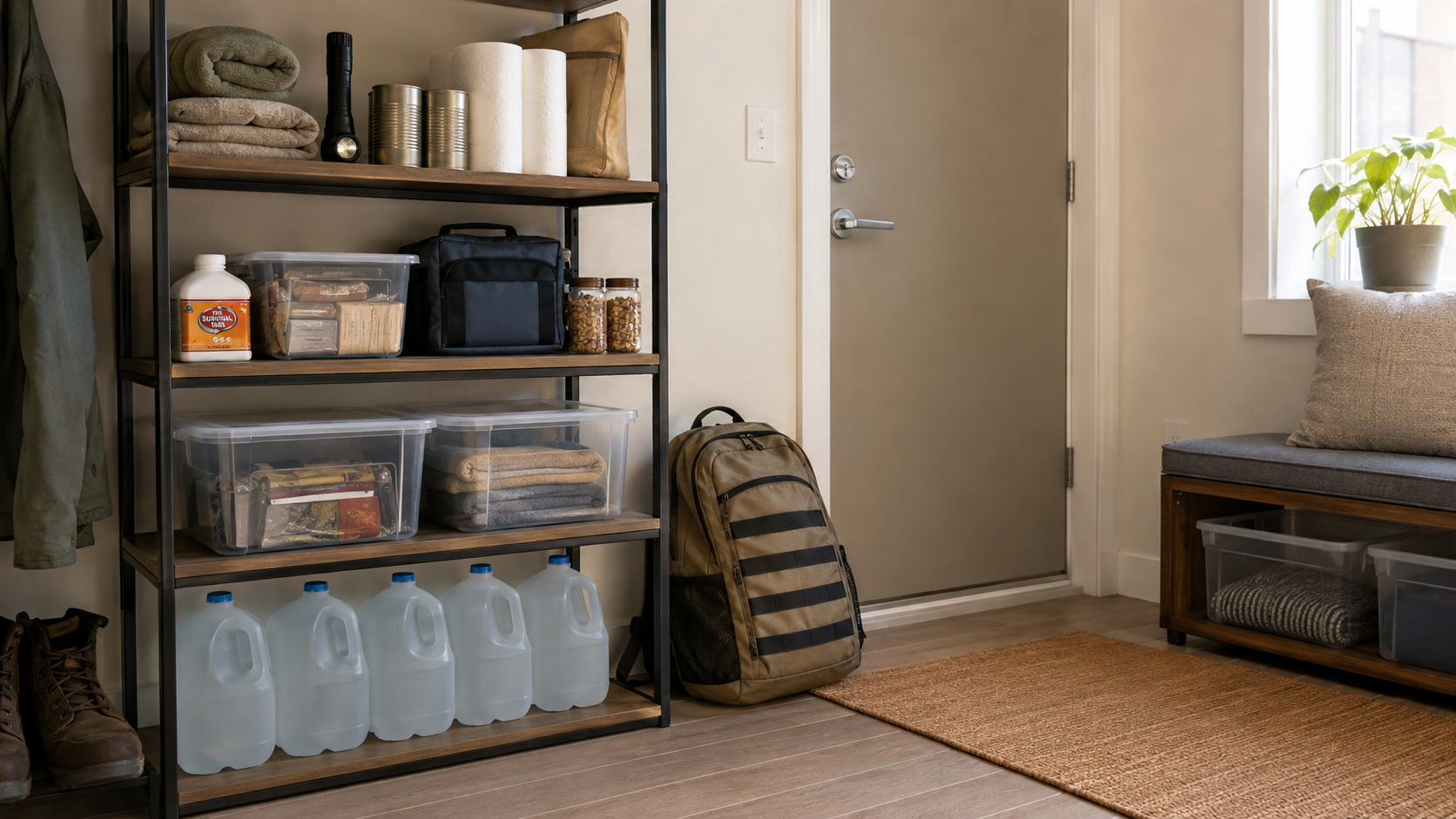
A safety-first system for apartments, small homes, dorms, shared housing, and other limited-storage spaces
Emergency supplies are useful only when household members can find, reach, inspect, and safely use them. In a small home, good storage is not about hiding the largest possible stockpile. It is about creating a compact, visible, rotating system that preserves exits, protects supplies from heat and moisture, and supports the people who live there.
This guide complements—not replaces—the Survival Tabs guides for emergency kits, food, water, medication, power, fire, and urban preparedness. Use those guides to decide what belongs in the supply plan; use this guide to decide where and how to store it.
Safety note: Building rules, lease terms, fire codes, product labels, medication instructions, and local emergency guidance take priority. Ask qualified professionals about structural loading, electrical work, hazardous materials, medical devices, accessibility, or other specialized needs.
Quick answer
The best small-space system separates supplies by purpose and urgency. Keep a light grab-and-go kit near the normal exit without narrowing the path. Store heavy water low and on stable surfaces. Keep food cool and dry. Store medicines according to their labels and secure them from children or unauthorized access. Keep batteries and hazardous products in their original packaging and away from heat. Record every location in one simple inventory.
Non-negotiable safety rules
* Keep doors, windows, hallways, stairs, fire escapes, and routes to exits completely clear.
* Do not place bins where they can fall into a walkway during an earthquake, impact, or hurried evacuation.
* Keep combustible supplies away from cooking, heating, electrical, and charging equipment.
* Do not store gasoline, propane cylinders, or other prohibited fuels inside an apartment or living area.
* Never transfer cleaners, fuels, pesticides, or medicines into unmarked food or drink containers.
* Do not overload shelves, hooks, lofts, cabinets, or floors; follow manufacturer and building limits.
* Keep essential items reachable for people with mobility, vision, dexterity, memory, or sensory needs.
* Secure medicines, sharp tools, matches, lighters, chemicals, and small batteries from children and pets.
* Use product labels—not a generic storage hack—to determine temperature, ventilation, separation, and disposal.
* Discard damaged, leaking, swollen, corroded, contaminated, or recalled products through the correct local channel.
Start with people, hazards, and the building
A small-space plan begins with the household, not the containers. Identify who needs supplies, what hazards are realistic, how the building works, and how quickly you may need to leave.
Household questions
* How many people normally sleep here, and who visits regularly?
* Does anyone use prescription medicine, refrigerated medicine, mobility equipment, oxygen, hearing devices, or powered medical equipment?
* Are there infants, older adults, children, service animals, or pets?
* Who can lift or carry each module?
* Who needs large-print labels, tactile markers, translated instructions, or simplified checklists?
* Which supplies must remain private or locked?
* Which items need daily use and therefore must stay easy to rotate?
Building questions
* Where are the primary and alternate exits?
* Where are smoke and carbon-monoxide alarms, sprinklers, extinguishers, utility shutoffs, and electrical panels?
* Which areas become hot, cold, damp, or exposed to sunlight?
* Are storage rooms, balconies, hallways, roofs, stairwells, or garages restricted by the lease or building management?
* How much weight can shelves and storage furniture safely hold?
* Could water from plumbing, sprinklers, windows, or flooding reach the storage area?
* Will tall furniture or high bins fall during shaking or impact?
* How long could elevators, water pumps, electronic access systems, or building communications be unavailable?
Choose a three-layer storage system
Layer 1: immediate evacuation
Keep a compact grab-and-go module where it can be reached on the way out. It must not block or narrow the exit. The module should be light enough for the assigned person to carry safely.
* Copies of essential contacts and evacuation information
* Necessary medicines and medical information, within legal and label requirements
* Phone charging cable and a small approved power bank
* Flashlight
* Small water and food allowance appropriate for movement
* Weather protection and basic hygiene items
* Keys, glasses, hearing-device supplies, and other personal essentials
* Pet leash, carrier plan, identification, and a compact pet module when applicable
Layer 2: shelter-at-home essentials
Store several-day household supplies in one or more stable zones. These modules support outages or temporary sheltering when remaining home is safe. They may be distributed across the home, but every location belongs on the same inventory.
Layer 3: specialized and replenishment supplies
Place less frequently needed refills, seasonal items, and specialized equipment in clearly labeled secondary storage. Do not bury daily medicines, the first flashlight, or the evacuation module behind these items.
Build storage zones
A zone is a defined location with one purpose, a safe capacity, and a label. Small homes work better with several modest zones than one overloaded closet.
Exit zone
* Use a low-profile hook, shelf, or bin beside—not in front of—the normal exit.
* Keep the floor clear.
* Prevent straps and cords from hanging into the walking path.
* Make the evacuation module recognizable by touch and sight.
* Return keys and essential mobility items to the same place after use.
Water zone
* Store water low because it is heavy.
* Use stable surfaces that can tolerate the load and possible leakage.
* Keep containers away from chemicals, fuels, pesticides, and contaminated areas.
* Protect containers from direct sunlight and temperature extremes.
* Do not stack beyond the container manufacturer’s instructions.
* Leave space to inspect every container for damage or leaks.
* Use a tray or other practical leak-control measure when appropriate.
* Record purchase, fill, inspection, and replacement dates.
Food zone
* Choose a cool, dry, dark location.
* Keep food off floors that may flood or become contaminated.
* Protect food from insects and rodents without using unsafe pesticide treatments.
* Use the original package or a food-safe container intended for the product.
* Keep labels, ingredient information, preparation directions, and dates visible.
* Place shorter-dated items in front.
* Separate foods needed for allergies, medical diets, infants, or pets.
* Do not rely on odor or appearance alone to decide whether unsafe food is usable.
Medical zone
* Follow the labeled storage conditions for every medicine and medical product.
* Keep an up-to-date medication list separate from the medicine supply.
* Use a secure location when children, visitors, or unauthorized access are concerns.
* Keep original labels and dosing information.
* Protect medicines from water damage when flooding is possible.
* Plan with a clinician or pharmacist for refrigeration, controlled medicines, early refills, substitutions, and travel.
* Do not use expired, heat-damaged, wet, contaminated, or questionable medicine without qualified guidance.
* Use authorized take-back or disposal options for unused or expired medicines.
Light, communication, and power zone
* Keep the first flashlight immediately reachable, not at the bottom of a large bin.
* Store spare batteries in original packaging or a case that prevents terminal contact.
* Keep batteries dry and away from metal objects.
* Do not use damaged, leaking, corroded, recalled, or swollen batteries.
* Charge power banks on a stable, noncombustible surface according to instructions.
* Do not charge devices under pillows, bedding, clothing, or paper.
* Keep cords from crossing walking paths.
* Separate devices that need routine charging from long-term backup items.
* Test radios, lights, alarms, and chargers on a written schedule.
Documents and information zone
* Keep copies of identification, insurance, medical information, contacts, and household plans in a protected portable packet.
* Store only the information genuinely needed for an emergency.
* Protect paper copies from water.
* Protect digital copies with appropriate security and access controls.
* Make sure a trusted household member knows how to retrieve them.
* Do not display private medical, financial, or identity information on exterior bin labels.
* Review contact information after any move, policy change, medication change, or household change.
Hygiene and sanitation zone
* Keep soap and personal hygiene items dry and easy to reach.
* Keep cleaning and disinfecting products in original labeled containers.
* Never mix cleaning products.
* Separate chemicals from food, water, medicines, and pet supplies.
* Store chemicals according to label ventilation and temperature requirements.
* Keep waste bags, gloves, and sanitation supplies together without creating a chemical-mixing risk.
* Do not treat a household disinfectant as a wound, skin, food, or water treatment unless the label specifically permits that use.
Pet and service-animal zone
* Store pet food in an airtight, waterproof container.
* Keep a separate water allowance and portable bowl.
* Keep leashes, harnesses, carriers, identification, medicines, and records together.
* Check food and medicine dates during household rotation.
* Prevent pets from accessing chemicals, batteries, sharp items, and human medicines.
* Confirm that the evacuation module works with the animal’s actual carrier and mobility needs.
Use vertical space safely
Vertical storage can recover useful space, but height increases fall, lifting, and accessibility risks. Use it selectively.
* Anchor shelving or tall furniture where appropriate and permitted.
* Follow the furniture, wall, fastener, and building requirements.
* Store heavy items low.
* Store light, soft, infrequently used items higher.
* Do not place heavy bins above beds, desks, seating, or evacuation routes.
* Do not hang supplies from sprinklers, pipes, electrical conduits, doors, or fire-safety equipment.
* Keep all alarm, sprinkler, ventilation, electrical-panel, and utility access clear.
* Use a stable step stool only if the user can do so safely; otherwise redesign the zone.
* Do not require climbing during an evacuation.
Use hidden space without losing visibility
Under-bed, under-seat, and cabinet storage can work when it remains dry, clean, accessible, and recorded.
* Use shallow labeled modules that can be pulled out without moving heavy furniture.
* Do not block floor vents, heaters, electrical equipment, or access panels.
* Do not store medicines or food in a location that violates temperature or moisture requirements.
* Use water-resistant containers where minor leaks are plausible, but do not assume any bin is floodproof.
* Keep an inventory card at eye level showing what is stored below or behind.
* Do not hide emergency items so completely that a guest, caregiver, or responder cannot locate them when authorized.
Containers and labels
Choose containers based on the item, location, and user. Clear bins improve visibility; opaque bins protect privacy and light-sensitive contents. No single container is right for everything.
Container checklist
* Stable when placed in its intended location
* Within the shelf or furniture weight limit
* Easy for the assigned person to open
* Easy to carry without overexertion
* Appropriate for food, medicines, batteries, documents, or chemicals as applicable
* Protective against the likely dust, moisture, pests, or impact exposure
* Not falsely presented as fireproof, waterproof, childproof, or pest-proof
* Replaceable without forcing the whole system to be rebuilt
Label checklist
* Plain-language category name
* Location code
* Inspection or rotation month
* Key restrictions such as KEEP DRY or ADULT ACCESS
* Large, high-contrast print
* Tactile or translated marker when needed
* No unnecessary private information
* No label that obscures the manufacturer’s instructions, warnings, lot number, or expiration date
Design for accessibility
Preparedness storage must work for the least mobile or least familiar authorized user, not only for the person who organized it.
* Place high-priority supplies between comfortable reach levels.
* Use drawers, handles, and closures that match the user’s grip and dexterity.
* Limit module weight.
* Use contrasting colors and large-print labels.
* Add tactile markers or audio inventory access when useful.
* Keep mobility aids and service-animal equipment on the evacuation route without blocking it.
* Provide redundant instructions for people who cannot rely on sight, hearing, reading, memory, or a phone.
* Include backup power and manual alternatives for assistive technology.
* Practice retrieving supplies in low light and without an elevator.
* Ask the person who will use the system to test it.
Children, guests, and shared housing
* Secure dangerous items while keeping safe emergency items teachable and visible.
* Explain which bins children may open and which require an adult.
* Keep choking hazards, button batteries, medicines, chemicals, blades, and ignition sources inaccessible.
* Do not rely on a child-resistant closure as the only safeguard.
* Agree on shared-space limits with roommates.
* Label ownership only where it is genuinely useful.
* Keep private information and medicines secured.
* Make sure every resident understands the exit route and grab-and-go location.
* Do not store supplies in a way that violates lease, dormitory, or building rules.
Create one inventory
A compact inventory prevents overbuying, forgotten caches, and unsafe expiration. It can be a paper sheet, spreadsheet, or simple note. Keep an offline copy.
Minimum inventory fields
* Category
* Item
* Quantity
* Exact location
* Owner or intended user when relevant
* Purchase or fill date
* Expiration or replace-by date
* Inspection frequency
* Storage restriction
* Next action
Use simple location codes such as E1 for the exit module, W1 for the water zone, F1 for food, M1 for medical, and P1 for power. A code should help a household member find an item quickly without exposing private contents to visitors.
Rotation and maintenance
Check supplies on a predictable schedule and after any heat wave, freeze, leak, flood, pest problem, fire, move, evacuation, outage, recall, or product damage.
Monthly quick check
* Exit route remains clear.
* Grab-and-go module is present and carryable.
* First flashlight works.
* Phones and approved power banks can be charged.
* No leaks, pests, swelling, corrosion, odors, or damaged packaging are visible.
* Daily medicines and assistive supplies match the plan.
* Nothing has been moved without updating the inventory.
Scheduled full review
* Check every date and manufacturer instruction.
* Rotate food and water according to the chosen product and storage method.
* Review medication and medical-device plans with the appropriate professional.
* Test communications and lighting.
* Inspect shelving, anchors, bins, handles, labels, and load distribution.
* Check batteries and recalls.
* Confirm children, pets, roommates, and accessibility needs have not changed.
* Update documents, contacts, insurance details, and evacuation information.
* Dispose of chemicals, batteries, medicines, and electronics through approved channels.
* Practice locating and carrying each urgent module.
Low-cost implementation plan
Step 1: Clear the exits
Remove anything from doorways, hallways, windows used for escape, stairs, and the path to the building exit. Do this before buying containers.
Step 2: Inventory what you already own
Gather only safe, useful items. Remove duplicates you cannot realistically rotate and products that are expired, damaged, recalled, prohibited, or impossible to store correctly.
Step 3: Assign the three layers
Separate immediate evacuation, shelter-at-home, and replenishment supplies.
Step 4: Assign zones
Choose locations based on urgency, weight, temperature, moisture, access, privacy, and hazard separation.
Step 5: Reuse safe containers
Use existing bins, bags, drawers, or boxes when they are structurally sound and appropriate for the contents. Do not reuse food containers for chemicals or unlabeled containers for medicine.
Step 6: Label and record
Label every module and enter its exact location in the inventory.
Step 7: Test the system
Turn off the lights, simulate a need to leave, and ask each household member to locate their assigned supplies. Correct any blocked path, excessive weight, confusing label, or inaccessible location.
Step 8: Build gradually
Add supplies over time, prioritizing household-specific needs. A smaller maintained system is more reliable than an oversized, forgotten stockpile.
Common mistakes
* Buying containers before deciding what must be stored
* Blocking an exit with a convenient grab-and-go bag
* Storing heavy water on a high shelf
* Keeping all supplies in one location vulnerable to fire, flood, or inaccessibility
* Hiding supplies without an inventory
* Placing food or medicines in hot, damp, or freezing spaces
* Storing chemicals with food or water
* Keeping loose batteries where terminals can contact metal
* Charging batteries in clutter or on soft furnishings
* Assuming a sealed bin makes unsafe indoor fuel storage acceptable
* Using exterior labels that reveal private medical or identity information
* Making every module too heavy for the assigned person
* Failing to update the system after a move or household change
* Treating emergency food, water, medicines, or Survival Tabs as interchangeable or universally suitable
* Relying on decorative organization instead of inspection and practice
When to get professional help
* Ask building management or a qualified building professional before loading unusual quantities onto shelves, lofts, walls, or floors.
* Ask the fire department or fire-safety authority about local rules for exits, fuel, charging, alarms, extinguishers, and apartment storage.
* Ask a clinician or pharmacist about prescription access, refrigeration, temperature excursions, controlled medicines, and individual medical needs.
* Ask an electrician about fixed wiring, outlets, circuits, or transfer equipment; do not improvise electrical work.
* Ask local waste authorities about batteries, chemicals, pesticides, fuels, electronics, and medicine disposal.
* Ask an accessibility professional or the person who will use the system to validate reach, weight, labeling, and evacuation needs.
Frequently asked questions
Should all emergency supplies be stored together?
No. One inventory can describe several safe zones. Distributed storage reduces crowding and allows each category to meet its own temperature, weight, security, and access needs.
Can I store water under the bed?
Only if the surface safely supports the weight, the containers remain inspectable, leakage will not create an electrical or structural hazard, and the location meets the container guidance. Do not block access or ventilation.
Can I use a balcony for storage?
Only when the lease, building management, local rules, weather exposure, egress requirements, and product instructions permit it. Balconies are often unsuitable for food, water, medicines, batteries, chemicals, or fuel because of heat, freezing, sunlight, moisture, and fire risk.
Are vacuum bags good for emergency storage?
They can reduce the volume of some soft goods when the manufacturer permits it, but they do not make food, medicines, batteries, electronics, or hazardous products safe. Inspect compressed items for damage and make sure they remain usable.
How often should I rotate supplies?
Follow each product’s label and your household schedule. Use a monthly quick check plus a scheduled full review, and inspect immediately after conditions that could damage supplies.
Where should Survival Tabs be stored?
Follow the current product label and official Survival Tabs storage instructions. Keep packaging intact and include the product in the same inventory and rotation system as other emergency food. Do not treat any single product as a complete substitute for a household emergency food and water plan.
What if I have almost no budget?
Start by clearing exits, listing household needs, gathering safe items already owned, protecting important documents, and setting a rotation reminder. Build the kit over time rather than buying everything at once.
What if I may need to evacuate without an elevator?
Keep the immediate module within the user’s safe carrying ability, plan assistance in advance, know the building’s procedures, and practice the route. Do not depend on improvised carrying methods during an emergency.
Publication review gate
Before publication, this guide should be reviewed by qualified fire/life-safety, emergency-management, accessibility, building or structural, medical/pharmacy, electrical/battery, hazardous-materials, food-safety, pet-safety, and tenant/legal professionals as appropriate. Local codes, leases, official emergency instructions, and manufacturer labels must control where they are more specific.
Official sources
* Ready.gov — Build a Kit
* Ready.gov — Low and No Cost Preparedness
* U.S. Fire Administration — Hoarding and Fire Safety
* U.S. Environmental Protection Agency — Household Hazardous Waste
* U.S. Food and Drug Administration — Safe Drug Use After a Natural Disaster
* Ready.gov — Prepare Your Pets for Disasters