

Home Fire Emergency Guide
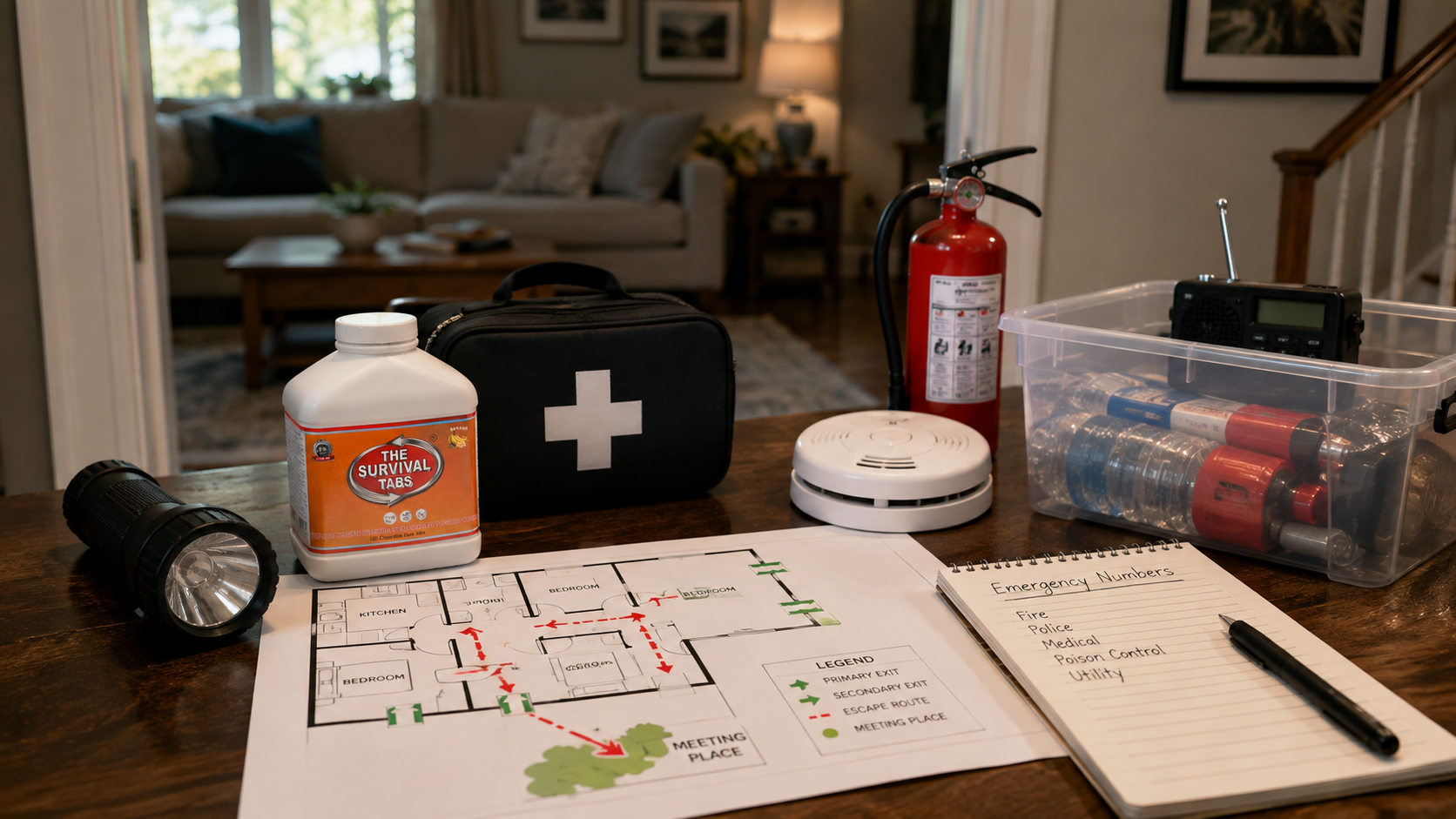
A calm, practical plan for preventing home fires, escaping quickly, helping every household member, and recovering safely.
Last reviewed: July 25, 2026
Important: If you see fire, smell smoke, or hear a smoke alarm, leave immediately when you can do so safely. Call your local emergency number from outside. Never reenter a burning building.
Quick Action: If a Fire Starts
• Alert everyone and begin your practiced escape plan.
• Leave by the nearest safe exit. Use your second exit if fire, heat, or smoke blocks the first.
• Stay low beneath smoke when you must move through a smoky area.
• Close doors behind you as you leave when doing so does not delay escape.
• Go directly to the household meeting place.
• Call emergency services from outside.
• Tell responders if anyone may still be inside.
• Stay out. Do not return for people, pets, medicine, phones, valuables, or emergency supplies.
Do not kick down a door or force entry into a fire area. Opening or breaking a door can expose you to extreme heat, flames, toxic smoke, or rapid fire growth. Firefighters use protective equipment, training, tools, and coordinated procedures that household members do not have.
What This Guide Covers
• Working smoke alarms and other warning systems
• A written home fire escape plan
• Two ways out and a safe outdoor meeting place
• Actions to take when an alarm sounds
• Doors, windows, smoke, stairs, elevators, and blocked exits
• Children, older adults, disabilities, pets, and visitors
• Apartment, rental, mobile-home, and multistory considerations
• Burn and smoke-exposure response
• Reentry, temporary housing, documentation, and recovery
• Fire prevention and plan maintenance
This guide provides general preparedness information. Building layouts, local fire codes, alarm requirements, emergency numbers, and fire-department procedures vary. Ask your local fire department or fire-prevention office for advice specific to your home.
1. Build the Warning System
Place smoke alarms where they can warn sleeping and awake occupants
• Install alarms on every level of the home.
• Install alarms inside bedrooms and outside sleeping areas.
• Follow the manufacturer’s placement instructions and local code.
• Use interconnected alarms when possible so one alarm causes all alarms to sound.
• Choose alarm types and accessibility features that household members can detect.
• Do not paint, cover, disable, or remove batteries from smoke alarms.
• Keep alarms away from locations where drafts or unsuitable placement could interfere, as directed by the manufacturer.
Maintain alarms
• Test alarms on the schedule stated by the manufacturer and your local fire authority.
• Replace batteries when required and respond promptly to low-battery signals.
• Replace the entire alarm at the end of its rated service life.
• Clean alarms only as the manufacturer directs.
• Record installation and replacement dates.
• Replace an alarm that is damaged, unreliable, recalled, or outside its service life.
• Never assume silence means safety; use properly installed, working alarms.
Plan for access and communication needs
• Use bed shakers, strobe alarms, low-frequency sounders, or other approved alerting devices when appropriate.
• Make sure children recognize the alarm sound and know what to do.
• Assign assistance only when it can be provided without delaying everyone’s escape.
• Keep mobility devices, eyeglasses, hearing aids, and essential nighttime items within reach.
• Ask the local fire department about programs for alarm installation or accessible fire-warning equipment.
2. Make a Home Fire Escape Plan
Map the home
• Draw every level of the home.
• Mark bedrooms, common rooms, doors, windows, stairs, porches, balconies, and exterior gates.
• Identify two possible exits from every room when the structure allows.
• Check that doors and windows open easily and are not painted, nailed, locked, or blocked shut.
• Keep exit routes clear of furniture, storage, cords, security bars, and clutter.
• Include garages, attached workshops, basements, and sleeping areas.
• Mark smoke alarms, fire extinguishers, utility shutoffs, and the outdoor meeting place.
Choose the meeting place
• Select a fixed location a safe distance from the home.
• Choose a place that is easy for children and visitors to recognize.
• Keep it away from smoke, traffic, falling glass, power lines, fuel tanks, and responding vehicles.
• Make sure everyone knows to go there without stopping elsewhere.
• Use the meeting place to account for household members and report missing people to firefighters.
Assign simple roles
• Every person’s first responsibility is to escape.
• An adult may guide a young child or a person who needs assistance when that role is realistic and practiced.
• Do not assign anyone to search a burning home.
• Do not assign anyone to collect valuables, emergency food, documents, or pets.
• Choose who will call emergency services after reaching safety.
• Choose a backup caller in case the primary person is unavailable.
• Make sure visitors receive a short explanation of exits and the meeting place.
3. Practice the Plan
• Practice during the day and after dark.
• Practice at least twice a year or as advised by your fire department.
• Start drills using the smoke-alarm test button so people recognize the sound.
• Practice using both primary and alternate exits where safe.
• Practice moving low beneath simulated smoke without creating a hazard.
• Practice closing doors behind you.
• Practice reaching the meeting place and taking attendance.
• Review what slowed anyone down.
• Correct blocked exits, confusing roles, alarm problems, or accessibility gaps.
• Never use real smoke, flames, locked exits, blindfolds, surprise tactics, or unsafe window escapes during a drill.
4. When the Alarm Sounds
Leave immediately
• Treat every alarm as real unless authorized responders or building staff confirm otherwise.
• Wake or alert others while continuing toward an exit.
• Take the safest available route.
• Leave belongings behind.
• Do not hide in a closet, bathroom, under a bed, or elsewhere.
• Do not stop to investigate the source of the fire.
• Do not delay to put on clothes or gather an emergency kit.
• Once outside, move to the meeting place and remain available to responders.
Check a closed door before opening
• Look for smoke entering around the door.
• Use the back of your hand to check the door and hardware for unusual heat if this can be done without delaying escape.
• Do not open a hot door.
• Use the second exit when the door is hot or smoke is entering.
• If the door appears safe, open it slowly while staying ready to close it if heat or smoke enters.
• Close doors behind you as you leave.
Move through smoke only when necessary
• Smoke can contain toxic gases and obscure exits.
• Stay low, where air may be clearer and cooler.
• Move quickly toward the planned exit.
• Do not stand upright to look around in heavy smoke.
• Do not use a wet cloth, dust mask, or improvised covering as a reason to remain inside.
• Never reenter after escaping.
5. If You Cannot Get Out
• Call emergency services and give your exact location in the building.
• Keep the door closed.
• Block smoke entry around the door only if materials are immediately available and doing so does not expose you to greater danger.
• Go to a window or balcony where responders can see or hear you.
• Signal with a light-colored cloth, flashlight, or phone.
• Do not jump from an upper floor unless responders direct you and no safer option exists.
• Stay low if smoke enters.
• Follow instructions from emergency dispatchers and firefighters.
• Do not break a window unless necessary for escape or signaling; broken glass, smoke flow, and incoming air can create additional hazards.
6. Apartments, High-Rises, and Shared Buildings
• Learn the building’s alarm sound, evacuation policy, stair locations, and assembly point.
• Know at least two routes from your unit when available.
• Use stairs, not elevators, during a fire unless emergency officials specifically direct otherwise.
• Keep corridor and stairwell fire doors closed.
• Do not prop open doors designed to limit smoke and fire spread.
• Report blocked exits, damaged doors, missing exit signs, and disabled alarms to property management.
• Know how to alert neighbors without delaying your own escape.
• Follow building-specific instructions for occupants who cannot use stairs.
• Never return to a unit during an alarm to collect belongings.
7. Children, Older Adults, and Disabilities
• Teach children that firefighters may look unfamiliar in protective gear but are there to help.
• Teach children never to hide from smoke, alarms, or firefighters.
• Place a responsible adult’s sleeping area near anyone who needs nighttime assistance when practical.
• Keep routes wide enough for mobility devices.
• Plan for stairs, locked exterior gates, power-dependent equipment, and communication barriers.
• Use approved visual, tactile, or low-frequency alerting equipment when needed.
• Arrange a nearby support person only as a backup; the household plan must not depend on someone who may be unavailable.
• Share essential assistance information with trusted caregivers and building staff.
• Ask the local fire department to review the plan when specialized evacuation needs exist.
8. Pets
• Include pets in prevention and drill planning, but never delay human escape.
• Keep collars, carriers, and leashes near a normal exit when practical.
• Use window alerts or other responder information only when current and permitted locally.
• Tell firefighters how many pets may remain inside and where they are commonly located.
• Do not reenter a burning building to rescue a pet.
• Arrange temporary pet care as part of the recovery plan.
9. Fire Extinguishers: Limited Use
• Escape is the priority.
• Use an extinguisher only on a very small, contained fire when you are trained, the correct extinguisher is available, the room is not filling with smoke, emergency services have been called, and a clear exit remains behind you.
• Never fight a fire that is growing, spreading, producing heavy smoke, blocking your exit, or involving an unknown hazard.
• Do not let extinguisher use delay evacuation.
• Maintain extinguishers according to the label, manufacturer, and local fire-code requirements.
• Consider hands-on instruction from the local fire department.
10. Burns and Smoke Exposure
• Call emergency services for severe burns, breathing difficulty, confusion, loss of consciousness, significant smoke exposure, or any life-threatening condition.
• Move to fresh air only when you can do so without entering the fire area.
• Cool a minor thermal burn with cool running water; do not use ice, butter, oils, toothpaste, or unverified remedies.
• Do not remove material stuck to a burn.
• Cover a cooled minor burn loosely with a clean, nonstick dressing if appropriate.
• Seek professional medical advice for burns involving the face, hands, feet, genitals, major joints, a large area, deep tissue, electricity, chemicals, or vulnerable individuals.
• Smoke effects can be delayed. Follow emergency or medical guidance even when someone initially feels well.
• Do not give food or drink to an unconscious or seriously injured person.
This section is not a substitute for emergency medical care. Follow dispatcher instructions and local medical guidance.
11. After You Escape
• Account for everyone at the meeting place.
• Give responders the address, fire location if known, and information about missing people, pets, fuels, oxygen cylinders, batteries, or other hazards.
• Keep streets, hydrants, driveways, and access points clear.
• Do not approach firefighters while they are operating unless they request information.
• Do not reenter until fire authorities say it is safe.
• Do not turn utilities back on without authorization.
• Keep children and pets away from debris, ash, standing water, damaged batteries, chemicals, and unstable structures.
• Contact the property owner, insurer, utility providers, and local relief resources as appropriate.
• Document damage only after authorities permit entry and conditions are safe.
• Keep receipts and a written log of calls, temporary lodging, repairs, and replacement expenses.
12. Recovery and Reentry
• Follow the fire department’s reentry decision.
• Wear appropriate protective clothing if authorities allow entry.
• Avoid wet electrical equipment, damaged wiring, unstable ceilings, and contaminated food or medicine.
• Discard food exposed to heat, smoke, soot, firefighting chemicals, or unsafe temperature conditions according to official guidance.
• Do not consume water until the responsible authority confirms it is safe if plumbing or municipal systems were affected.
• Use qualified professionals for structural, electrical, gas, heating, ventilation, and cleanup work.
• Replace smoke and carbon-monoxide alarms damaged by heat, smoke, water, or firefighting activity.
• Review the escape plan after the event and correct failures before the home is occupied again.
13. Prevent Common Home Fires
Cooking
• Stay with cooking that uses high heat or open flame.
• Keep combustibles away from burners and hot appliances.
• Turn pot handles inward without placing them over another burner.
• Keep children and pets away from the cooking area.
• Never use water on a grease fire.
• When safe, turn off heat and cover a small pan fire with a lid; otherwise leave and call emergency services.
• Keep grills and outdoor cooking equipment outside and away from structures as required.
Heating and combustion
• Keep space heaters away from bedding, curtains, furniture, paper, and other combustibles.
• Plug portable heaters directly into an appropriate wall outlet as directed by the manufacturer.
• Turn portable heaters off when leaving the room or sleeping unless the device is specifically designed and approved for that use.
• Have chimneys, fireplaces, furnaces, and fuel-burning appliances inspected and maintained by qualified professionals.
• Never use grills, generators, charcoal, camp stoves, or other outdoor combustion devices inside a home, garage, tent, or enclosed area.
• Install and maintain carbon-monoxide alarms according to local requirements and manufacturer instructions.
Electrical and battery safety
• Replace damaged cords, plugs, outlets, and appliances.
• Do not overload outlets or extension cords.
• Use extension cords only as intended and not as permanent wiring.
• Keep charging devices on stable, noncombustible surfaces with ventilation.
• Use compatible chargers and follow the manufacturer’s instructions.
• Stop using batteries that are swollen, leaking, unusually hot, damaged, or recalled.
• Keep electrical panels and exits accessible.
Smoking, candles, and open flame
• Smoke only in permitted areas and extinguish materials completely.
• Never smoke in bed or near medical oxygen.
• Keep matches and lighters away from children.
• Use flameless candles when possible.
• Keep burning candles in stable holders, away from combustibles, children, and pets.
• Extinguish candles before leaving the room or sleeping.
14. Home Fire Readiness Checklist
• Working smoke alarms are installed in the required locations.
• All household members recognize the alarm.
• Accessible warning devices are installed where needed.
• Two exits are identified from each room when possible.
• Doors, windows, stairs, and exterior gates work and remain clear.
• The outdoor meeting place is known to everyone.
• Emergency numbers and the full address are easy to find.
• Children and visitors understand the escape plan.
• Assistance roles are realistic and practiced.
• Pets are included without delaying human escape.
• Drills are completed and recorded.
• Fire extinguishers are maintained and household members understand their limits.
• Heating, cooking, electrical, battery, candle, and smoking hazards are reviewed.
• Important insurance and contact records are backed up securely outside the home.
• The plan has been reviewed with the local fire department when special needs or unusual building conditions apply.
15. Maintenance Schedule
Monthly
• Check exit routes for clutter or new obstacles.
• Confirm doors, windows, and gates open as planned.
• Review new appliances, chargers, heaters, or storage for fire hazards.
• Follow the manufacturer’s smoke-alarm testing schedule.
Twice each year
• Practice the escape plan in different conditions.
• Review assistance roles and contact information.
• Check that children and visitors understand the meeting place.
• Review extinguisher condition and training needs.
• Update the home map after layout changes.
After any major change
• Revise the plan after moving, remodeling, changing bedrooms, adding security bars, welcoming a new household member, acquiring a pet, or changing mobility or medical needs.
• Replace or service alarms and safety equipment after a recall, malfunction, damage, or end-of-life notice.
• Ask the local fire authority about any new local requirements.
Frequently Asked Questions
Should I kick down a door to rescue someone?
No. Forced entry can expose you to fire, toxic smoke, structural hazards, and rapidly changing conditions. Leave, call emergency services, tell firefighters exactly who may be inside and where, and stay available to provide information.
Should I open a door if I smell smoke?
Do not open a door that is hot or has smoke entering around it. Use your second exit. If you cannot escape, keep the door closed, call emergency services, signal from a window, and follow dispatcher instructions.
Should I break a window?
Use a window as a planned exit only when it is safe and appropriate for that room. Breaking a window can cause cuts and change smoke or fire movement. If trapped, signal responders and follow emergency instructions.
Can I go back for my emergency kit or documents?
No. Keep copies of vital records backed up so you do not need to retrieve them during a fire. Escape immediately and remain outside.
Can a wet towel protect me from smoke?
A wet cloth does not make fire smoke safe to breathe and must not be used to justify remaining inside. Escape promptly, stay low if moving through smoke is unavoidable, and seek medical care for smoke exposure.
How fast should we escape?
As quickly as you can safely follow the plan. Official guidance emphasizes practicing an escape in under two minutes because a home fire can become dangerous very quickly.
Professional Review and Publication Note
Before publication, this guide should be reviewed by a qualified fire-safety professional or local fire-prevention authority. Medical statements should be checked by an appropriate clinician or first-aid authority. Local codes and emergency numbers must be verified for the intended audience.
Official Sources
U.S. Fire Administration — Home Fire Escape Plans
Ready.gov — Practice Your Home Fire Escape Plan
Ready.gov — Home Fires
National Fire Protection Association — Installing and Maintaining Smoke Alarms
U.S. Fire Administration — Fire Is Everyone’s Fight
U.S. Fire Administration — Fire Safety for Older Adults
Survival Tabs editorial standard: education first, calm tone, no fear-based language, no unsupported health or performance claims, and no implication that any product replaces a complete emergency plan.