

Emergency Power Guide
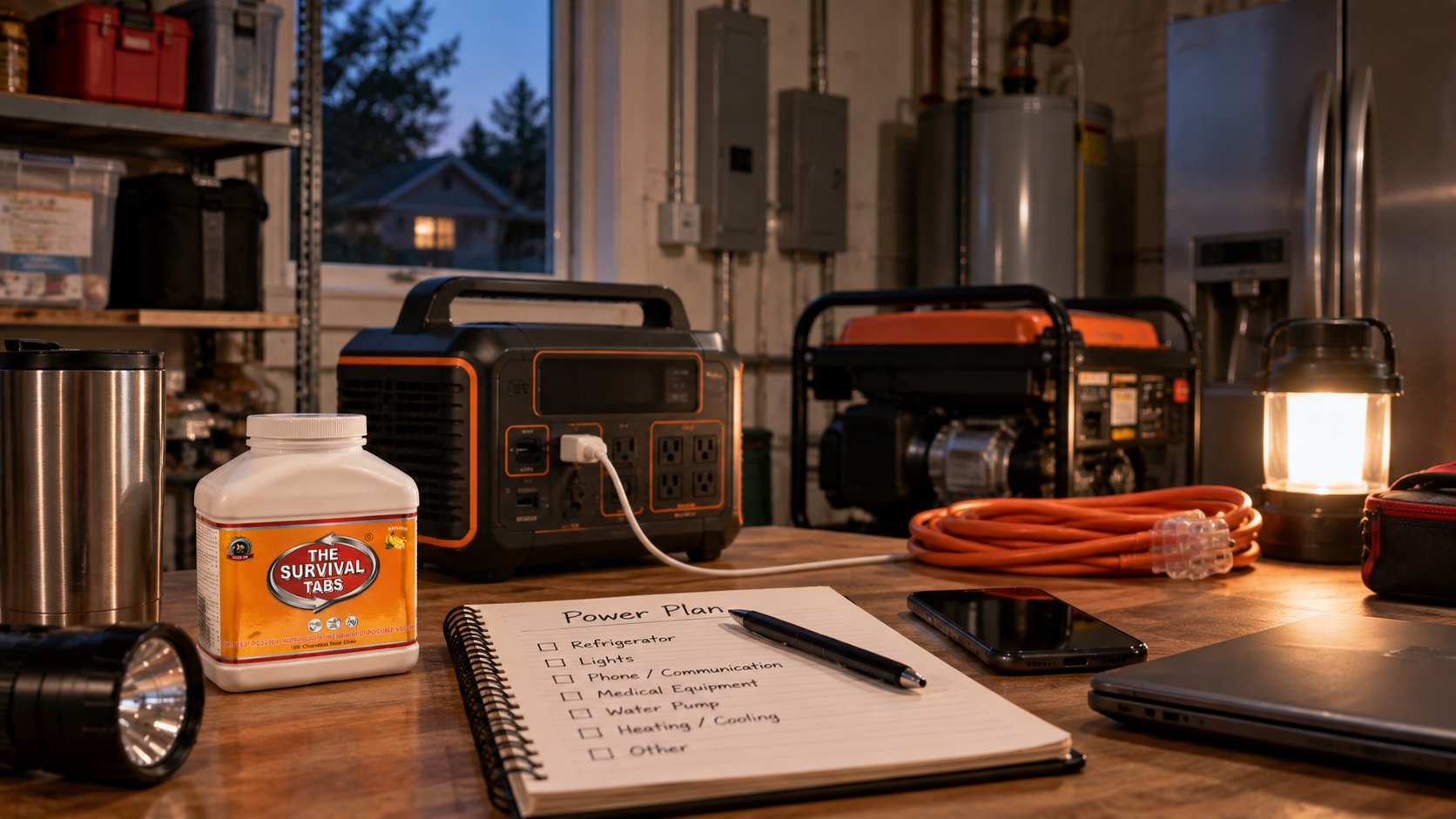
How to plan safe, realistic backup power for outages
A power outage can interrupt lighting, communications, refrigeration, heating or cooling, water systems, medical equipment, transportation, and access to information. A useful power plan begins with people and essential functions, then selects equipment that can support those priorities safely.
This guide explains how to assess essential loads, compare backup-power options, operate equipment safely, and prepare no-power alternatives. It does not provide instructions for building generators, gasifiers, Faraday cages, transfer switches, battery packs, or other electrical systems.
Never connect a portable generator directly to household wiring through a wall outlet. Backfeeding can electrocute utility workers, neighbors, and occupants. Any connection to household circuits requires approved equipment installed by qualified professionals.
1. Start With the Outage, Not the Equipment
The right system depends on what failed, expected duration, surrounding hazards, and who depends on electricity. A short local outage differs from a regional disaster affecting roads, fuel, communications, and public services.
* Identify the hazards most likely to cause outages where you live.
* Estimate whether typical interruptions last minutes, hours, or days.
* Record household members who rely on powered medical devices or refrigerated medication.
* Identify electrically powered water pumps, sump pumps, sewage systems, lifts, gates, or accessibility equipment.
* List safe places you could relocate if home power cannot support health or temperature needs.
* Enroll in utility and local emergency alerts.
Backup power does not make a damaged home safe. Fire, flooding, gas leaks, structural damage, extreme temperatures, wildfire, and evacuation orders may require leaving.
2. Build an Essential-Load Inventory
Record each essential device, rated watts, startup demand, expected hours of use, and whether it can be cycled instead of operated continuously.
Priority 1: Life safety
* Medical devices and their approved backup arrangements.
* Smoke alarms, carbon-monoxide alarms, and essential safety equipment.
* Emergency communications, phones, weather radio, and accessible alerting devices.
* Safe lighting for exits, stairs, medication handling, and caregiving.
Priority 2: Health and household stability
* Refrigeration for food or medication.
* Heating or cooling only when equipment can be powered and operated safely.
* Water pumps, well controls, sanitation, and sump pumps when applicable.
* Mobility, transfer, communication, and accessibility equipment.
Priority 3: Limited continuity
* A laptop, internet equipment, task lighting, or other low-power tools.
* Selective appliance use after life-safety loads are covered.
* Comfort devices that do not displace essential capacity.
Use nameplates or manufacturer documentation for electrical requirements. Motors may draw much more power at startup. Consult the manufacturer or a qualified electrician when information is unclear.
3. Understand Watts, Watt-Hours, and Runtime
Watts describe power use at a moment. Watt-hours describe energy used over time. A 50-watt device operating four hours uses about 200 watt-hours before system losses.
Estimate watt-hours by multiplying device watts by hours of operation. Add all essential devices, then include margin for conversion losses, battery limits, temperature, aging, and unexpected use.
* Check usable capacity, continuous output, surge output, outlet limits, and supported charging methods.
* Treat advertised runtimes as estimates under stated test conditions.
* Test the actual essential-load plan before an emergency.
* Recalculate when household equipment or medical needs change.
4. Choose Backup-Power Layers
Most households benefit from layers. Small batteries support communications and lighting; a power station may cover selected appliances; professionally planned generators or stationary batteries may support larger loads.
Disposable and rechargeable batteries
* Use them for flashlights, headlamps, radios, and small devices.
* Store correct sizes in original packaging and protect terminals from short circuits.
* Rotate according to manufacturer guidance and inspect for damage or leakage.
USB power banks
* Confirm cables and charging compatibility before an outage.
* Recharge on a maintenance schedule and replace swollen or damaged units.
Portable power stations
* They can provide quiet indoor power because they produce no combustion exhaust during use.
* They still require safe charging, dry placement, ventilation, cable management, and manufacturer-approved operation.
* Do not cover, flood, block exits with, or use a damaged, overheated, swollen, or recalled unit.
* Confirm the unit can support motor startup and the intended continuous load.
Portable generators
* They can support larger loads but create carbon-monoxide, fire, shock, noise, and fuel hazards.
* Operate outdoors at least 20 feet from windows, doors, and attached garages, with exhaust directed away.
* Never operate inside a home, garage, basement, shed, crawlspace, tent, or partially enclosed area.
* Use working battery-powered or battery-backup carbon-monoxide alarms.
Standby generators and stationary batteries
* These may support selected circuits or automatic operation when professionally designed and installed.
* They require load planning, permits, code compliance, inspection, maintenance, and safe placement.
Do not assume rooftop solar works during an outage. Many grid-connected systems shut down to protect utility workers. Outage operation requires suitable isolation equipment and often battery storage.
5. Generator Safety Is Non-Negotiable
Carbon monoxide is colorless and odorless. If an alarm sounds or anyone develops headache, dizziness, weakness, nausea, vomiting, chest pain, or confusion, move to fresh air and call emergency services.
* Keep generators outdoors and at least 20 feet from the home and all openings.
* Point exhaust away from people and structures, including neighboring buildings.
* Use carbon-monoxide alarms on every level and near sleeping areas as recommended.
* Never use a gas range, oven, grill, camp stove, or other combustion appliance to heat the home.
* Shut down and cool the generator before refueling.
* Keep children and pets away from equipment, fuel, cords, and hot surfaces.
* Stop use if flooding, high winds, wildfire conditions, damage, or manufacturer restrictions make operation unsafe.
6. Prevent Shock, Fire, and Backfeeding
Keep power equipment and hands dry. Do not operate damaged plugs, cords, outlets, or devices.
* Use cords rated for the load, environment, and intended application.
* Inspect cords for cuts, exposed conductors, loose connections, and heat damage.
* Do not run cords through water or where they create trip hazards.
* Do not daisy-chain power strips or defeat grounding connections.
* Do not exceed generator, outlet, cord, power-strip, or device ratings.
* Use ground-fault protection where required.
* Have a qualified electrician install transfer equipment or household-circuit connections.
If a breaker trips, a plug becomes hot, insulation smells burnt, equipment arcs, or a battery smokes or hisses, disconnect only if safe, move away, and call appropriate emergency or technical help.
7. Store and Handle Fuel Safely
Storing fuel creates serious fire, vapor, poisoning, and legal risks. Follow manufacturer instructions and local fire codes.
* Use approved, labeled containers intended for the specific fuel.
* Store fuel outside living spaces and away from ignition sources.
* Do not store fuel in basements, near exits, or in unsuitable containers.
* Protect fuel from children, pets, heat, sunlight, flooding, and vehicle impact.
* Never refuel a running or hot generator.
* Do not smoke or create sparks near fuel.
* Know local limits for fuel quantity and storage location.
* Use approved transport and disposal methods.
8. Medical Devices and Refrigerated Medication
Create an individualized plan with clinicians, pharmacists, device suppliers, the utility, and emergency management before an outage.
* Record device make, model, power input, battery type, runtime, and approved backup options.
* Keep supplier, clinician, pharmacy, utility, and emergency contacts on paper and in phones.
* Ask what to do when battery runtime becomes limited.
* Identify an accessible powered location and transportation plan.
* Register for utility programs where available, while recognizing they do not guarantee uninterrupted service.
* Follow medication labeling and pharmacist guidance for temperature excursions.
Never improvise electrical connections to medical equipment or rely on a single battery, charger, generator, or location when power loss could be life-threatening.
9. Food, Water, and Temperature Safety
* Keep refrigerator and freezer doors closed and monitor temperatures when possible.
* Do not taste food to decide whether it is safe.
* Use coolers and ice only when they can be managed safely.
* Prioritize medication refrigeration according to professional guidance.
* Know whether water or sewage systems depend on electricity.
* Store safe drinking water before outages.
* Relocate when indoor temperatures threaten health and safe heating or cooling cannot be maintained.
10. Solar Charging and Battery Systems
Solar can extend runtime when sunlight, panel placement, charge rate, and storage are adequate. Output varies with weather, shade, orientation, season, temperature, dirt, and system limits.
* Use compatible panels, controllers, cables, connectors, and batteries.
* Follow manufacturer limits for voltage, current, temperature, and moisture.
* Secure panels against wind and trip hazards.
* Keep connectors dry and inspect for damage.
* Do not block exits with equipment or cables.
* Use qualified professionals for permanent solar-plus-storage installations.
11. Prepare a No-Power Fallback
* Keep flashlights and headlamps instead of relying on candles.
* Store printed contacts, maps, medication lists, and instructions.
* Maintain a battery or hand-crank radio where appropriate.
* Keep ready-to-eat food and safe water that do not depend on electric cooking or pumping.
* Identify safe heating or cooling locations outside the home.
* Prepare manual accessibility and communication alternatives.
* Plan how to open gates, doors, garages, and security systems safely without power.
12. Test and Maintain the System
1. List essential devices and confirm their electrical requirements.
2. Charge batteries and follow manufacturer maintenance instructions.
3. Test one layer at a time with safe ventilation and supervision.
4. Record actual runtime and recharge time.
5. Check alarms, cords, plugs, fuel containers, and fire extinguishers.
6. Practice the transition to no-power fallbacks.
7. Correct problems and document the final procedure.
* Recheck portable batteries every three to six months or as directed.
* Maintain generators only as directed by the manufacturer.
* Replace expired fuel and damaged components through approved channels.
* Review the plan after a move, new appliance, medical change, household change, or major outage.
13. During an Outage
1. Confirm the outage and check official utility and emergency information.
2. Check for fire, gas, flooding, structural, and evacuation hazards.
3. Account for household members and medical-device needs.
4. Start with communications, lighting, and life-safety loads.
5. Operate generators only under full outdoor separation and carbon-monoxide rules.
6. Monitor fuel, batteries, cords, equipment temperature, alarms, weather, and household conditions.
7. Reduce loads early rather than waiting for complete depletion.
8. Relocate or evacuate when the plan can no longer maintain safety.
14. After Power Returns
* Watch for repeated outages or unstable service.
* Reconnect equipment gradually according to utility and manufacturer instructions.
* Inspect cords, batteries, fuel containers, and appliances for damage.
* Follow food and medication safety guidance.
* Recharge equipment in a safe location.
* Allow generators to cool before refueling, transport, or storage.
* Document runtimes, failures, near misses, and missing supplies.
* Restock and revise the plan.
15. What This Guide Does Not Recommend
* Homemade gasifiers or improvised combustion generators.
* DIY Faraday cages or guaranteed EMP-protection claims.
* Backfeeding through wall outlets or improvised household wiring.
* Indoor or partially enclosed generator operation.
* Unapproved fuel storage.
* Homemade lithium battery packs or repairs to damaged batteries.
* Using vehicles, grills, stoves, or ovens as indoor heat sources.
* Electrical work beyond the user’s qualifications or legal authority.
Frequently Asked Questions
Can rooftop solar power my home during an outage?
Not necessarily. Many grid-connected systems shut down. Outage operation requires properly designed isolation and compatible equipment; sustained power often requires storage or another approved source.
Can I run a generator in a garage with the door open?
No. A garage is not safe, even with the door open. Operate portable generators outdoors and at least 20 feet from openings, with exhaust directed away.
How large should my power station or generator be?
Size it from verified essential loads, startup requirements, hours of use, losses, and safety margin. Seek qualified advice for medical, high-load, or household-circuit applications.
Does a utility medical-priority program guarantee power?
No. It may help with notification or restoration priorities, but cannot guarantee service. Maintain backup, relocation, and emergency plans.
Are battery power stations risk-free indoors?
No. Batteries can overheat or ignite if damaged, misused, charged incorrectly, flooded, recalled, or poorly ventilated. Follow manufacturer instructions.
Should I build EMP protection for electronics?
This guide does not recommend unverified DIY shielding. Focus first on common outage risks, redundant communications, safe backup power, and offline records.
Final Emergency Power Checklist
* Essential loads documented.
* Medical and accessibility plans confirmed.
* Backup options matched to watts, watt-hours, surge demand, and duration.
* Generator location meets outdoor separation requirements.
* Carbon-monoxide and smoke alarms tested.
* Approved cords, fuel containers, chargers, and cables inspected.
* Transfer equipment professionally installed where needed.
* Solar and battery limitations understood.
* No-power fallbacks prepared.
* Maintenance and test dates recorded.
* Evacuation and relocation thresholds understood.
Professional Review Required Before Publication
This article requires review by a qualified electrician, fire-safety professional, emergency manager, medical-device or clinical specialist where applicable, and a reviewer familiar with local fuel-storage and building requirements. Product instructions, local codes, utility rules, and official emergency directions take priority.
Official Sources
Ready.gov — Power Outages
Ready.gov — Power Outage Hazard Information Sheet
CDC — Power Outage Safety
U.S. Department of Energy — Solar and Resilience Basics
U.S. Department of Energy — Solar Inverters and Grid Services
U.S. Consumer Product Safety Commission — Carbon Monoxide Safety Center