

Emergency Nutrition for First Responders
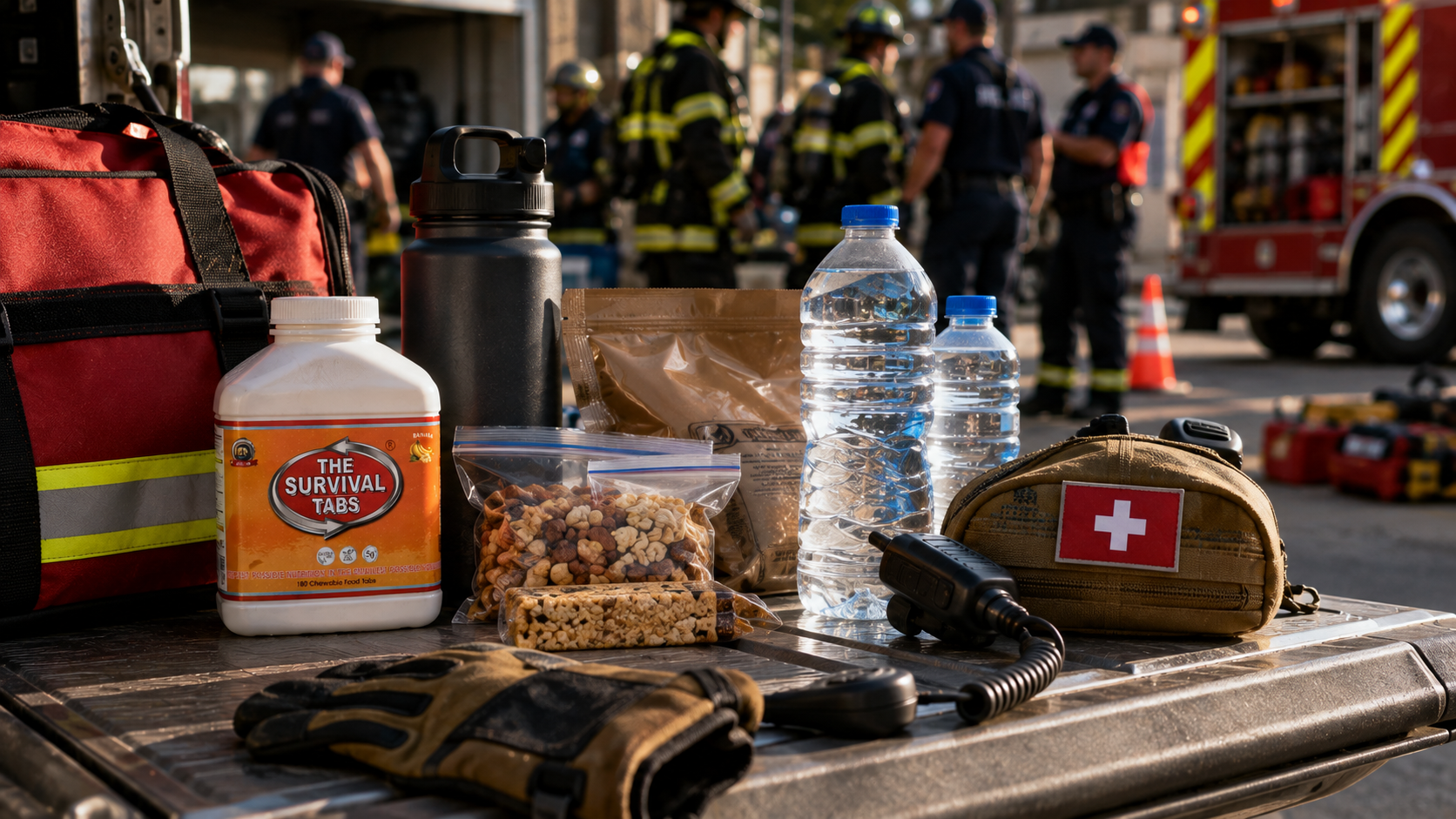
A practical guide to hydration, portable food, incident rehabilitation, and safe use of compact emergency nutrition
First responders may work long, unpredictable shifts in heat, cold, smoke, rain, or remote locations. A sound nutrition plan supports readiness by making ordinary food, water, and recovery supplies available before they are urgently needed.
This guide is for firefighters, emergency medical personnel, search-and-rescue teams, disaster volunteers, law-enforcement personnel, and the people who stock their vehicles, stations, deployment bags, and rehabilitation areas.
It is general preparedness information, not medical advice or a substitute for agency policy, an incident action plan, occupational-health guidance, or individualized advice from a qualified clinician or registered dietitian.
The core principle: build a system, not a single-product solution
No tablet, snack, beverage, or packaged ration can replace a complete responder nutrition and hydration program. A reliable system has several layers:
- Normal meals before and between assignments
- Accessible drinking water and a department-approved hydration plan
- Portable foods for delayed meals and extended operations
- Incident rehabilitation with rest, environmental protection, hydration, nutrition, and medical assessment when required
- A compact reserve for situations in which ordinary food is temporarily inaccessible
The United States Fire Administration describes rehabilitation as including rest, hydration, nutrition, and medical assessment during or after strenuous emergency operations. Follow the rehabilitation procedures and medical direction established by your agency.
Before the shift or deployment
Start with ordinary food
When possible, eat a balanced meal before a demanding shift or planned deployment. Choose familiar foods that you tolerate well. A practical meal generally combines a carbohydrate source, a protein source, produce, and fluids.
Avoid experimenting with unfamiliar foods, supplements, or unusually large meals immediately before strenuous work. Individual needs vary with body size, medical conditions, climate, workload, shift length, and personal tolerance.
Prepare for missed or delayed meals
Responder work is unpredictable. Pack more than one type of food so the plan still works if refrigeration, heating, utensils, or a long meal break is unavailable.
- Ready-to-eat foods that require no heating
- A more substantial shelf-stable meal for extended delays
- A compact backup ration
- Foods that meet allergies, dietary restrictions, and agency requirements
- Drinking water stored where it is protected and easy to reach
Label personal supplies where appropriate, monitor expiration dates, and separate food from fuel, chemicals, contaminated equipment, medications, and other hazards.
Hydration is operationally important
Do not wait for a crisis to discover that the vehicle, crew area, or deployment bag lacks water. Pre-position water and follow your agency’s heat, cold, and incident-rehabilitation procedures.
Hydration needs are not identical for every responder or every assignment. Heat, protective clothing, workload, duration, altitude, illness, medications, and individual health can change fluid needs. Excessive fluid intake can also be dangerous, so use department and medical guidance rather than forcing a universal quantity.
- Begin duty reasonably hydrated
- Drink at appropriate intervals under agency guidance
- Use electrolyte products only as directed and when appropriate for the work and conditions
- Report symptoms such as confusion, fainting, severe weakness, vomiting, chest pain, or loss of coordination immediately
- Do not use caffeine or energy products as a replacement for water, food, rest, or medical evaluation
During an incident, the incident commander, safety officer, rehabilitation unit, and medical personnel—not an article or product label—determine when a responder must rest, be evaluated, be reassigned, or leave operations.
Build a responder food kit in layers
Layer 1: quick-access food
Keep a small quantity of familiar, easy-to-eat food where it can be reached during an approved break. Examples may include nut or seed packets, dried fruit, crackers, shelf-stable tuna or chicken kits, fruit cups, bars, or other foods compatible with the responder’s dietary needs.
Layer 2: a real shelf-stable meal
For longer assignments, include food that provides a more complete meal. Consider calories, protein, carbohydrate, fat, sodium, fiber, allergies, preparation needs, water requirements, and packaging waste. Rotate it before quality declines.
Layer 3: compact emergency reserve
A compact ration can help bridge a short gap when normal meals are delayed or inaccessible. It should be treated as backup capacity, not as proof that a responder can safely continue working without rest, hydration, monitoring, or adequate food.
Layer 4: team and rehabilitation supplies
At the organizational level, plan for the number of personnel, likely incident duration, weather, mutual-aid partners, dietary restrictions, safe food handling, sanitation, resupply, and accountability. A personal snack cannot replace a properly supplied rehabilitation operation.
Using The Survival Tabs appropriately
The Survival Tabs are compact, chewable emergency nutrition tablets designed for storage and portability. Their small size may make them useful as one component of a vehicle kit, go bag, station reserve, or deployment cache.
Use the current package label as the controlling source for serving size, nutrition facts, ingredients, allergens, directions, storage, and warnings. Product formulations and labels can change.
- Do not describe the product as improving mental clarity, reaction time, endurance, alertness, or job performance unless an approved substantiation file specifically supports that claim
- Do not present the product as a replacement for water, sleep, rest, rehabilitation, medical care, or a balanced diet
- Do not imply endorsement by firefighters, emergency medical services, search-and-rescue organizations, government agencies, or individual responders without documented authorization
- Do not use an emergency ration to justify extending duty beyond agency limits or bypassing rehabilitation
- Consider allergies, medical conditions, dietary requirements, and the current ingredient label before use
The official Survival Tabs FAQ estimates a 25-year shelf life for unopened product, while also recommending rotation to help preserve maximum food value. Store and rotate supplies according to the current label and official product guidance.
Where to store responder nutrition
Personal deployment bag
Keep food in a clean, sealed, easy-to-find compartment. Protect it from crushing, moisture, pests, and cross-contamination.
Emergency vehicle or apparatus
Vehicle interiors can experience severe temperatures. Check the product label, inspect packaging, and rotate heat-exposed or damaged supplies more conservatively. Keep food away from fuels, cleaning agents, patient-care waste, and contaminated gear.
Station or base cache
Use clearly labeled bins, stock by earliest expiration or rotation date, and maintain a simple inventory. Include options for common dietary needs, but do not promise that one stock item fits everyone.
Incident rehabilitation area
Organizational supplies should support the agency’s rehabilitation plan. Provide safe water, suitable food, sanitation, weather protection, waste handling, and medical oversight as required. Scale quantities for personnel and anticipated duration, and plan a resupply route.
Food safety during operations
Emergency scenes can create contamination risks. Wash or sanitize hands before eating when feasible, use clean utensils, protect food from dust and chemicals, and follow agency decontamination rules before entering a clean eating or rehabilitation area.
- Discard food with damaged, leaking, swollen, or compromised packaging
- Do not eat food that may have contacted floodwater, chemicals, smoke residues, body fluids, or contaminated equipment
- Keep perishable food within safe temperature controls
- Separate allergen-sensitive foods and avoid cross-contact
- When safety is uncertain, follow the incident safety officer, public-health authority, or agency medical direction
A simple maintenance schedule
After each use or deployment
- Replace consumed items
- Remove trash and inspect the storage area for contamination
- Record any supply, access, packaging, or dietary problem while it is still fresh
On the agency’s regular inspection cycle
- Check seals, damage, pests, moisture, and temperature exposure
- Rotate food and beverages according to labels and policy
- Verify that water containers are clean and serviceable
- Confirm that supplies still match current staffing and dietary needs
- Review the kit after vehicle changes, new equipment, policy changes, or lessons learned from an incident
Planning questions for supervisors and logistics teams
- How many people must the plan support, and for how long?
- What happens if the normal meal schedule is interrupted?
- Where are water, quick food, full meals, and backup rations stored?
- Who establishes and operates rehabilitation?
- How are dietary restrictions and allergies documented without exposing private information?
- How will supplies be transported, protected, tracked, and resupplied?
- Who checks food safety, temperature exposure, expiration, and packaging integrity?
- What triggers medical evaluation or removal from duty?
Common mistakes to avoid
- Relying on one compact product as the entire nutrition plan
- Stocking food without enough water
- Choosing food that requires heating, tools, or water that may not be available
- Ignoring allergies, medical conditions, dietary rules, and personal tolerance
- Leaving supplies in damaging vehicle heat without inspection or rotation
- Using promotional claims as operational or medical guidance
- Treating food or caffeine as a substitute for sleep, rehabilitation, or medical assessment
Frequently asked questions
Can compact emergency nutrition replace a meal during a response?
A compact ration may help bridge a temporary access gap, but it should not be treated as a complete long-term food plan or as permission to skip required rehabilitation. Extended work requires adequate food, water, rest, monitoring, and agency support.
Do first responders need a special diet?
There is no single responder diet that fits everyone. Use balanced, familiar food as the base and seek individualized guidance when medical conditions, medications, allergies, weight goals, or performance requirements make nutrition more complex.
Should every responder carry the same food?
A common framework is useful, but contents should account for allergies, cultural and dietary needs, medical restrictions, storage conditions, and personal tolerance. Agencies should also plan shared supplies and resupply rather than relying only on personal kits.
Can food or supplements prevent fatigue?
No food or supplement eliminates the effects of long hours, heat, stress, sleep loss, illness, or excessive workload. Fatigue and heat-illness risks require operational controls, rest, rehabilitation, supervision, and medical evaluation when indicated.
What is the right role for The Survival Tabs?
They can serve as a compact backup within a broader responder food and hydration system. They should not be represented as a complete operational solution, a performance enhancer, a medical product, or an endorsement by first responders.
Final checklist
- Balanced ordinary food is the base plan
- Water and agency hydration procedures are in place
- Quick food, a shelf-stable meal, and compact backup are available
- Allergies, restrictions, storage conditions, and food safety are addressed
- Incident rehabilitation and medical escalation rules are understood
- Supplies are inspected, rotated, and replenished
- Product claims stay within the current label and approved substantiation
Sources and further guidance
United States Fire Administration — Emergency Incident Rehabilitation
United States Fire Administration — Emergency Services Ergonomics and Wellness
Editorial and compliance note
This article consolidates 15 legacy records mapped to “Emergency Nutrition for First Responders.” It intentionally excludes unsupported statements about mental clarity, rapid energy, performance, endurance, lifesaving effects, product superiority, and first-responder endorsement. It does not replace agency policy, medical direction, incident command, occupational-health requirements, or the current product label.