

Emergency Medication and First Aid Kit Guide
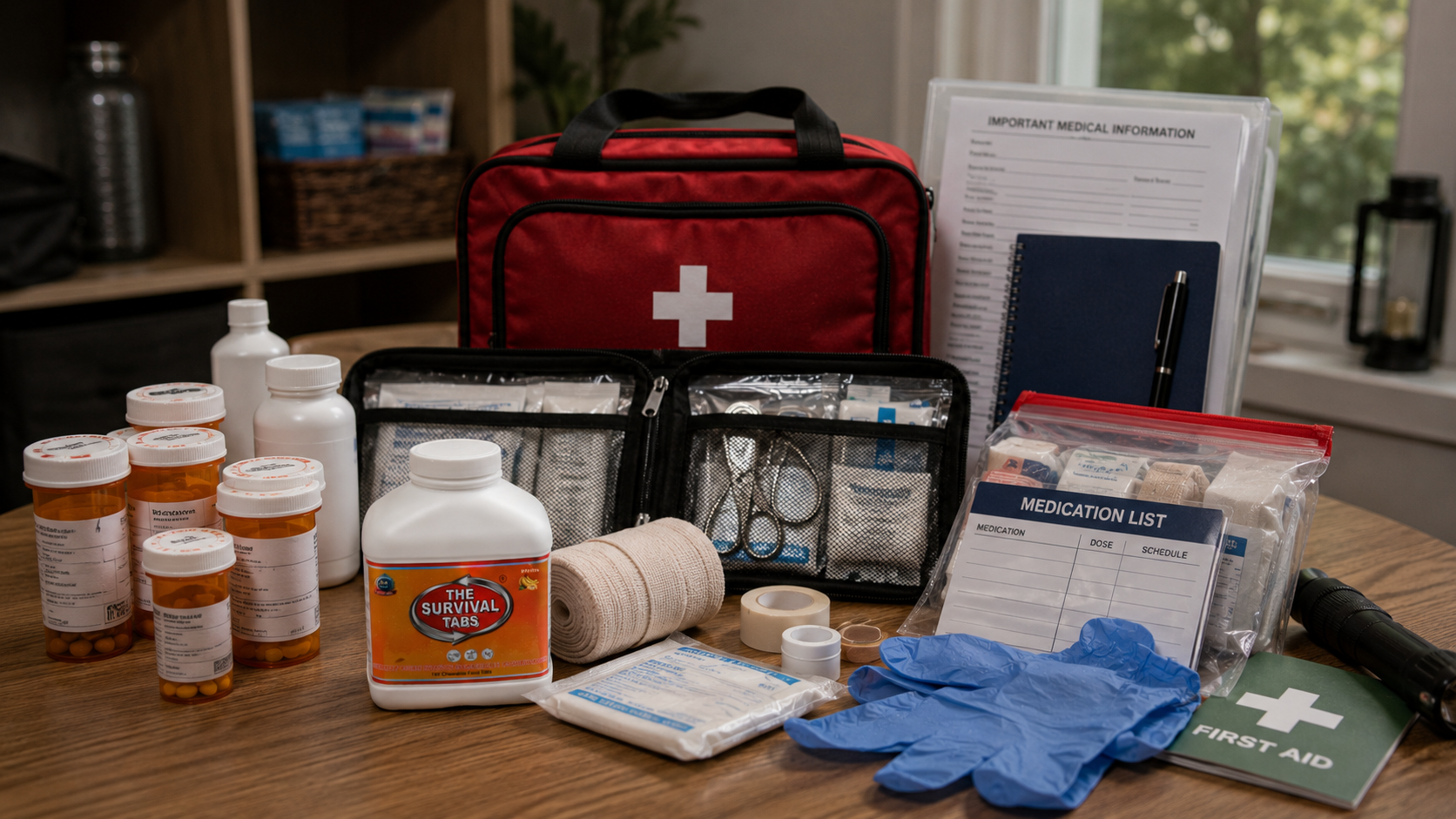
How to organize essential health information, medications, first-aid supplies, and a safe maintenance plan for emergencies
Medical review required before publication. This guide provides preparedness and organization information only. It does not diagnose conditions, prescribe medicines, replace product labels, or replace advice from a physician, pharmacist, emergency medical professional, or poison-control service.
Why medical preparedness belongs in every emergency plan
Disasters can close pharmacies, interrupt transportation, cut power, separate family members, and make routine health needs harder to manage. A medical kit helps reduce confusion by keeping essential supplies, records, and instructions organized.
The goal is continuity and safer decision-making—not self-treatment beyond your training. Build the kit around the actual people in your household, then review it with a qualified healthcare professional.
Start with a household health inventory
Before buying supplies, document what each person routinely needs and what could become urgent if access is interrupted.
- Full name, date of birth, allergies, diagnoses, and relevant medical conditions
- Prescription name, strength, form, schedule, prescribing clinician, and dispensing pharmacy
- Over-the-counter medicines, vitamins, supplements, and known interactions or sensitivities
- Medical devices, mobility aids, batteries, charging equipment, and replacement parts
- Emergency contacts, insurance information, preferred hospital, and specialist contacts
- Communication, sensory, cognitive, dietary, or accessibility needs
Keep the working inventory current. Give a trusted household member enough information to find and present it during an emergency, while protecting private health information from unnecessary access.
Plan prescription continuity with professionals
Do not create an extra prescription supply by changing doses, skipping doses, sharing medicine, buying from an unverified source, or storing medicine prescribed to someone else.
Ask your prescriber, pharmacist, and insurer what emergency refill options are legally available where you live. Rules, coverage, controlled-substance restrictions, and early-refill policies vary.
Discuss these questions before an emergency:
- How many days of medication should reasonably be kept available?
- Which medicines must never be stopped suddenly?
- Which medicines require refrigeration or protection from heat, moisture, freezing, or light?
- What backup plan applies if power, transportation, or pharmacy access is interrupted?
- Can copies of prescriptions, medication labels, or a clinician-approved action plan be stored with the kit?
- What should be carried during evacuation, and what can remain at home?
Keep medicines in their original, labeled containers unless a clinician or pharmacist has approved another system. Labels help responders identify the person, medicine, dose, instructions, prescriber, and pharmacy.
Build the first-aid supply module
Choose supplies that match your household, likely hazards, environment, and level of training. A basic kit commonly includes:
- Assorted adhesive bandages
- Sterile gauze pads and a gauze roll
- Medical tape
- Disposable non-latex gloves
- Antiseptic wipes or another label-approved cleaning product
- A digital thermometer and spare batteries if required
- Tweezers and blunt-tip scissors
- An elastic wrap
- A cold pack
- A breathing barrier for CPR if the household is trained to use it
- An emergency blanket
- A first-aid instruction card from a recognized training provider
- Personal items recommended by a clinician, such as prescribed rescue medicine or condition-specific supplies
Do not add equipment you cannot safely use. Training is part of the kit: take a recognized first-aid and CPR course and refresh it as recommended by the training provider.
Separate medications from general first-aid supplies
A modular system makes the kit easier to inspect and use. Suggested modules include:
- Prescription medicines
- Over-the-counter medicines approved for household members
- Wound-care and protective supplies
- Personal medical devices and accessories
- Health records and emergency contacts
- Cold-chain or temperature-sensitive items
Label the outside of each module by function, not by detailed private diagnosis. Inside, use a simple inventory showing item name, owner, quantity, expiration date, storage requirement, and next review date.
Use over-the-counter medicines carefully
A preparedness article cannot determine which nonprescription medicines are appropriate for a particular person. Age, pregnancy, kidney or liver disease, allergies, interactions, and other conditions can change what is safe.
Before adding any over-the-counter medicine, ask a pharmacist to review the complete household medication list. Keep the original Drug Facts label and measuring device with liquid medicines. Never use kitchen spoons for dosing.
Do not combine products with the same active ingredient unless a qualified professional has specifically instructed you to do so.
Storage: follow the label
Medication stability depends on the product and its labeled storage conditions. Heat, freezing, humidity, direct sunlight, contamination, and damaged packaging can make a product unsafe or less effective.
- Store medicines according to the manufacturer label and pharmacy instructions
- Avoid damp bathrooms, hot vehicles, direct sun, and unconditioned outdoor storage unless the label specifically permits it
- Keep lids closed and packaging intact
- Protect liquids, glass containers, needles, and fragile devices from impact
- Keep medicines secure from children, visitors, pets, and unauthorized users
- Separate household chemicals, fuel, food, and medicines
A car kit can carry general first-aid supplies, but most medicines should not live permanently in a vehicle because temperatures can exceed labeled limits.
Refrigerated and temperature-sensitive medicine
Make a written power-outage plan with the pharmacist or manufacturer before an emergency. The correct temperature range and allowable time outside refrigeration depend on the specific product.
- Identify every item requiring refrigeration or another controlled temperature
- Record the labeled temperature range and manufacturer contact information
- Prepare an insulated transport container if recommended
- Use a temperature-monitoring method appropriate for the product
- Keep medicine from direct contact with ice or frozen packs unless instructed
- Know where backup power, a cooling location, or an alternate pharmacy may be available
After a temperature excursion, do not guess. Contact a pharmacist, healthcare provider, or manufacturer for product-specific advice.
Expiration dates and rotation
Use the expiration date on the label as the household standard. Government stockpile-extension programs do not authorize consumers to treat ordinary expired medicine as safe.
Replace expired, damaged, contaminated, unlabeled, discolored, leaking, or improperly stored products. Do not rely on appearance alone to judge safety.
Check the medical kit at least twice a year and after every use, evacuation, move, major prescription change, or severe temperature event.
- Confirm medicines still match current prescriptions
- Check expiration dates and package integrity
- Replace used or missing first-aid supplies
- Test devices and replace batteries as appropriate
- Update contacts, allergies, insurance details, and care plans
- Verify storage temperatures and security
Safe organization and access
In an emergency, the right person must be able to find the kit quickly without making it easy for children or unauthorized users to access medicines.
- Choose a dry, temperature-appropriate, easy-to-reach location
- Use a secure container where household risk requires it
- Keep a portable evacuation module ready
- Use large, readable labels and color-independent text
- Include a flashlight or headlamp nearby
- Teach responsible household members where the kit is and how to bring it during evacuation
Sharps require a puncture-resistant disposal container and local disposal guidance. Do not place loose needles or lancets in ordinary trash or recycling.
Documents and privacy
Keep a concise paper health summary in a water-resistant sleeve. An encrypted digital backup can help if paper records are lost, but it should not be the only copy.
- Medication list with prescribing and dispensing contacts
- Allergy and critical-condition summary
- Copies or photos of current labels when legally and practically appropriate
- Insurance and identification information
- Medical-device model and supplier details
- Written emergency or condition-specific plans approved by a clinician
Limit the information to what is useful in an emergency. Decide who may access it and avoid displaying sensitive information on the outside of the kit.
Evacuation and go-kit module
The portable medical module should be light enough to carry and specific to the person using it.
- Current medicines in original labeled containers
- Medication and allergy list
- Essential devices, chargers, batteries, and consumables
- Basic first-aid supplies
- Protective container for documents and temperature-sensitive items
- Contact details for clinicians, pharmacy, insurer, caregiver, and equipment supplier
Never leave essential medicine behind to save space. If evacuation is possible, plan transportation and accessible shelter options early.
During an emergency
Call emergency services for severe or life-threatening symptoms. Do not delay professional care because a kit is available.
Use medicine only for the person to whom it was prescribed and exactly as directed. Follow labels and clinician-approved plans. Do not share medicines.
Record significant events such as missed doses, temperature exposure, medicine taken, first-aid supplies used, and advice received. Give that record to the next healthcare professional involved.
After an emergency
- Seek follow-up care when needed
- Replace used, damaged, contaminated, or temperature-exposed items
- Ask a pharmacist about any medicine whose storage conditions were compromised
- Dispose of unneeded or expired medicine through an authorized take-back option when available
- Update the inventory and restore the portable module
- Review what was difficult to find, carry, understand, or use
Special household considerations
Children
Use child-specific products only when appropriate and follow the label and pediatric guidance. Store every medicine out of sight and reach, preferably locked when risk warrants. Keep the correct measuring device with liquid medicine.
Older adults and people with disabilities
Plan for mobility aids, communication tools, backup power, personal assistance, and accessible packaging. Large-print instructions or tactile labels may help, but must not obscure the original pharmacy label.
Pregnancy and breastfeeding
Ask an obstetric clinician or pharmacist to review every prescription, over-the-counter medicine, and supplement in advance.
Pets
Keep veterinary medicines separate from human medicines. Maintain a pet-specific list, original labels, veterinarian contacts, and species-appropriate first-aid guidance.
What this kit should not become
- A substitute for emergency medical care
- A collection of unverified remedies
- A stockpile of prescription medicine obtained outside professional care
- A place to keep expired or unidentified pills
- A reason to attempt procedures beyond your training
- A shared medicine cabinet where products are used by anyone
Simple maintenance schedule
Monthly quick check
- Confirm the kit is present, secure, dry, and accessible
- Check critical medicines and powered devices
- Replace anything used during the month
Twice-yearly full review
- Review the inventory with current prescriptions
- Check every expiration date and package
- Test equipment and review storage conditions
- Update documents and contacts
- Practice locating and carrying the kit
After any change or emergency
- Restock immediately
- Document losses or temperature exposure
- Ask professionals about uncertain products
- Revise the plan based on what happened
Frequently asked questions
How much prescription medicine should I keep for emergencies?
Ask your prescriber, pharmacist, and insurer. The appropriate and legally available amount varies by medicine, location, coverage, and individual need. Do not alter your normal dosing to build a reserve.
Can I use medicine after its expiration date?
For household planning, follow the labeled expiration date and replace expired medicine. Ask a pharmacist or other qualified professional about a specific emergency situation.
Can I store medicine in my car emergency kit?
Many vehicles experience temperatures outside labeled storage limits. Keep general first-aid supplies in the car, but check each medicine’s label and pharmacist guidance before vehicle storage.
What if refrigerated medicine loses power?
Protect it from extreme temperatures and contact a pharmacist, manufacturer, or healthcare provider for product-specific advice. Do not assume that ice contact, refreezing, or appearance proves safety.
Should I buy a preassembled first-aid kit?
A reputable preassembled kit can provide a useful base, but it must be checked, personalized, maintained, and matched to household needs and training.
Who should review the finished kit?
A pharmacist should review medicines and storage. A clinician should review condition-specific needs and action plans. A recognized first-aid instructor can help match supplies to training.
Final checklist
- Household health inventory completed
- Prescription continuity plan reviewed with professionals
- Medicines kept in original labeled containers
- First-aid supplies matched to training and household needs
- Temperature-sensitive medicine plan documented
- Expiration and restocking schedule established
- Documents protected and privacy considered
- Portable evacuation module ready
- Children, disabilities, older adults, pregnancy, and pets considered
- Kit reviewed by a pharmacist or clinician before publication or reliance
Sources
CDC — Prescriptions and emergency preparedness
CDC — Building an emergency kit for individual needs
FDA — Expired medicines and safe storage
FDA — Safe disposal of unused medicines
American Red Cross — First-aid kit guidance
Ready.gov — Basic emergency supply kit
Editorial and compliance notes
This article consolidates 11 legacy records. It excludes commercial shelving content except for general organization principles, and it removes unsupported treatment, medication-selection, dosing, stockpiling, and product-performance claims.
Publication gate: pharmacist or qualified clinician review is required before the article is published or used as medical guidance.