

Emergency Kit Maintenance and Rotation Guide
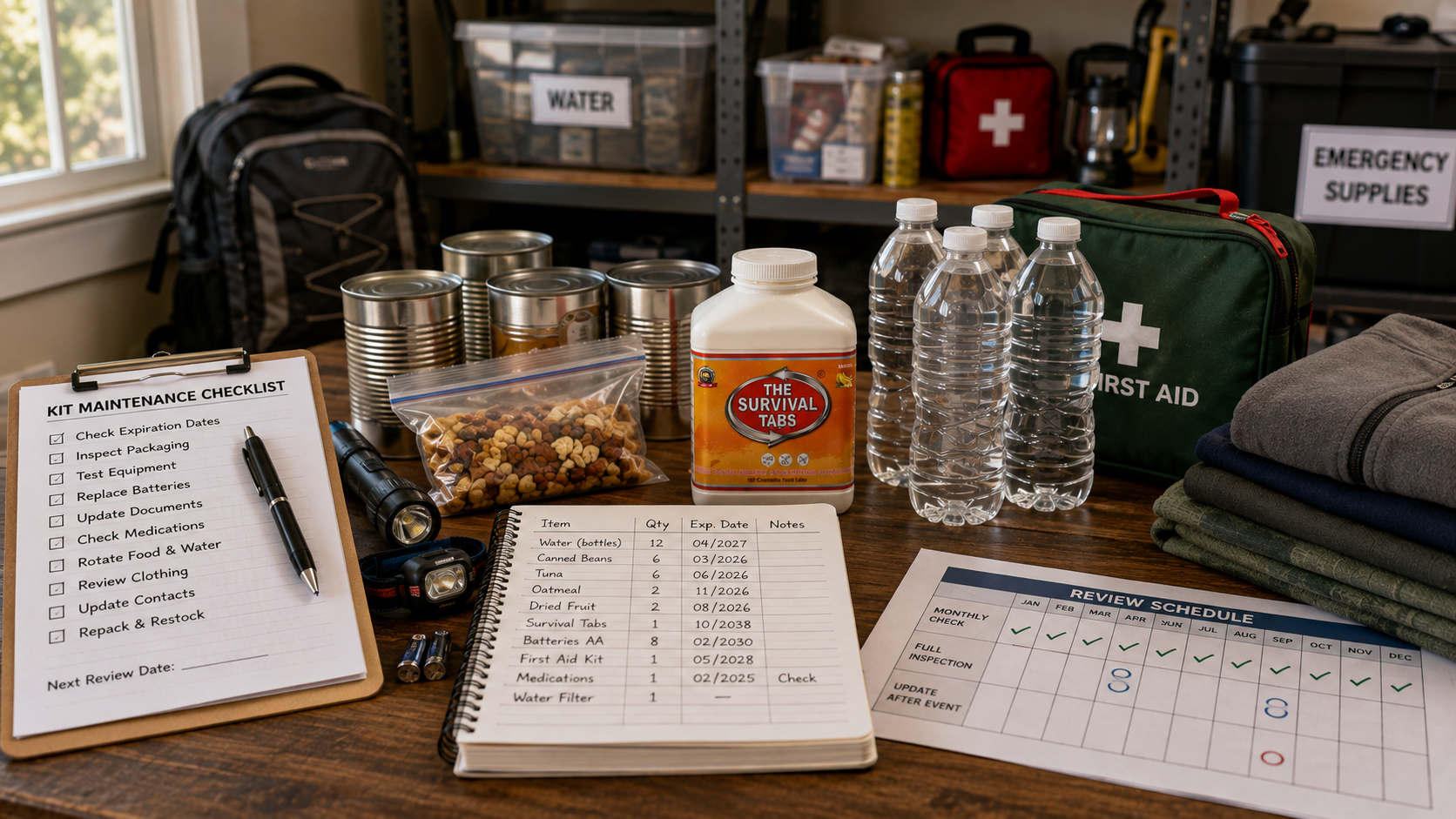
A preparedness kit is useful only if its contents work, fit the household, and can be found quickly. Maintenance turns a one-time shopping project into a reliable system.
This guide provides a calm, repeatable process for reviewing emergency supplies and household plans. It complements a 72-hour kit, vehicle kit, bug-out bag, and longer-term home supplies.
Quick answer
Review the kit on a recurring schedule, replace expired or damaged items, update it when household needs change, and practice the plan. Ready.gov specifically advises replacing expired items and reconsidering needs every year.
Use a simple inspection log so the next review date, replaced items, and unresolved gaps are visible.
Why emergency kits fail
Food, water, medicine, batteries, documents, clothing, and contact information do not age at the same rate.
A sealed container can create false confidence. Heat, moisture, leaks, pests, corrosion, dead batteries, expired medicines, missing chargers, and outdated documents can make a complete-looking kit unreliable.
Family circumstances also change. A kit may no longer fit children, older adults, pets, medical needs, transportation arrangements, or seasonal hazards.
A practical maintenance rhythm
Use three review triggers instead of relying on memory.
Monthly quick check
- Confirm the kit is in its assigned location and remains accessible.
- Check for water leaks, pests, unusual odors, rust, swollen batteries, damaged packaging, or broken seals.
- Confirm flashlights, radios, alarms, and power banks are present.
- Look for household changes that require an immediate update.
Twice-yearly full inspection
- Choose two memorable dates about six months apart.
- Empty each kit far enough to inspect every item.
- Test equipment, review dates, rotate consumables, update documents, and record the result.
- Adjust clothing and seasonal modules before local weather changes.
Event-driven update
Review the kit after a move, new child, new pet, medication change, diagnosis, job or school change, new vehicle, household separation, major purchase, or local hazard change.
Inspect and restock after any emergency, evacuation, drill, camping trip, or power outage in which supplies were used.
Create a kit inventory
- Use one inventory for each kit: home, vehicle, workplace, school, evacuation bag, or pet kit.
- Record the item, quantity, storage location, expiration or inspection date, replacement date, and notes.
- Keep a paper copy in or near the kit and a secure digital copy that can be accessed away from home.
- Mark the outside of the container with the last inspection date and next scheduled review.
Water inspection and rotation
- Check every container for leaks, bulging, cracks, damaged caps, contamination, or heat exposure.
- Follow the manufacturer’s date and storage instructions for commercially packaged water.
- If you store water in your own containers, use food-grade containers and follow current public-health guidance for cleaning, storage, and replacement.
- Keep water away from fuels, pesticides, cleaning products, direct sunlight, and extreme heat.
- Do not taste questionable water to decide whether it is safe.
Food inspection and rotation
- Read the manufacturer’s storage and date guidance for every product.
- Remove food with damaged packaging, broken seals, swelling, leakage, rust at seams, pest damage, moisture exposure, or unusual odor.
- Rotate foods into normal household use before quality declines, then replace them with fresh stock.
- Confirm the kit still contains foods household members can safely eat.
- Check for an appropriate manual can opener if canned food is included.
- Choose foods that match the kit’s likely conditions, including available water, cooking fuel, and time.
- Survival Tabs are compact emergency nutrition and should be stored and used according to the product label and current manufacturer instructions.
- Do not treat any single emergency food as a complete substitute for water, normal meals, or medical nutrition without qualified guidance.
Medication and medical-supply review
- Review prescriptions, over-the-counter medicines, first-aid supplies, medical devices, and written health information.
- Do not use an emergency kit to build an unauthorized stockpile or change a prescription schedule.
- Ask a pharmacist or clinician how much medicine to keep, how to rotate it, and how to manage temperature-sensitive products.
- Keep medicines in labeled packaging unless a qualified professional directs otherwise.
- Check expiration dates, packaging, storage conditions, and device batteries.
- Replace used or expired first-aid supplies and inspect sterile packaging for damage.
- Update medication lists, allergies, diagnoses, clinician contacts, pharmacy contacts, dosages, and equipment instructions.
- Plan for refrigerated medicines with professional guidance; a cooler alone does not prove safe storage.
Batteries, lighting, radios, and power
- Test flashlights, headlamps, radios, weather radios, battery lanterns, and personal safety alarms.
- Replace leaking, swollen, corroded, or damaged batteries safely.
- Store spare batteries so terminals cannot short against metal.
- Recharge power banks on a schedule and verify that they hold a charge.
- Confirm charging cables and adapters match the household’s current phones, radios, medical devices, and assistive equipment.
- Do not run generators, grills, or fuel-burning devices indoors or in enclosed spaces.
Documents, money, and contact information
- Review copies of identification, insurance information, medical information, account contacts, property records, and household emergency contacts.
- Replace documents that are expired, unreadable, incomplete, or no longer accurate.
- Use a waterproof portable container for necessary paper copies.
- Protect digital copies with appropriate security and confirm that trusted household members know how to access them.
- Update evacuation destinations, out-of-area contacts, schools, caregivers, employers, veterinarians, utilities, and local emergency numbers.
- Keep some cash in appropriate denominations if this fits the household plan, and review it for security and accessibility.
Clothing, shelter, hygiene, and tools
- Confirm clothing still fits and suits the current season.
- Inspect blankets, sleeping bags, rain protection, sturdy shoes, gloves, masks, and shelter materials for moisture, mildew, tears, or contamination.
- Replace opened, leaking, or degraded hygiene items.
- Check eyeglasses, hearing-aid supplies, mobility-device accessories, communication aids, and other functional-needs items.
- Test whistles and simple hand tools; confirm that household members know their intended use.
- Avoid adding unfamiliar tools, weapons, or hazardous equipment simply because they appear on generic survival lists.
Household-specific modules
Infants and children
Update diapers, formula or feeding supplies, clothing sizes, comfort items, consent information, school contacts, and age-appropriate instructions.
Older adults and people with disabilities
Review support-network contacts, assistive equipment, chargers, batteries, communication aids, mobility needs, and backup arrangements.
Pets and service animals
Rotate food and water, update medicines and veterinary records, check carriers, replace damaged leashes, and confirm current identification.
Ready.gov recommends reviewing pet kits regularly and considering both a larger shelter-in-place kit and a lighter evacuation kit.
Vehicle and workplace kits
Vehicle kits experience temperature extremes, vibration, and theft risk. Inspect them more often than climate-controlled home supplies.
Replace heat-damaged food, water, medicines, adhesives, batteries, and plastic items.
Check seasonal vehicle supplies and confirm emergency contacts, charging equipment, reflective gear, and basic roadside items are current.
At work, follow site rules and keep the kit small enough to carry if evacuation is required.
Update the emergency plan with the kit
A maintained kit cannot replace a practiced plan.
Review how the household will receive alerts, shelter, evacuate, communicate, reunite, assist members with access needs, and care for animals.
Confirm two meeting places when practical: one near the home and one outside the neighborhood.
Make sure everyone knows where kits, utility controls, fire extinguishers, and important documents are located.
Practice relevant parts of the plan and correct problems found during the drill.
Do not wait for the next calendar review when an alert system, evacuation route, contact, or household need changes.
Ten-minute quick-check procedure
- Look at the container and storage area for damage or hazards.
- Confirm the kit is accessible and clearly identified.
- Check water and food packaging.
- Check medicine and critical medical-supply dates.
- Test one flashlight and the radio.
- Check power-bank charge status.
- Confirm the contact card is current.
- Check seasonal clothing and household-specific modules.
- Note anything missing, used, or damaged.
- Schedule and complete replacements instead of leaving a note indefinitely.
Full inspection procedure
- Bring the inventory, a pen, replacement labels, and a box for removed items.
- Inspect one category at a time.
- Separate items into keep, rotate into household use, replace, and dispose safely.
- Test equipment using the manufacturer’s instructions.
- Update quantities and dates in the inventory.
- Clean and dry the container before repacking.
- Pack frequently needed and life-safety items where they can be reached first.
- Keep incompatible products separated, including food and chemicals.
- Record unresolved gaps, the responsible person, and a completion date.
- Mark the next review date on the kit and the household calendar.
After an emergency or drill
- Account for everything used, opened, damaged, contaminated, or loaned.
- Replace critical items first: water, medicines, medical supplies, lighting, communications, and necessary food.
- Clean or dispose of equipment according to manufacturer and public-health guidance.
- Update the plan based on delays, confusion, inaccessible supplies, or missing information.
- Document insurance or replacement information when appropriate.
- Do not repack wet, contaminated, or uninspected items.
Common maintenance mistakes
- Reviewing only expiration dates and ignoring damage or changing needs.
- Keeping every kit in one location that may become inaccessible.
- Storing batteries inside devices for years without inspection.
- Leaving obsolete charging cables and dead power banks in the kit.
- Keeping children’s clothing or pet supplies after they no longer fit the household.
- Treating copied documents as current without checking them.
- Replacing food but never practicing the communication or evacuation plan.
- Buying more gear instead of fixing known gaps.
Maintenance log template
- Kit name and location
- Inspection date
- Inspector
- Items tested
- Items rotated into household use
- Items replaced
- Items removed
- Documents updated
- Plan changes
- Unresolved gaps and responsible person
- Next review date
Frequently asked questions
How often should I inspect my emergency kit?
Use a monthly visual check, a full inspection about twice a year, and an immediate review after household changes or kit use. Ready.gov also advises reconsidering household needs every year.
Should I throw away food as soon as a best-by date arrives?
Follow the product label and manufacturer guidance. Date wording, storage history, packaging condition, and safety are not interchangeable. When in doubt about safety, do not use the item.
Can I keep medicine in a hot vehicle kit?
Many medicines have specific temperature requirements. Ask a pharmacist about the exact product and use a separate plan for medicines that cannot tolerate vehicle temperatures.
Should every household use the same checklist?
No. Start with official baseline guidance, then adjust for household size, climate, hazards, health needs, pets, transportation, work, and evacuation realities.
Is testing equipment enough?
No. Also confirm that people know how to use it safely and that necessary accessories, fuel, batteries, cables, and instructions are present.
What should I do with removed supplies?
Rotate safe food into normal use, recycle where accepted, donate only suitable unexpired items under local rules, and dispose of medicines, batteries, chemicals, and contaminated products through appropriate programs.
Limitations and safety note
This guide supports preparedness maintenance; it does not replace product labels, local emergency instructions, medical advice, food-safety guidance, or equipment manuals.
During an emergency, follow instructions from local authorities and qualified professionals.