

Emergency Food Storage Guide
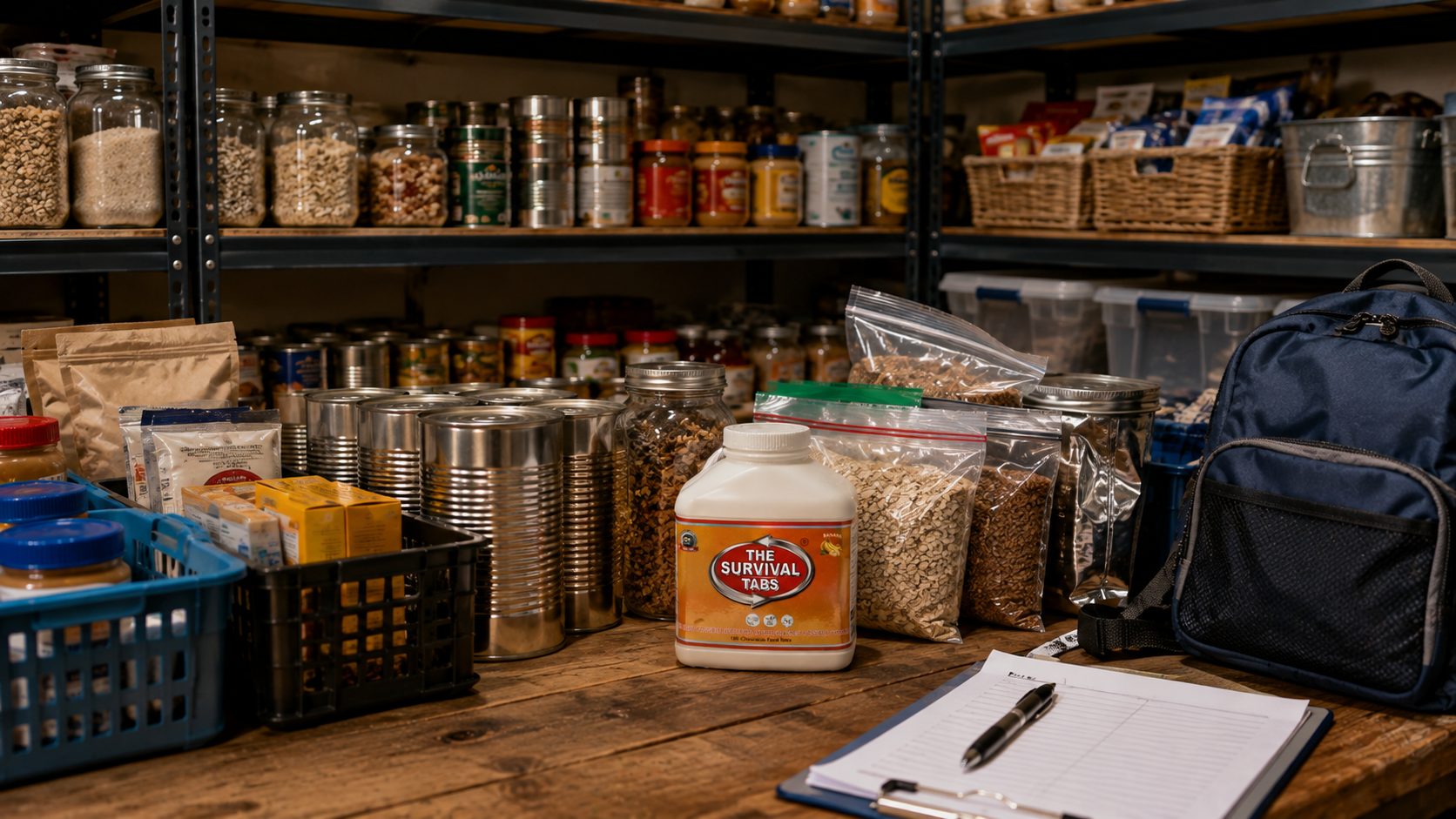
Emergency food storage is less about collecting the largest possible stockpile and more about maintaining food your household can safely eat when shopping, refrigeration, cooking fuel, water, or transportation is disrupted. A useful reserve is familiar, nutritionally varied, easy to prepare, protected from damage, and reviewed often enough that nothing important is forgotten.
Start with a manageable supply for several days, then expand according to local guidance, household needs, storage space, climate, budget, and the disruptions most likely where you live. Store food as one part of a larger plan that also covers water, medications, sanitation, communication, and safe preparation.
1. SET A REALISTIC STORAGE GOAL
Begin with the people and animals you are responsible for. Count household members, pets, likely guests, dietary restrictions, allergies, medical needs, ages, activity levels, and whether anyone depends on specialized foods.
Build in layers rather than trying to buy everything at once:
- A short-disruption layer of foods that can be eaten immediately with little or no preparation.
- A multi-day home layer with familiar shelf-stable foods and simple meals.
- A longer-duration layer only after water, storage conditions, cooking methods, rotation, and budget are workable.
Ready.gov recommends including foods that do not require refrigeration, cooking, water, or special preparation. That principle is especially important for the first layer of your reserve.
2. CHOOSE FOODS THAT WORK DURING AN EMERGENCY
Select foods your household already knows and tolerates. An emergency is a poor time to discover that a product is difficult to prepare, causes digestive problems, or is disliked by the people who need to eat it.
Prioritize a balanced mix:
- Ready-to-eat canned foods, pouches, or shelf-stable meals.
- Dry staples that fit your available water and cooking plan.
- Protein sources such as canned fish, meat, beans, nut or seed products, or other suitable alternatives.
- Fruits and vegetables in shelf-stable forms.
- Energy-dense foods and familiar snacks for times when appetite or preparation capacity is limited.
- Foods appropriate for allergies, diabetes, swallowing difficulties, religious practices, vegan or vegetarian diets, and other household needs.
- Baby food, formula, pet food, and other specialized supplies when relevant.
Do not judge a food only by its advertised shelf life. Consider calories, protein, fat, micronutrients, preparation needs, serving size, packaging, cost, and whether the household will realistically rotate it.
3. PLAN FOR WATER, COOKING, AND POWER LIMITS
Many dry or freeze-dried foods need substantial water. Some also require long cooking times. If water service or power is interrupted, those foods may be difficult to use even when the package remains intact.
For every stored meal, ask:
- Can it be eaten safely without cooking?
- How much water is required?
- What fuel, appliance, cookware, and ventilation are needed?
- Can the opened package be finished or safely stored without refrigeration?
- Does everyone who may prepare it understand the instructions?
Keep a manual can opener with the food supply. If you plan to use a camp stove, grill, or generator, follow manufacturer instructions and never operate fuel-burning equipment indoors or in any enclosed area where carbon monoxide can accumulate.
4. CREATE SAFE STORAGE CONDITIONS
A cool, dry, dark, clean location generally protects shelf-stable food better than a hot attic, damp basement, unventilated shed, or vehicle. Avoid direct sunlight, temperature extremes, standing water, cleaning chemicals, fuels, pesticides, and locations vulnerable to pests.
Ready.gov advises keeping canned food in a cool, dry place and boxed food in tightly closed plastic or metal containers. Secondary containers can help protect packages from moisture, insects, rodents, and crushing, but they do not extend the manufacturer’s stated life of the food inside.
Use shelving that is stable, cleanable, and appropriate for the load. Keep heavy containers on lower shelves. Do not place food directly on a floor where leaks, pests, or flooding could reach it. Leave enough space to inspect packages and rotate older food forward.
A log cabin, apartment, suburban home, or off-grid property follows the same basic rule: choose the safest available indoor storage conditions rather than relying on the building type.
5. PROTECT PACKAGING AND CONTAINERS
Keep commercially packaged food in its original packaging unless there is a clear reason to transfer it. The original label contains ingredients, allergen information, preparation directions, lot codes, and dates that may be important.
For dry goods that benefit from secondary protection, use clean, food-grade containers with tight-fitting lids. Label the container with the product name, allergen information, original package date, and any preparation instructions. Never use a container that previously held chemicals or fuel.
Inspect cans and packages before storage and during every review. Discard or follow official food-safety guidance for items with:
- Bulging, leaking, or badly damaged cans.
- Broken seals or punctured pouches.
- Moisture, mold, unusual odor, or pest evidence.
- Rust that is extensive or affects seams.
- Missing labels when the contents, ingredients, or safety cannot be confirmed.
Never taste questionable food to decide whether it is safe.
6. LABEL, INVENTORY, AND ROTATE
A simple inventory prevents the reserve from becoming an expensive collection of forgotten packages. Record the food, quantity, storage location, purchase date, manufacturer date or best-by date when present, special dietary use, and next review date.
Use a first-in, first-out system: place newer items behind older items and use the older suitable items first. Rotation does not mean waiting for food to approach the end of its shelf life. Include stored foods in normal meals, then replace what you use.
Review the supply on a recurring schedule and after heat, flooding, pest activity, package damage, or relocation. During each review:
- Count what is actually present.
- Check packaging and storage conditions.
- Update household dietary and medical needs.
- Replace items that were used, damaged, recalled, or are no longer appropriate.
- Test the planned preparation method.
- Update the written inventory.
7. UNDERSTAND DATES AND SHELF-LIFE CLAIMS
Package dates have different meanings depending on the food and manufacturer. A best-by date often relates to quality rather than automatically proving that a product becomes unsafe on that day, but packaging condition, storage history, product type, recalls, and official guidance all matter.
Do not extend a shelf-life claim on your own. Follow the manufacturer’s label and current instructions. If storage conditions have been poor or the package is damaged, a printed date does not guarantee safety.
For The Survival Tabs, the official website currently estimates a 25-year shelf life for unopened containers. The company also provides separate guidance for opened containers. Store the product according to its label and current official FAQ, keep the container sealed until needed, and do not replace the manufacturer’s instructions with advice from an older blog article.
8. STORE THE SURVIVAL TABS AS PART OF A LARGER FOOD PLAN
Compact emergency nutrition can be useful where storage space, portability, or no-cook access matters. It should still be planned alongside water and other suitable foods rather than treated as a substitute for every household food need.
When including The Survival Tabs:
- Keep unopened containers sealed and protect them from moisture, contamination, and avoidable heat.
- Retain the original label and lot information.
- Record the container in the same inventory used for other emergency food.
- Follow current manufacturer guidance after opening.
- Plan water separately.
- Consider children, older adults, allergies, medical conditions, and dietary needs when building the complete reserve.
9. PREPARE FOR POWER OUTAGES
Shelf-stable food reduces dependence on refrigeration, but households also need a plan for the food already in the refrigerator and freezer.
FoodSafety.gov and FDA guidance states that an unopened refrigerator generally keeps food cold for about four hours. A full unopened freezer can hold temperature for about 48 hours, while a half-full freezer can hold temperature for about 24 hours. These are general time frames; use appliance thermometers and official food-safety guidance to evaluate specific foods.
Keep refrigerator and freezer doors closed. Never taste food to determine safety. Discard perishable food when official time-and-temperature guidance indicates it is unsafe. Food exposed to floodwater or damaged by contamination may require disposal even when the package looks intact.
10. AVOID COMMON STORAGE MISTAKES
- Buying unfamiliar food only because it has a long shelf-life claim.
- Storing large quantities without a realistic water or cooking plan.
- Keeping every item in one location that could be lost to heat, flood, fire, or pests.
- Using non-food containers or containers with an unknown history.
- Removing labels and losing allergen or preparation information.
- Ignoring pets, infants, medications, allergies, or special diets.
- Treating a best-by date as the only safety check.
- Failing to rotate food into ordinary meals.
- Assuming long shelf life means the food is nutritionally complete for every person or every duration.
11. PRACTICAL EMERGENCY FOOD STORAGE CHECKLIST
Confirm that your household can answer yes to the following:
- We have a written food inventory and know where everything is stored.
- The supply includes foods everyone can safely eat.
- At least part of the supply requires no refrigeration or cooking.
- We have enough safe water for drinking and planned food preparation.
- We have a manual can opener and a safe preparation method.
- Food is protected from moisture, heat, pests, chemicals, and flood risk.
- Packages and secondary containers are labeled and inspectable.
- Older suitable food is used before newer food.
- We review the supply on a recurring schedule.
- We know how to handle refrigerated and frozen food during an outage.
- We follow current manufacturer instructions for The Survival Tabs and all other stored products.
12. FREQUENTLY ASKED QUESTIONS
How much emergency food should I store?
Start with several days of suitable food, then expand according to local guidance, household needs, storage space, and your ability to rotate the supply. A maintained smaller reserve is more useful than a larger neglected one.
What foods are best for the first emergency layer?
Choose familiar foods that can be eaten without refrigeration and with little or no cooking, water, or special preparation. Include variety and household-specific dietary needs.
Should I repackage all dry food for long-term storage?
No. Keep original labels and packaging when practical. Use clean food-grade secondary containers where they add protection, and preserve ingredient, allergen, date, and preparation information.
Can emergency food be stored in a garage, shed, attic, or vehicle?
Temperature extremes and moisture can shorten quality and damage packaging. Use the coolest, driest, most stable safe location available and follow product-specific instructions. Some items should not remain in vehicles year-round.
How often should I inspect the supply?
Use a recurring schedule that you will remember, and inspect immediately after heat, flooding, pest activity, package damage, or a move.
Does a long shelf life remove the need for rotation?
No. Rotation helps maintain familiarity, quality, inventory accuracy, and suitability for changing household needs.
CONCLUSION
A dependable emergency food reserve is selected deliberately, stored safely, and used as part of normal household management. Choose familiar shelf-stable foods, plan for water and preparation limits, protect packaging, label everything clearly, rotate what you store, and follow current official and manufacturer guidance.
Build gradually. The goal is not a perfect stockpile; it is a food system your household can actually maintain and use safely.
SOURCES
Ready.gov — Food: https://www.ready.gov/food
Ready.gov — Build a Kit: https://www.ready.gov/kit
FoodSafety.gov — Food Safety in a Disaster or Emergency: https://www.foodsafety.gov/keep-food-safe/food-safety-in-disaster-or-emergency
FoodSafety.gov — Food Safety During a Power Outage: https://www.foodsafety.gov/food-safety-charts/food-safety-during-power-outage
FDA — Food and Water Safety During Power Outages and Floods: https://www.fda.gov/food/buy-store-serve-safe-food/food-and-water-safety-during-power-outages-and-floods
The Survival Tabs — Official FAQ: https://thesurvivaltabs.com/pages/faqs