

Foraging Safety Guide
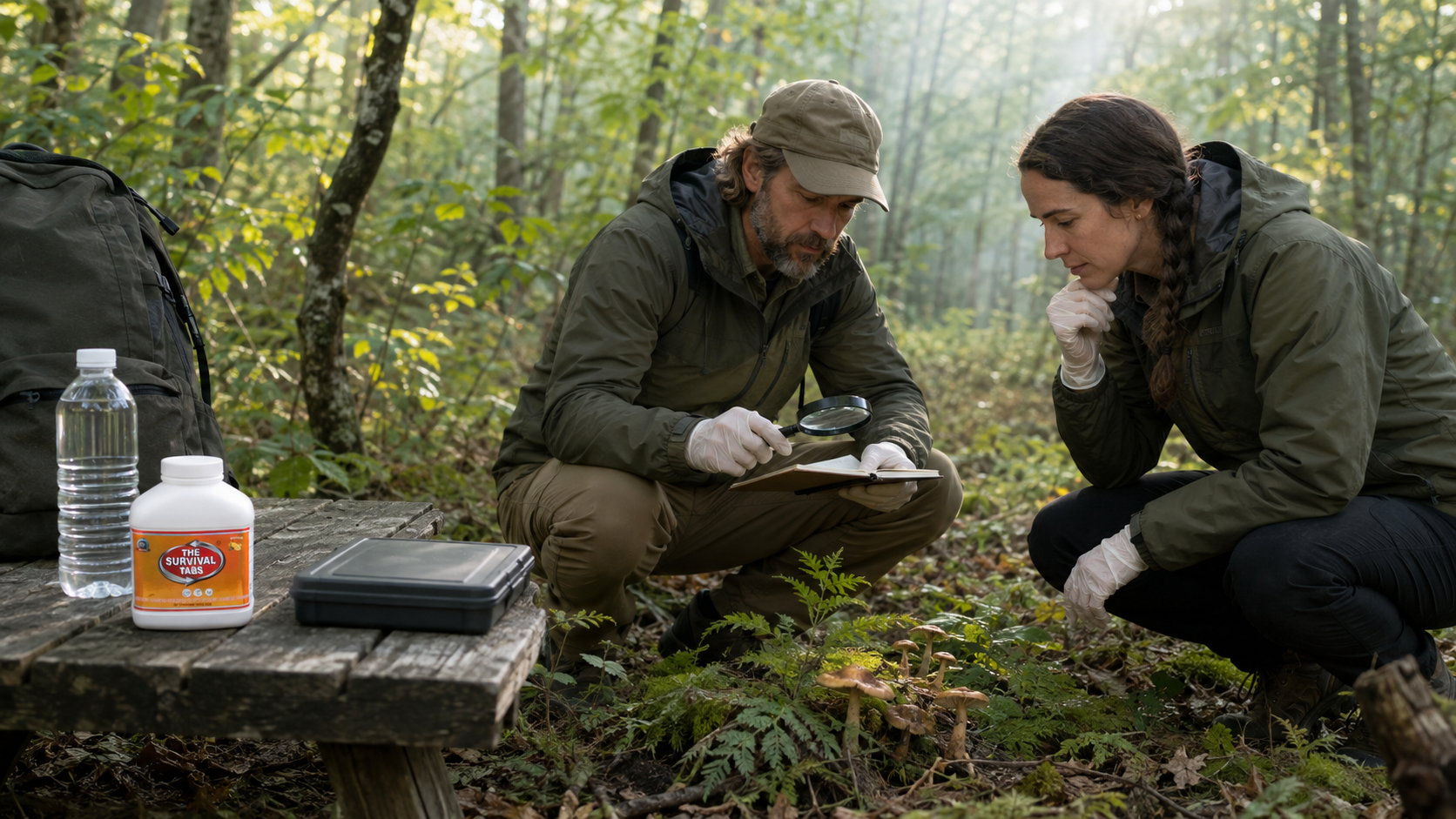
How to reduce poisoning, legal, contamination, and environmental risks when gathering wild plants and mushrooms
Foraging can be educational and meaningful, but it is not a dependable shortcut to emergency food. A wrong identification, contaminated site, unlawful harvest, or unsafe medical claim can cause severe harm.
This guide is designed to prevent harm. It does not identify edible species, diagnose poisoning, prescribe treatment, or certify any wild item as safe.
The Safety Standard
Do not eat, serve, preserve, sell, or use a wild plant or mushroom as medicine unless its identity and intended use have been confirmed in person by a qualified local expert and the harvest is legal.
Photographs, phone apps, social-media posts, AI tools, folk names, taste, smell, animal behavior, and a single field guide are not sufficient proof of edibility.
Non-negotiable stop rules
* Do not consume an item when any uncertainty remains.
* Do not use a universal edibility test. No reliable universal test exists.
* Do not assume cooking, soaking, drying, freezing, fermenting, or peeling removes natural toxins.
* Do not eat a wild mushroom based only on a photograph or app result.
* Do not give a foraged item to a child, pregnant person, older adult, or medically vulnerable person without appropriate professional guidance.
* Do not use wild plants or mushrooms to treat, prevent, or cure a medical condition.
* Do not harvest where collection is prohibited or permission is unclear.
* Do not harvest beside polluted water, treated lawns, industrial sites, dumps, busy roads, rail corridors, or recently sprayed areas.
* Do not rely on foraging as the primary food plan during an evacuation or disaster.
What this guide covers
* How to decide whether a foraging activity should proceed.
* How to choose qualified local instruction.
* How to check access, permits, protected species, and harvest limits.
* How to screen sites for contamination and physical hazards.
* How to separate, label, transport, clean, store, and discard gathered material.
* How to protect children, pets, and people with higher medical risk.
* How to respond to suspected poisoning.
* How to reduce ecological damage and respect Indigenous and local stewardship.
Why Foraging Risk Is Different
Edible species can resemble toxic species. Resemblance may change with age, weather, region, growth stage, season, or which plant part is examined.
A name learned in one country may refer to a different organism elsewhere. CDC travel guidance warns that edible species in one place can have deadly look-alikes in another.
Some toxins cause early stomach symptoms. Others may initially appear mild and later injure the liver, kidneys, nervous system, or heart.
Natural Does Not Mean Safe
* Natural toxins may remain after cooking.
* Edible parts and toxic parts can occur on the same plant.
* Correct identification does not eliminate allergy, intolerance, drug-interaction, or illness risk.
* Wild foods can carry dirt, fecal contamination, parasites, or harmful microorganisms.
* Plants can absorb or retain contaminants from soil, water, or spray drift.
* Traditional use is not proof of safety for every person, dose, preparation, or condition.
Emergency Conditions Increase Mistakes
* Hunger and scarcity can encourage risk-taking.
* Stress and fatigue reduce attention.
* Storm damage may expose contaminated soil or sewage.
* Floodwater can contaminate plants and mushrooms.
* Power loss can make refrigeration and food handling difficult.
* Closed roads and overloaded medical services can delay treatment.
* Unfamiliar evacuation locations increase identification and legal uncertainty.
Choose Qualified Guidance
* Training is local to the region and habitat.
* Instruction includes poisonous look-alikes and uncertainty, not only desirable species.
* Identification uses multiple physical features and context.
* The teacher is willing to say do not eat this.
* Legal access and conservation rules are part of the lesson.
* Food-safety and poisoning response are discussed.
* Commercial or medicinal claims are separated from identification education.
Safer Learning Sequence
* Begin with observation only.
* Join an in-person walk led by a reputable local botanical, mycological, Cooperative Extension, tribal, university, or land-management organization.
* Learn applicable laws before collecting.
* Practice documenting specimens without eating them.
* Have each intended food item confirmed in person by a qualified expert.
* Keep unknown items physically separate from food.
* Stop when local conditions or rules change.
Limits of Digital Tools
* Apps can suggest candidates, but they cannot certify edibility.
* One photograph may omit important structures, habitat, or changes.
* Image results can be confidently wrong.
* Remote comments do not replace physical examination.
* AI-generated descriptions must never be treated as permission to eat or medicate with a specimen.
Legal and Access Checks
* Identify the landowner or managing agency.
* Obtain permission from private landowners.
* Check the current compendium, forest order, permit page, or local rule.
* Confirm whether personal-use collection is allowed.
* Confirm species, quantity, season, tool, and area limits.
* Check whether sale, barter, or gifting changes permit requirements.
* Check protected-species and habitat restrictions.
* Respect closures, tribal rights, cultural sites, research plots, restoration areas, and private leases.
* Carry any required permit and harvest-area map.
* Recheck rules on the day of collection.
Permission and Stewardship
USDA guidance emphasizes asking permission and giving back. Responsible practice recognizes living cultural traditions, local knowledge, and ecological relationships.
Do not publish sensitive locations, enter culturally restricted areas, or use Indigenous knowledge commercially without appropriate permission.
Reject a Site When
* Ownership or permission is unclear.
* The area is closed, protected, or under restoration.
* There is evidence of pesticide, herbicide, rodenticide, or other chemical treatment.
* The site is near industrial activity, mining waste, dumping, sewage, or contaminated sediment.
* Plants are in flood-affected soil or beside potentially contaminated water.
* The site is beside heavy traffic, rail infrastructure, treated utility corridors, or heavily used pet areas.
* There are unstable slopes, wildfire damage, falling limbs, severe weather, or unsafe access.
* Local wildlife, hunting, fire, or navigation hazards cannot be managed.
* Emergency access is inadequate for the group’s risk level.
Urban Foraging Cautions
* Confirm land ownership and collection rules.
* Treat roadside and vacant-lot contamination as unknown without credible site information.
* Avoid building runoff, dog-walking areas, pesticide treatment, and illegal dumping.
* Do not enter abandoned property, cross rail lines, climb structures, or interfere with utilities.
* Public access does not mean permission to harvest.
Identification Without False Confidence
This article intentionally provides no species descriptions. Safe identification is regional, specimen-specific, and best learned through supervised field practice.
Document location, date, habitat, recent weather, growth pattern, size, substrate, nearby species, and multiple clear views for a qualified expert.
Keep lawful samples separate and labeled. Never taste an unknown specimen.
Never Use These as Proof
* An animal ate it.
* It smells or tastes good.
* It looks like a photograph.
* An app returned high confidence.
* A relative used the same common name.
* Cooking destroys every toxin.
* Only brightly colored species are poisonous.
* Anything growing in a yard is safe.
Mushroom-Specific Boundaries
* Do not consume a wild mushroom without in-person confirmation by a qualified local expert.
* Keep uncertain specimens separate so fragments and spores do not mix with food.
* Do not serve wild mushrooms when any identification or handling uncertainty remains.
* Do not assume previous consumption prevents a future reaction.
* Do not consume raw wild mushrooms.
* Do not assume heat neutralizes all toxins.
* Do not use mushrooms as medical treatment.
* Do not gather where rules prohibit it.
* Treat illness after wild-mushroom consumption as potentially urgent.
Commercial and Shared Meals
Selling or serving wild mushrooms can trigger food-code, licensing, traceability, and approved-source requirements.
A personal-use permit may not allow sale, barter, restaurant service, or distribution.
Consult the health department, land manager, and qualified legal or regulatory professional before commercial use.
Children
* Teach children never to taste a plant, berry, or mushroom without an authorized adult.
* Supervise closely in yards, parks, campsites, and trails.
* Do not use games that reward tasting unknown items.
* Store specimens, baskets, tools, and prepared foods out of reach.
* Keep the Poison Help number available in the United States.
Pets
* Prevent pets from eating mushrooms, berries, compost, or discarded specimens.
* Use a leash or close control in high-risk areas.
* Keep collected items and waste inaccessible.
* Contact a veterinarian or animal poison service promptly after suspected exposure.
* Do not give human remedies to an animal unless directed by a veterinarian.
People Who May Need Stricter Limits
* Pregnant or breastfeeding people.
* Infants and young children.
* Older adults.
* People with liver, kidney, immune, gastrointestinal, or metabolic conditions.
* People taking prescription medicines or supplements.
* People with food allergies or prior severe reactions.
* Anyone unable to reliably describe symptoms or exposure.
* The safest choice for higher-risk people may be to avoid wild foods unless a clinician and qualified local expert address the situation.
Low-Impact Harvesting
* Take only what is lawful and needed.
* Leave enough for wildlife, reproduction, and other people.
* Do not harvest rare, threatened, culturally sensitive, or uncertain species.
* Avoid digging roots or disturbing soil unless explicitly permitted.
* Do not rake forest litter or damage fungal networks.
* Use clean tools and minimize trampling.
* Spread activity instead of stripping one patch.
* Do not collect every mature specimen.
* Pack out waste.
* Follow current land-manager directions.
Records for Accountability
* Land manager and permission contact.
* Permit number and expiration date.
* Approved area and map.
* Date and conditions.
* Identifier’s name and confirmation method.
* Quantity gathered and intended use.
* Storage and preparation time.
* People who consumed the item.
* Symptoms or discarded batch.
Field Handling
* Use clean, food-safe containers.
* Keep each confirmed type separate.
* Keep unknown specimens completely separate from food.
* Label containers immediately.
* Protect samples from heat, crushing, chemicals, and pets.
* Do not mix a questionable item into a larger batch.
* Wash hands after handling unknown items.
* Clean tools and surfaces before contact with other food.
At-Home Handling
* Reconfirm identity before preparation.
* Discard uncertain, mixed, spoiled, or contaminated material.
* Wash produce under clean running water when appropriate.
* Do not wash produce with soap, bleach, or disinfectants.
* Prevent cross-contamination.
* Use clean cutting boards, knives, and containers.
* Follow safe cooking, cooling, and refrigeration practices.
* Label stored items with identity, source, date, and verifier.
* Do not preserve without a validated method.
* Discard doubtfully identified items where children and animals cannot retrieve them.
Medicinal Claims and Home Remedies
* Do not substitute a foraged product for prescribed medicine.
* Do not use a wild item to treat poisoning.
* Do not promise immune, energy, detoxification, pain, infection, cancer, or mental-health benefits.
* Do not apply unidentified plant material to wounds or skin.
* Do not give preparations to children or medically vulnerable people.
* Do not combine wild preparations with medication without clinician and pharmacist guidance.
* Do not sell medicinal products without understanding applicable law.
Suspected Poisoning: Act Fast
* In the United States, call Poison Help at 1-800-222-1222 immediately after suspected plant, berry, or mushroom ingestion. Do not wait for symptoms.
* If a person collapses, has trouble breathing, has a seizure, or cannot be awakened, call 911.
* Stop eating and remove the item from reach.
* Follow the poison specialist’s instructions.
* Do not induce vomiting unless directed.
* Do not give alcohol, milk, salt water, charcoal, herbs, or home remedies unless directed.
* Preserve remaining specimens, meals, packaging, and photographs safely.
* Record what was eaten, how much, when, source, preparation, and who else ate it.
* Do not let an affected person drive.
* Contact a veterinarian promptly for animal exposure.
Urgent Symptoms
* Trouble breathing, swelling, or severe allergic reaction.
* Seizure, confusion, extreme drowsiness, or loss of coordination.
* Persistent vomiting or diarrhea.
* Severe abdominal pain.
* Yellowing skin or eyes.
* Very little urine or severe dehydration.
* Abnormal heart rate, fainting, or chest symptoms.
* Symptoms that improve and then return.
* Any illness after wild-mushroom consumption.
* This list is not exhaustive. Poison specialists may recommend evaluation even without symptoms.
Foraging in an Emergency
* Use the household emergency-food plan first.
* Check official shelters, distribution sites, and community resources.
* Protect safe water and sanitation first.
* Use familiar, legally obtained food with known handling history.
* Consult authorities and qualified experts before considering wild food.
* Do not experiment with unknown plants or mushrooms under pressure.
Stop Emergency Foraging When
* There is flooding, wildfire, chemical release, or sewage contamination.
* No qualified local identifier is available.
* Legal permission is absent.
* Clean water is unavailable.
* Safe cooking, chilling, or storage is unavailable.
* Medical help is distant or unavailable.
* The group includes medically vulnerable people.
* Fatigue, darkness, severe weather, or poor navigation increases risk.
Group Activity: Before
* Name a responsible leader and qualified identifier.
* Check weather, wildfire, hunting, closure, and access conditions.
* Confirm permits and permissions.
* Set observation-only or collection boundaries.
* Share route, return time, and emergency contact.
* Carry water, navigation, communication, first aid, and suitable clothing.
* Brief participants on no-tasting, separation, child, pet, and stop rules.
* Arrange accessibility needs and a low-risk alternative.
Group Activity: During and After
* Stay within the approved area.
* Keep the group together or use check-ins.
* Do not pressure anyone to taste or collect.
* Label samples immediately.
* Stop for weather, injury, navigation, wildlife, or contamination concerns.
* Leave unknown, rare, damaged, or prohibited items in place.
* Clean hands, tools, footwear, and containers.
* Discard uncertain items safely.
* Report exposures promptly.
* Do not post sensitive locations or unsafe identification claims online.
Frequently Asked Questions
Can an app certify edibility?
No. It cannot certify identity, edibility, contamination status, legal permission, or individual medical safety.
Is there a universal edibility test?
No. Taste, skin contact, animal behavior, smell, color, and stepwise sampling cannot prove safety.
Does cooking make a poisonous mushroom safe?
No. Some toxins remain after cooking, and FDA notes that cooking does not guarantee safety for wild-type mushrooms.
Can I forage in a national park or forest?
Rules vary. Check the exact managing unit’s current rules, permits, maps, and limits.
Are untreated-yard plants safe?
Not automatically. Identity, soil history, runoff, pet waste, earlier treatment, allergens, and handling still matter.
Can children learn foraging?
They can learn observation, ecology, and never-taste rules. Consumption activities require exceptional caution and qualified local supervision.
Can I use wild plants as medicine?
This guide does not recommend it. Identity, dose, interactions, contamination, and medical claims require clinical and regulatory review.
Should I save a sample after suspected poisoning?
Yes, if safe. Keep remaining material, photos, and preparation details for professionals, and call promptly.
What if I feel fine after eating an unknown item?
Call Poison Help or the appropriate local poison center. Serious effects can be delayed.
Is foraging a good emergency-food strategy?
It is not a reliable primary strategy. Stored food, safe water, official assistance, and familiar food are safer foundations.
Professional Review Required Before Publication
* Regional botanist and mycologist review.
* Poison-control or medical toxicology review.
* Food-safety review.
* Land-management and conservation review.
* Accessibility review.
* Legal and regulatory review.
* Indigenous or tribal consultation where cultural knowledge, rights, or stewardship are discussed.
Official Sources
* CDC — Foraging safety and poisoning risks
* CDC Yellow Book — Poisonings during travel
* HRSA Poison Help — Plants and wild mushrooms
* FDA — Illnesses associated with morel mushrooms
* FDA — Selecting and serving produce safely
* USDA — Foraging and harvesting wild plants best practices
* U.S. Forest Service — Mushroom permits and restrictions
* National Park Service — Collecting plants and mushrooms
Source pages and local regulations can change. Recheck the responsible agency and local poison-center information before publication and before each activity.
Editorial note: This guide intentionally excludes edible-species lists, identification keys, medicinal recommendations, survival-foraging promises, preparation recipes, and claims that a remote tool can certify safety.