

Emergency Food Comparison Guide
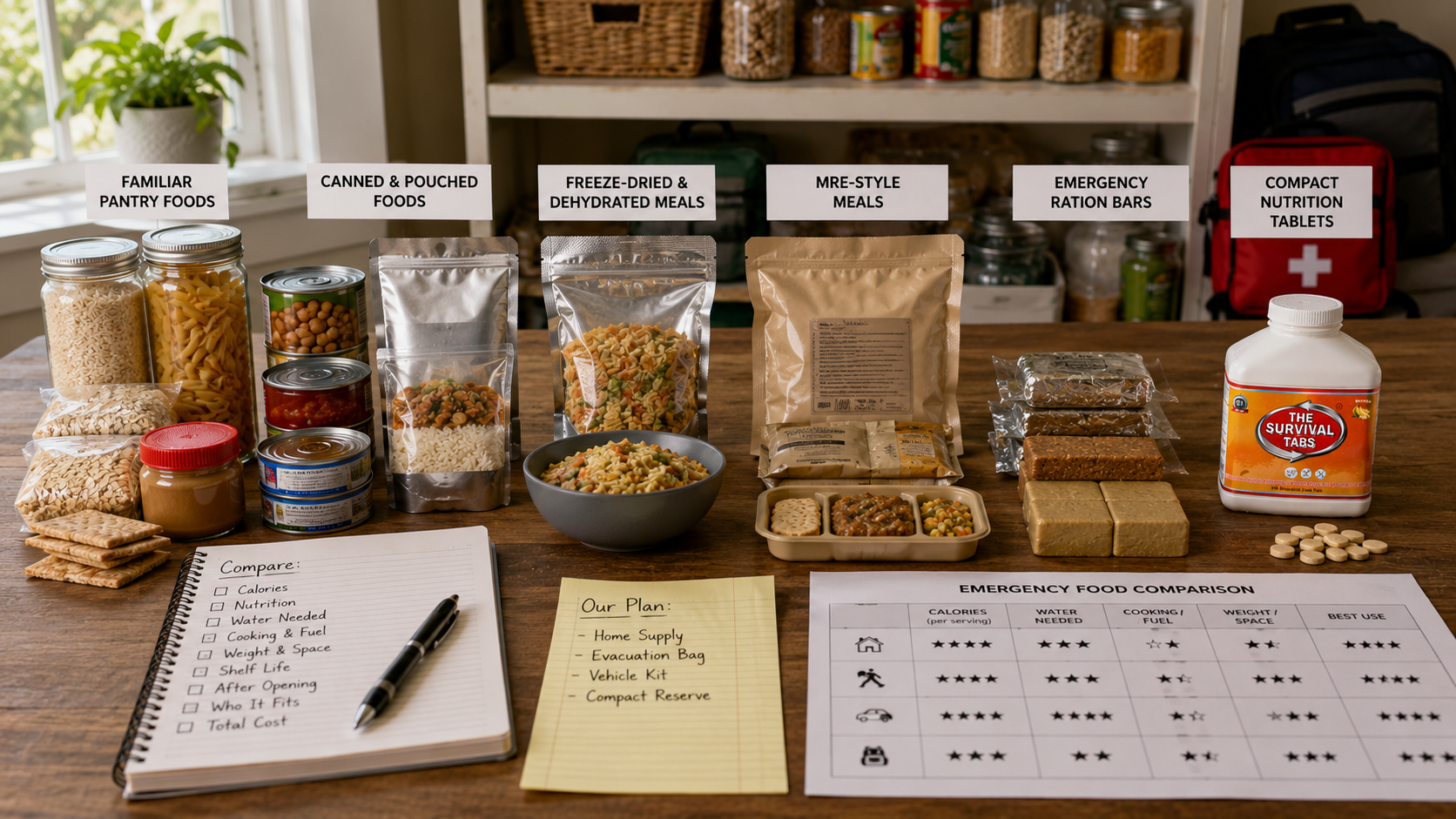
There is no single emergency food that is best for every household or every disruption. A food that works well in a home pantry may be too heavy for evacuation. A lightweight meal may require water and fuel that are unavailable. A compact ration may save space but provide far fewer calories than a conventional meal.
The most dependable approach is to compare foods by the job they must do, then combine several types. This guide evaluates six common categories without treating any one product as a complete answer.
QUICK ANSWER: WHICH TYPE DOES WHAT BEST?
- Familiar pantry foods: usually best for routine rotation, family acceptance, and building a home supply gradually.
- Canned and pouched foods: strong for ready-to-eat home use, but cans can be heavy and opened leftovers may need refrigeration.
- Freeze-dried and dehydrated meals: useful when low weight and long storage matter, but many require safe water, preparation time, and sometimes fuel.
- MRE-style meals: self-contained, calorie-dense, and generally ready to eat, but bulkier and heavier than compact rations.
- Emergency ration bars: compact sources of calories with little preparation, but nutrition, allergens, taste, and serving claims vary by product.
- Compact nutrition tablets: especially useful where space, weight, and no-cook access matter, but they should not be mistaken for a full-calorie daily food plan.
For most households, the strongest plan is a layered mix: familiar foods for the main supply, ready-to-eat foods for outages and evacuation, and compact reserve food for locations where normal meals do not fit.
THE NINE QUESTIONS TO ASK BEFORE BUYING
1. How many usable calories are in a realistic serving?
Compare calories per package, calories per stated serving, and calories per day. Marketing terms such as “meal,” “day,” or “serving” are not interchangeable. Confirm how much food a person would actually eat and whether the package count matches the household plan.
2. What nutrition does it provide?
Calories matter, but so do protein, fat, carbohydrate, fiber, vitamins, minerals, sodium, and dietary variety. A product can be rich in micronutrients but low in energy, or high in calories but limited in micronutrients. Read the current Nutrition Facts label.
3. Does it require water?
Water needed for rehydration or cooking must be added to drinking and sanitation needs. Dry foods can look efficient on a shelf while creating a large hidden water requirement during an outage.
4. Does it require cooking, fuel, or equipment?
Count the stove, fuel, ventilation, cookware, utensils, cleanup, and time needed to turn stored ingredients into food. Ready.gov recommends including foods that require no refrigeration, cooking, water, or special preparation.
5. How much space and weight does it add?
Home storage, vehicle kits, evacuation bags, boats, aircraft, and workplace drawers have different limits. Compare the full package, not only the food inside it.
6. What does the shelf-life statement actually mean?
Shelf life depends on the product, packaging, storage temperature, and manufacturer instructions. A printed date is not permission to ignore heat, moisture, pests, broken seals, or damaged containers. Hot storage can shorten useful life.
7. What happens after opening?
Large containers can be economical but difficult to protect once opened. Check resealing instructions, serving size, moisture exposure, allergen labeling, and whether leftovers require refrigeration.
8. Does it fit the people who may need it?
Check allergies, religious requirements, medical diets, vegan or vegetarian needs, swallowing ability, age, appetite, and food preferences. Infants, pets, and people with medical nutrition needs require dedicated supplies.
9. What is the practical total cost?
Compare cost per usable calorie, cost per day at a realistic intake, required water and fuel, storage containers, rotation losses, shipping, and likely waste. Price per package alone can be misleading.
CATEGORY-BY-CATEGORY COMPARISON
Familiar shelf-stable pantry foods
Examples include rice, oats, pasta, beans, nut or seed butter, crackers, cereal, shelf-stable milk, dried fruit, cooking oil, and foods the household already eats.
- Strengths: flexible, familiar, easy to rotate, widely available, and often economical.
- Tradeoffs: some foods require significant water, fuel, cooking time, or a manual can opener; a balanced plan takes multiple items.
- Best fit: home supplies, gradual budget building, and households that want normal meals during longer disruptions.
Canned and pouched ready-to-eat foods
Examples include canned beans, meat, fish, fruit, vegetables, soup, and shelf-stable pouches.
- Strengths: many products can be eaten without cooking; sealed containers protect food and labels provide ingredient and allergen information.
- Tradeoffs: cans are heavy, can be damaged, and opened food may need refrigeration. Sodium and serving sizes vary.
- Best fit: short home outages, shelter-in-place supplies, and a first layer that works when cooking is unavailable.
Freeze-dried and dehydrated foods
These products remove much of the water before packaging. They can be lightweight and space-efficient relative to prepared meals, but the water generally must be added back.
- Strengths: low carrying weight, compact dry storage, and a broad range of meal formats.
- Tradeoffs: safe water is essential; some products need hot water, waiting time, cookware, or fuel. Calories and package “servings” must be checked carefully.
- Best fit: planned home reserves with water and cooking capacity, hiking, and evacuation situations where carrying weight matters.
MREs and commercial MRE-style meals
A U.S. military MRE is a specific operational ration, not a generic name for every shelf-stable meal. The Defense Logistics Agency states that one current military MRE averages about 1,250 kilocalories, is ready to eat except for beverages, and has a three-year shelf life at 80°F. Civilian products labeled “MRE-style” can differ substantially.
- Strengths: self-contained components, substantial calories, no cooking required for most food components, and optional heating.
- Tradeoffs: heavier and bulkier than bars or tablets; menus, sodium, allergens, storage history, and shelf life require review.
- Best fit: vehicle or home supplies, field work, and situations where a complete packaged meal is more important than minimum size.
Emergency ration bars
Ration bars are designed to put concentrated calories into a compact package. Formulas and serving systems vary, so compare the actual label rather than assuming every bar performs the same way.
- Strengths: compact, portable, ready to eat, and usually simple to divide into portions.
- Tradeoffs: limited menu variety, possible allergen concerns, texture or thirst considerations, and variable micronutrient coverage.
- Best fit: evacuation bags, vehicles, marine kits, workplace kits, and short interruptions when cooking is not practical.
The Survival Tabs and other compact nutrition tablets
The current Survival Tabs product information identifies 12 tablets as a serving providing 240 calories, 12 grams of fat, 30 grams of carbohydrate, 4 grams of protein, and 100% of the listed daily value for 15 essential vitamins and minerals. The current product line is described as gluten-free and non-GMO, and the label includes milk ingredients, so it is not dairy-free or vegan.
The company states a 25-year shelf life for unopened product when stored according to its guidance. Buyers should confirm the current package label, ingredients, serving information, lot details, and storage instructions at the time of purchase.
- Strengths: very compact, lightweight, chewable, requires no cooking or added water for preparation, and provides defined micronutrients.
- Tradeoffs: 240 calories per 12-tablet serving is far below the normal daily energy requirement of most adults; it is not a substitute for water, medical care, or a balanced long-term food supply.
- Best fit: compact reserve nutrition in go-bags, vehicles, desk drawers, small apartments, boats, aircraft kits, and other spaces where a normal meal is difficult to store.
SURVIVAL TABS VS. MREs
These products solve different problems. A military MRE is a complete operational meal with roughly 1,250 calories on average. A 12-tablet serving of The Survival Tabs provides 240 calories and listed vitamins and minerals in a much smaller format.
- Choose an MRE-style meal when substantial calories, familiar food components, and a self-contained meal matter more than minimum size and weight.
- Choose compact nutrition tablets when the main constraint is storage space, carrying weight, or no-cook access—and pair them with other calorie sources whenever possible.
- Use both when a layered kit can accommodate them: complete meals for primary feeding and compact tablets as a backup layer.
Do not compare the two only by package count or advertised “days.” Compare total calories, nutrition, storage history, weight, volume, allergens, water, preparation, and the number of people served.
SURVIVAL TABS VS. FREEZE-DRIED MEALS
Freeze-dried meals generally offer a more meal-like experience and may provide more calories per prepared portion. The tradeoff is dependence on safe water and, for many products, hot water or fuel. The Survival Tabs require no water for preparation and occupy little space, but provide much less energy than a typical meal.
- Freeze-dried meals are usually stronger when water, preparation capacity, and meal satisfaction are available.
- Compact tablets are usually stronger when water and cooking cannot be assumed or every ounce and cubic inch matters.
- A combined plan can use freeze-dried food for planned meals and compact tablets for delays, transit, or backup.
SURVIVAL TABS VS. ORDINARY PANTRY FOOD
Ordinary shelf-stable food is usually the foundation of a household supply because it can provide familiar meals, broader nutrition, and routine rotation. Compact tablets are easier to store in small or mobile kits but should not displace the household’s main calorie supply.
- Use pantry foods for the primary home reserve.
- Use compact reserve food where pantry meals are difficult to carry, cook, or store.
- Review both together so a long shelf-life product does not create a false sense that water, calories, dietary variety, and household-specific needs are fully covered.
HOW TO BUILD A BALANCED EMERGENCY FOOD SYSTEM
Layer 1: immediate no-cook food
Keep food that can be eaten safely when power, water, or cooking is unavailable. Include familiar ready-to-eat items, a manual can opener where needed, and portions that can be finished after opening.
Layer 2: familiar home meals
Build a larger supply from shelf-stable foods the household already uses. Rotate them through normal meals and replace what is consumed.
Layer 3: longer-storage specialty foods
Add freeze-dried meals, dehydrated ingredients, purpose-made rations, or other specialty foods only after water, fuel, storage, serving sizes, and dietary fit are understood.
Layer 4: compact reserve nutrition
Place bars, tablets, or other compact food in go-bags, vehicles, workplace kits, and small backup caches. Treat this as resilience against delay or loss of access, not permission to under-plan calories.
Layer 5: special-needs supplies
Store infant formula, allergy-safe food, medically necessary nutrition, pet food, and other items that general emergency products cannot replace.
A SIMPLE PURCHASE CHECKLIST
- Read the Nutrition Facts and ingredient labels.
- Calculate total calories, not just servings or advertised days.
- Confirm water, fuel, cookware, and preparation time.
- Compare package weight and storage volume.
- Check unopened and opened-package storage instructions.
- Verify allergens and household dietary needs.
- Confirm the manufacturer’s current shelf-life statement and storage conditions.
- Calculate practical cost per usable calorie or person-day.
- Buy a small amount first and test taste, preparation, and digestion before relying on it.
- Review the supply at least twice a year and after heat, moisture, flood, pest, or packaging damage.
COMMON COMPARISON MISTAKES
- Calling a product “best” without defining the scenario.
- Comparing package counts instead of calories and realistic portions.
- Treating vitamins and minerals as a replacement for adequate calories.
- Ignoring the water and fuel needed to prepare dry food.
- Assuming every civilian “MRE” matches U.S. military MRE specifications.
- Using shelf life as the only measure of value.
- Storing emergency food in a hot vehicle without accounting for temperature exposure.
- Buying a long-duration supply before testing taste, allergens, and preparation.
- Relying on one food type for every emergency.
FREQUENTLY ASKED QUESTIONS
Are The Survival Tabs better than MREs?
Not in every situation. MREs provide a much larger meal and more calories; The Survival Tabs use much less space and require no preparation. The better choice depends on whether calories, portability, storage volume, or meal completeness is the limiting factor.
Can The Survival Tabs replace normal meals for a long emergency?
They should not be treated as a complete long-term meal plan. A 12-tablet serving provides 240 calories, which is far below the usual daily energy needs of most adults. Use them as one layer alongside safe water and additional food.
Are freeze-dried meals always the best long-term option?
No. They can store efficiently and carry well, but they may require substantial safe water, preparation, and fuel. Pantry foods, canned foods, ready-to-eat meals, and compact rations can fill different roles.
What should I compare first?
Start with realistic calories, safe water, no-cook access, dietary fit, and the emergency you are preparing for. Shelf life and price matter only after the food can actually be used safely.
Should I include more than one type of emergency food?
Yes. A mixed supply is more resilient because it can support sheltering at home, evacuation, power loss, limited water, and different household needs.
FINAL TAKEAWAY
Emergency food should be chosen as a system, not a contest. Familiar pantry foods, canned foods, freeze-dried meals, MRE-style meals, ration bars, and compact nutrition tablets each have useful roles and real limitations.
Build the main calorie supply from foods your household can safely use. Add no-cook food for utility loss, lightweight options for movement, and compact reserve nutrition where ordinary meals do not fit. Verify every current label and storage instruction, then maintain the plan over time.
SOURCES
USDA Food Safety and Inspection Service — Shelf-Stable Food Safety
Defense Logistics Agency — Meal, Ready-to-Eat (MRE)