

Complete Guide to Emergency Water
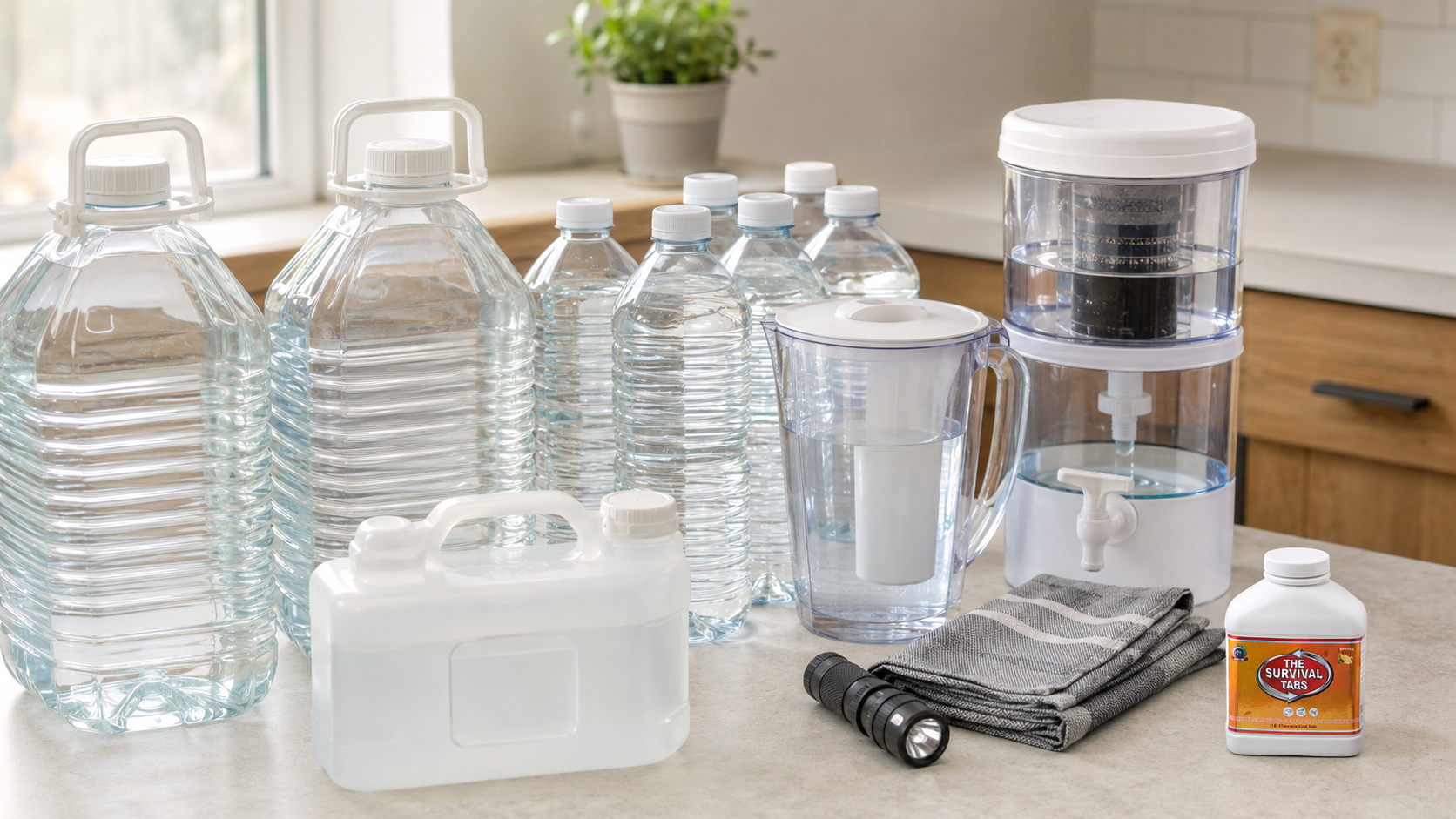
How to plan, store, protect, treat, use, and restore a household water supply before, during, and after an emergency.
Survival Tabs Knowledge Center | ST-KC-044
The central rule
Safe water is a household system, not a single filter or container.
Your plan should combine stored water, trusted alerts, backup sources, appropriate treatment, clean containers, sanitation controls, and periodic maintenance.
Water that looks clear can still contain disease-causing germs or hazardous chemicals.
No household treatment method solves every contamination problem.
During an official advisory, follow the instructions from the water utility, public-health department, or emergency-management agency even if they differ from your normal plan.
What this guide covers
* Household drinking-water storage
* Water needs for drinking, food preparation, hygiene, sanitation, pets, and medical care
* Safe containers and storage locations
* Advisories and source decisions
* Boiling, filtration, and chemical disinfection boundaries
* Chemical, radiological, flood, and saltwater contamination limits
* Private wells and building plumbing
* Accessibility and household-specific needs
* Rotation, inspection, outage response, and recovery
What this guide does not teach
* Homemade water-filter construction
* Homemade activated charcoal
* Improvised desalination
* Solar-still or atmospheric-water guarantees
* Nanotechnology or speculative purification systems
* Brand rankings or unsupported performance comparisons
* Private-well shock chlorination without qualified guidance
* Plumbing alterations or cross-connection work
* Medical treatment for dehydration or waterborne illness
1. Start with household water needs
Ready.gov advises storing at least one gallon of water per person per day for several days, for drinking and sanitation.
One gallon is a planning baseline, not a promise that every person or household will have enough.
Hot weather, pregnancy, nursing, illness, physical work, high altitude, and some medications can increase needs.
Children, older adults, and people with disabilities may need additional planning support.
Pets and service animals need their own safe-water allocation.
Food preparation may require water beyond what a package label makes obvious.
Cleaning feeding equipment, medical equipment, or reusable hygiene items may require additional safe water.
Do not reduce drinking water below safe needs merely to preserve a target number of storage days.
Ask a clinician or pharmacist about water requirements connected to a medical condition, medication, dialysis, enteral feeding, or other device.
Build the plan from actual household uses, not from a universal online calculator.
2. Create a simple water budget
Use a written household calculation so everyone understands the assumptions.
* Count residents who may be present during an emergency.
* Add likely guests, caregivers, or relatives if your plan includes them.
* Add pets and service animals.
* Choose the number of days appropriate to local hazards and available space.
* Separate drinking and food-preparation water from sanitation water.
* Add a reserve for spills, heat, delayed restoration, and damaged containers.
* Note any medical or accessibility-related requirements.
* Record where every container is stored.
* Review the calculation whenever the household changes.
Treat the budget as a minimum planning tool, not permission to ration dangerously.
3. Use safe containers
Commercially bottled water is a convenient emergency option when stored according to the label.
For water you fill yourself, use food-grade water-storage containers intended for drinking water.
Do not use containers that previously held chemicals, fuel, pesticides, cleaners, or other hazardous materials.
Do not assume a container is safe merely because it looks clean.
Choose containers that household members can lift, open, pour, and close safely.
Smaller containers reduce lifting strain and limit the loss if one leaks.
Larger containers can increase capacity but need a stable location and a safe dispensing method.
Keep lids and openings clean.
Use clean hands and utensils when filling or dispensing.
Do not dip cups, hands, or contaminated tools into stored water.
Label each container with the fill date and its intended use.
Keep drinking water clearly separate from non-potable water.
4. Choose storage locations carefully
Store water in a cool location away from direct sunlight when practical.
Protect containers from freezing, excessive heat, puncture, impact, pests, and chemicals.
Do not block exits, stairs, electrical panels, fire equipment, or access routes.
Remember that water is heavy; confirm shelves and floors can safely support the load.
Place heavy containers low to reduce falling and lifting hazards.
Use secondary containment where a leak could damage property.
Keep at least part of the supply where it remains reachable during a power outage.
Divide the supply among more than one location when possible.
Keep an evacuation-ready portion near other go-kit supplies without creating a trip hazard.
Do not store all water in a garage, vehicle, attic, or other space with severe temperature swings.
Households in small spaces can use modular containers distributed across safe, documented zones.
5. Protect quality through rotation
Follow manufacturer instructions and local public-health guidance for storage and replacement.
Inspect containers on a regular schedule.
* Check for leaks, swelling, cracks, damaged seals, odors, cloudiness, or contamination.
* Confirm labels and dates remain readable.
* Wipe dust from the exterior without contaminating openings.
* Verify caps and dispensing equipment are clean and functional.
* Replace questionable containers rather than tasting the water to test it.
* Update the household inventory after using or replacing water.
Use a calendar reminder instead of relying on memory.
Do not claim that self-filled water remains safe indefinitely.
After opening a container, protect it from hands, cups, pests, and dirty surfaces.
6. Know the three main advisory types
A boil-water advisory addresses germs that can often be controlled by boiling or another method specified by authorities.
A do-not-drink advisory may involve chemicals, toxins, or other hazards that boiling does not remove.
A do-not-use advisory means the water should not be used for drinking, cooking, bathing, cleaning, or other contact unless authorities give specific exceptions.
Do not treat these notices as interchangeable.
Read the exact advisory, geographic area, start time, and affected uses.
Check whether the advisory applies to ice, coffee makers, refrigerators, fountains, filters, and building tanks.
Use official utility, health-department, or emergency-management channels.
Save alerts offline when internet or power may fail.
Continue following the advisory until the issuing authority says it has ended.
After cancellation, follow flushing, filter replacement, ice disposal, or appliance-cleaning instructions.
7. Choose the safest available source
Use commercially bottled water or properly stored emergency water first when authorities recommend it.
Use an unaffected public supply only when its safety is confirmed.
Water from a private well may be unsafe after flooding, loss of pressure, structural damage, or nearby chemical release.
Surface water can contain germs, chemicals, animal waste, sewage, and other hazards even when it looks clean.
Floodwater is not a drinking-water source.
Pool, spa, radiator, boiler, and waterbed water are not automatically safe to drink.
Salt water cannot be made safe by ordinary boiling or common camping filters.
Water from an unknown industrial or agricultural area should not be used without authoritative confirmation.
If chemical or radiological contamination is suspected, use another source and follow official instructions.
When uncertain, prioritize a known safe source over experimenting with treatment.
8. Understand treatment as a sequence
Emergency water treatment begins with identifying the hazard and choosing an appropriate source.
Settling or prefiltering cloudy water may improve later treatment but does not make the water safe by itself.
Boiling can kill disease-causing germs but does not remove chemicals, salts, or radioactive material.
Many portable filters remove some parasites and sediment but may not remove viruses or bacteria.
Chemical disinfectants have organism-specific limits and require the correct product, dose, contact time, temperature, and water conditions.
Combining filtration and disinfection may be appropriate when official guidance and product instructions support it.
A device label is more reliable than general claims about pore size or appearance.
No treatment step should be skipped merely because the water tastes or smells normal.
Do not use improvised test methods to declare water potable.
When public authorities say bottled water only, do not substitute a home treatment system.
9. Boiling water safely
CDC guidance identifies boiling as the best way to kill germs in emergency water when boiling is appropriate for the hazard.
Bring clear water to a rolling boil for one minute.
At high elevations, follow current CDC or local instructions for a longer boiling time.
If water is cloudy, allow it to settle and filter it through a clean material before boiling as directed by official guidance.
Let boiled water cool naturally in a clean, covered container.
Prevent burns by keeping hot water and unstable pots away from children, pets, and crowded walkways.
Use safe ventilation and approved cooking equipment.
Never use grills, charcoal devices, camp stoves, or generators indoors or in enclosed spaces.
Boiling does not remove fuel, pesticides, heavy metals, salt, toxins, or radioactive contamination.
Do not repeatedly boil water in an attempt to remove chemical contaminants.
Under a do-not-drink or do-not-use advisory, follow the advisory instead of defaulting to boiling.
10. Use filters within their limits
Match the filter to the contaminants and organisms of concern.
Read the manufacturer’s instructions before the emergency.
Check certifications, replacement intervals, flow limits, storage conditions, and temperature limits.
Confirm whether the device addresses parasites, bacteria, viruses, chemicals, or only taste and sediment.
Most pitcher and refrigerator filters are not substitutes for a boil-water advisory.
A filter used on contaminated water may require cleaning, disinfection, or replacement after the advisory.
Never assume visible clarity proves effective treatment.
Do not extend cartridge life beyond instructions to conserve supplies.
Protect the clean outlet, hose, and container from contact with untreated water.
Keep untreated and treated containers physically separated and clearly labeled.
When CDC guidance calls for filtering and then disinfecting, complete both steps.
11. Chemical disinfection requires exact instructions
Use only products and concentrations specifically supported by current public-health instructions.
Follow the issuing authority or product label for dose, water volume, contact time, temperature, and limitations.
Do not use scented, splashless, color-safe, gel, or mixed cleaning products unless official instructions explicitly identify them as suitable.
Never mix bleach with ammonia, acids, vinegar, alcohol, or other cleaners.
Do not estimate container volume by sight.
Use a clean measuring device reserved for the task.
Chemical disinfection may not kill every parasite and does not remove chemical contamination.
Iodine products may be unsuitable for some people and for extended use; follow medical and product guidance.
Do not give universal drop-count formulas without knowing the product concentration and current official guidance.
Store treatment chemicals securely away from children, pets, food, and drinking-water openings.
If exposure or poisoning is suspected, contact emergency services or Poison Control as appropriate.
12. Chemical and radiological contamination
Boiling may concentrate some chemicals because water evaporates while contaminants remain.
Ordinary filters may not remove dissolved chemicals, salt, or radioactive material.
Odor, color, and taste cannot reliably identify all hazardous contamination.
Do not use floodwater or water near spills, fire runoff, damaged fuel systems, farms, mines, or industrial sites unless authorities confirm it is safe.
Do not improvise activated carbon from campfire charcoal.
Do not depend on homemade stills, solar devices, or fabric layers for chemical removal.
Follow public-health instructions about bottled water, evacuation, contact avoidance, and disposal.
Keep advisory messages and receipts when they may be needed for recovery or reimbursement.
Report unusual water conditions through the local utility or public-health channel.
Seek medical advice for suspected exposure or symptoms.
13. Private wells after emergencies
Flooding, power loss, damaged wellheads, and loss of pressure can compromise a private well.
Do not drink from a flooded or damaged well until it has been assessed and tested as directed by local authorities.
Use bottled water or another confirmed safe source while the well is under evaluation.
Keep people away from exposed wiring, damaged pumps, unstable covers, and contaminated standing water.
Do not perform electrical or confined-space work around a well.
Well disinfection procedures depend on the well design, water chemistry, contamination, and local requirements.
Use a licensed well contractor, qualified water professional, or health department when needed.
Testing should use an appropriate laboratory and the timing specified by authorities.
Boiling can address germs but not chemical contamination.
Retain test results and service records with household emergency documents.
14. Use water safely during an outage
Assign drinking-quality water to drinking, oral medication, infant formula, food preparation, brushing teeth, and other uses specified by authorities.
Follow medical guidance for wound care, respiratory devices, dialysis, feeding equipment, or immune-compromised household members.
Use disposable items strategically when they reduce unsafe washing demands.
Do not prepare food with unsafe water.
Discard ice made during the contamination period when authorities direct.
Disable or label affected water dispensers so household members do not use them accidentally.
Keep treated water covered and dispense it without dipping.
Use hand sanitizer only when hands are not visibly dirty and public-health guidance supports it.
Manage toilets and waste according to local sanitation instructions.
Never connect a non-potable source to household plumbing without approved backflow protection and qualified work.
15. Prevent cross-contamination
Create a clear untreated-water zone and a separate treated-water zone.
Use different containers, utensils, and labels.
Wash or disinfect hands before handling clean equipment.
Do not place clean caps on dirty surfaces.
Pour rather than dip whenever possible.
Keep pets away from treatment and storage areas.
Clean spills promptly so floors do not become slip hazards.
Do not return unused water to the clean container.
Keep treatment records when multiple batches are prepared.
Discard any batch whose source, treatment, or handling cannot be verified.
16. Accessibility and household-specific planning
Place essential water where every household member or caregiver can reach it.
Provide manageable container sizes and dispensing aids.
Use large-print, tactile, color-contrast, or multilingual labels as needed.
Keep written and audio instructions available offline.
Plan for power-dependent pumps, lifts, refrigeration, and medical devices.
Coordinate with caregivers, neighbors, building management, and emergency services before an outage.
Include water in evacuation transport planning without overloading mobility devices or vehicles.
Keep service-animal water and bowls with the animal’s go kit.
Ask household members what barriers they expect rather than making assumptions.
Review the plan after any change in health, mobility, medication, or living arrangement.
17. Infants, children, older adults, and pets
Use water that meets public-health instructions for infant formula and feeding equipment.
Do not dilute formula or food to stretch supplies.
Prevent children from accessing treatment chemicals, hot water, open containers, or contaminated sources.
Watch for dehydration and illness; seek professional medical advice promptly for concerning symptoms.
Older adults may have reduced thirst awareness or medical fluid restrictions.
Never override a clinician-directed fluid restriction with a generic emergency target.
Provide pets with safe water and prevent drinking from floodwater, toilets, puddles, or chemically treated containers.
Keep veterinary records and pet-specific water needs in the plan.
Clean pet bowls without contaminating human food-preparation areas.
Use separate labeled supplies when household allergies, infections, or medical needs require them.
18. Evacuation water planning
Keep a portable supply with each evacuation kit.
Balance capacity with the weight people can safely carry.
Use sealed containers that will not leak onto medication, documents, electronics, or food.
Carry additional water in a vehicle when conditions and temperature allow, but do not rely on vehicle storage as the entire supply.
Map verified refill locations only when they are likely to remain operational.
Do not delay evacuation to collect or treat water when officials say to leave.
Take water for pets and service animals.
Include a cup or dispensing method that does not contaminate the main container.
Protect water from fuel, chemicals, and dirty equipment during transport.
Replace any container damaged or heat-deformed in transit.
19. Recovery after service returns
Wait for the official all-clear.
Follow utility or health-department instructions for flushing plumbing.
Replace or sanitize filters, cartridges, refrigerator lines, ice makers, fountains, and treatment devices as directed.
Discard contaminated ice and water.
Clean storage and dispensing equipment using instructions appropriate to the material.
Inspect for leaks, sewage backup, flood contamination, and damaged plumbing.
Use a qualified plumber, well professional, or water-treatment specialist for unsafe conditions.
Restock the emergency supply promptly.
Document what failed, what was used, and what should change.
Update contact lists, labels, quantities, and rotation dates.
20. A household emergency-water checklist
* Calculate household, pet, sanitation, and medical needs.
* Store at least the official baseline and add household-specific reserves.
* Use food-grade containers and safe storage zones.
* Divide the supply across more than one location.
* Label drinking and non-potable water clearly.
* Keep portable water with evacuation kits.
* Save utility and public-health alert channels.
* Understand boil-water, do-not-drink, and do-not-use advisories.
* Keep treatment instructions and product labels offline.
* Maintain safe boiling equipment and carbon-monoxide precautions.
* Match filters to verified performance claims.
* Replace cartridges and stored water on schedule.
* Protect clean water from hands, cups, pets, and untreated equipment.
* Include accessibility aids and caregiver instructions.
* Plan for infant, medical, and pet needs.
* Recheck private wells after floods or damage.
* Follow official flushing and recovery instructions.
* Record lessons after every outage or drill.
Fast decision guide
Official safe supply available: use it and protect it from contamination.
Boil-water advisory: use bottled water or boil as instructed; ordinary home filtration alone may not be enough.
Do-not-drink advisory: use another safe source; do not assume boiling solves the hazard.
Do-not-use advisory: avoid all uses except any specifically allowed by authorities.
Unknown surface water: avoid when possible; if no safer source exists, follow current authoritative treatment guidance.
Suspected chemical, fuel, salt, or radiological contamination: do not rely on boiling or a common portable filter.
Flooded private well: use another source until assessment, disinfection, and testing requirements are completed.
Unclear message: contact the issuing utility, public-health agency, or emergency-management office.
Frequently asked questions
Can clear water still be unsafe?
Yes. Germs and chemicals may be present without visible signs.
Does boiling remove everything?
No. Boiling kills many disease-causing germs but does not remove salts, fuels, pesticides, heavy metals, or radioactive material.
Is a pitcher filter enough during a boil-water advisory?
Usually not. Follow the advisory; CDC notes that tap water should still be boiled during a boil-water advisory even if it passes through a home filter.
Can I make a reliable filter from sand, cloth, and charcoal?
Improvised layers may reduce visible sediment but cannot be trusted to make unknown water safe. This guide does not provide DIY filter construction.
Can I drink pool water in an emergency?
Do not assume pool water is potable. Use it only for purposes authorities identify as safe.
Can I desalinate salt water by boiling it?
Ordinary boiling does not remove salt from the water you drink. Improvised desalination is excluded because output and contamination are difficult to verify.
How much water should I store?
Start with Ready.gov’s baseline of at least one gallon per person per day for several days, then add household-specific needs and local hazard planning.
How often should I rotate water?
Follow container manufacturer and local public-health guidance, inspect regularly, label dates, and replace any questionable supply.
Should I treat water if authorities say bottled water only?
No. Use bottled water or another source specifically approved by authorities.
What if someone becomes ill after drinking emergency water?
Stop using the suspected source and seek medical or public-health guidance. Severe symptoms or a medical emergency require prompt professional care.
Professional review required before publication
This article should be reviewed by qualified public-health and drinking-water professionals.
Private-well content should be reviewed for state and local variation.
Medical and device-related content requires clinician or pharmacist review.
Accessibility content should be reviewed with people who have lived experience and appropriate specialists.
Plumbing, backflow, building-water, and electrical statements require qualified trade review.
Emergency-management and advisory language should be rechecked immediately before publication.
Official sources
CDC — How to Make Water Safe in an Emergency
EPA — Emergency Disinfection of Drinking Water
Ready.gov — Water
Ready.gov — Preparing Your Own Containers of Water
CDC — Water Treatment While Hiking, Camping, or Traveling
CDC — Drinking Water Advisories: An Overview
CDC — Guidelines for Treating Well Water
EPA — Drinking Water Emergency Response