

Apartment Emergency Preparedness Guide
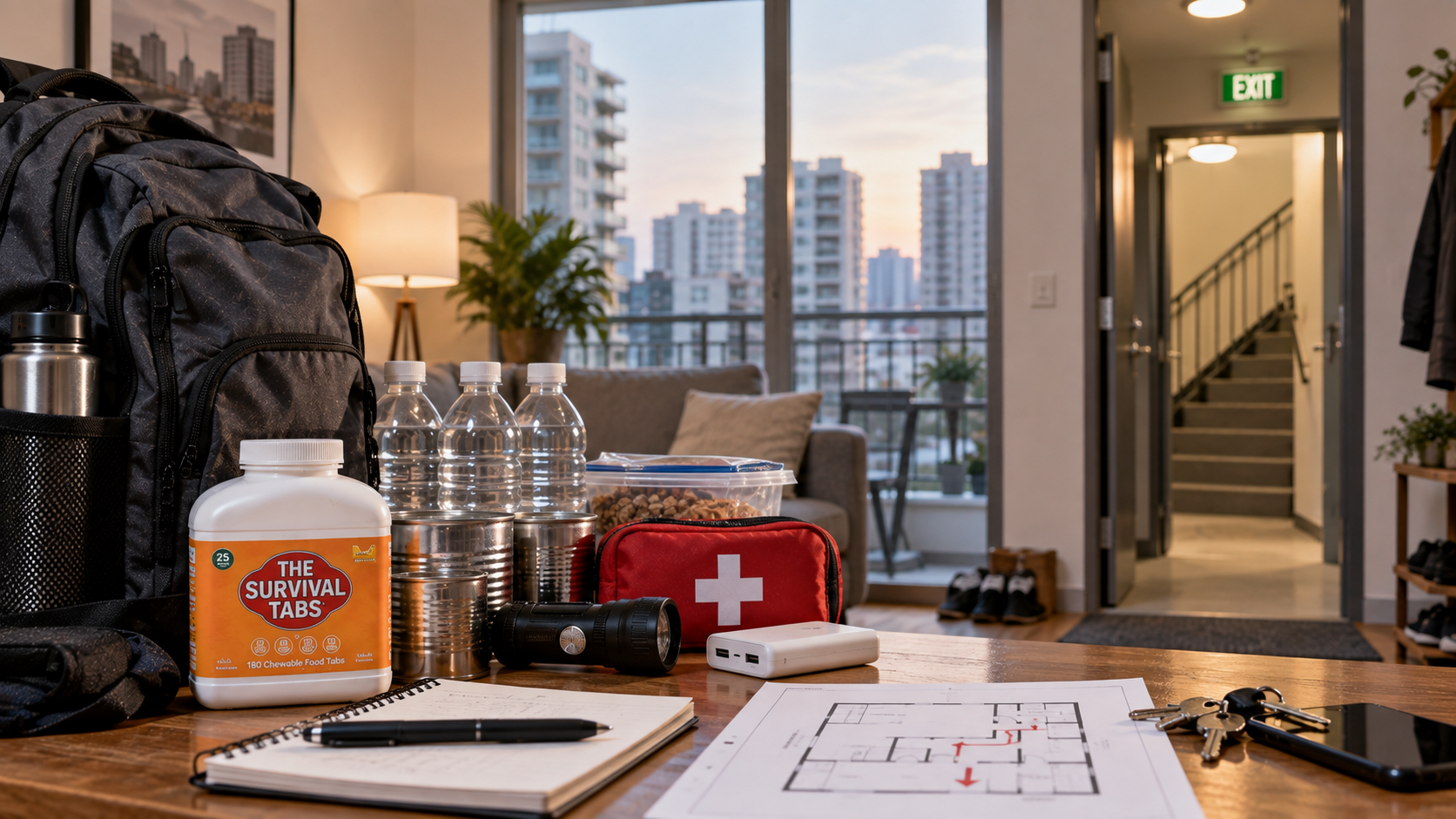
A practical, small-space plan for renters, condominium residents, and people living in multi-unit buildings
Apartment emergencies are different from emergencies in detached homes. You share hallways, stairwells, utilities, alarms, parking areas, and building systems with other residents. You may have limited storage, no private outdoor space, and no safe place to operate fuel-burning equipment. Elevators may stop during a fire or power outage, and access for emergency responders may depend on clear corridors and accurate unit information.
The good news is that apartment preparedness does not require a garage full of equipment. A compact, well-organized plan can cover the most important needs: warning, evacuation, sheltering, communication, water, food, medication, light, sanitation, and documents.
This guide explains how to build that plan without cluttering your home or violating your lease.
Quick answer: What should every apartment emergency plan include?
- Two ways out of the apartment whenever possible
- The location of every usable stairwell and building exit
- A meeting place outside the building
- A compact go-bag near the exit
- Several days of water, shelf-stable food, and essential medication
- Flashlights and charged backup power
- A written household communication plan
- Plans for children, pets, older adults, and anyone who may need assistance
- Knowledge of the building’s alarms, sprinklers, utility shutoffs, and emergency procedures
- A safe shelter-in-place location away from windows when the hazard requires staying indoors
Why apartment preparedness requires a different approach
A multi-unit building concentrates people and infrastructure. An emergency in one unit can affect an entire floor or building. Smoke can enter corridors. Water from sprinklers or firefighting can damage units far from a fire. A power outage can disable elevators, electronic entry systems, pumps, hallway lighting, or garage doors. Severe weather may make windows the main vulnerability, while an outside chemical incident may make sheltering indoors safer than leaving.
Your plan therefore needs three possible actions:
- Evacuate the apartment and building.
- Shelter inside your apartment.
- Leave the neighborhood with a go-bag.
Do not assume the same response is correct for every emergency. Follow alarms, building instructions, and directions from local authorities.
Start with a five-minute building assessment
Walk from your apartment to the street as if the lights were out and the elevator were unavailable. Do this calmly during normal conditions.
Identify your exits
- Find at least two ways out of your apartment when possible.
- Locate every stairwell that serves your floor.
- Confirm where each stairwell exits at ground level.
- Notice whether any door requires a key, access card, or special release.
- Never store personal belongings in hallways, landings, or stairwells.
- Choose an outdoor meeting place that is away from the building and accessible to everyone in your household.
Learn the building’s safety systems
Ask building management or the landlord:
- What does the building alarm sound like?
- Are smoke alarms, fire alarms, sprinklers, and carbon monoxide alarms installed?
- How are residents notified during a water outage, power outage, fire, severe storm, or security incident?
- Does the building have an emergency plan or designated assembly point?
- Are there residents who may need evacuation assistance?
- Who should be contacted after hours?
- Which doors automatically lock during an outage?
- How can the parking garage be opened if electrical power fails?
Keep management and emergency maintenance numbers in your phone and on paper.
Check your location-specific risks
Your priorities should reflect where you live. Consider:
- Fire and smoke
- Power failure
- Extreme heat or cold
- Flooding, including basement or parking-garage flooding
- Earthquakes
- Hurricanes, tornadoes, or severe thunderstorms
- Wildfire smoke
- Water interruption
- Hazardous-material incidents
- Civil emergencies or temporary building closure
Local emergency-management guidance should determine which hazards receive the most attention.
Create an apartment fire escape plan
Home fires can become life-threatening quickly. Plan before smoke or an alarm makes decisions difficult.
Prepare the apartment
- Install and maintain smoke alarms as required by local rules and your lease.
- Test alarms regularly and report defective building alarms immediately.
- Keep cooking areas clear and never leave active cooking unattended.
- Do not overload outlets or use damaged cords.
- Keep space heaters away from anything that can burn.
- Store matches and lighters away from children.
- Keep doors, windows, and escape routes clear.
When the alarm sounds
- Treat every alarm as real unless authorities clearly instruct otherwise.
- Take keys and your go-bag only if they are immediately available.
- Feel a closed door with the back of your hand before opening it. If it is hot, use another route.
- If the route is clear, leave quickly and close doors behind you.
- Pull the fire alarm on the way out if needed.
- Use the stairs during a fire. Do not use an elevator unless firefighters specifically direct you to do so.
- Go to the meeting place and call emergency services from safety.
- Never return for possessions or pets after leaving.
USFA guidance for high-rise residents emphasizes knowing all exit stairs, leaving the apartment, closing the door, activating the alarm, and using stairs rather than elevators unless the fire department directs otherwise.
If smoke or fire blocks your exit
Conditions and building designs differ. If you cannot safely reach an exit:
- Call emergency services and state your building address, unit number, floor, and condition.
- Keep the apartment door closed.
- Seal obvious gaps where smoke is entering with available material when practical.
- Move to a window or balcony only if it is safe.
- Signal your location with a light-colored cloth or flashlight.
- Follow instructions from emergency responders.
Do not jump from a window or improvise dangerous rope escapes.
Build a compact apartment emergency kit
Small-space preparedness works best when supplies are divided by purpose instead of stored in one oversized container.
Layer 1: Exit kit
Keep a small pouch or go-bag close to the primary exit. Include:
- Copies of identification and insurance information
- Household contact list
- Essential medication and copies of prescriptions
- Phone charging cable and compact power bank
- Flashlight or headlamp
- Spare keys
- N95 or similar protective masks
- Small first-aid kit
- Emergency cash
- Water and compact shelf-stable food
- Pet leash, carrier plan, and basic pet supplies when applicable
The bag must be light enough for the person carrying it and should not block the doorway.
Layer 2: Shelter supplies
Store household supplies in small containers under a bed, on a closet shelf, or in another dry, accessible location.
Include:
- Drinking water
- Shelf-stable food requiring little or no preparation
- Manual can opener
- Flashlights and spare batteries
- Battery-powered or hand-crank radio
- Backup power for phones
- First-aid supplies
- Hygiene and sanitation supplies
- Necessary medication and health equipment
- Blankets or seasonally appropriate clothing
- Supplies for infants, pets, or household members with special needs
- Basic tools, work gloves, and duct tape
- Paper maps and written emergency contacts
Rotate food, water, batteries, and medication on a regular schedule.
Layer 3: Everyday carry
The supplies you already carry can reduce the pressure on your home kit:
- Phone
- Identification
- Payment method and emergency cash
- Essential medication
- Small flashlight
- Charging cable
- Contact information
Water planning in a small apartment
Water may stop because of building maintenance, contamination, pump failure, or a wider utility outage.
Store water in several smaller containers instead of one very heavy container. Smaller containers are easier to rotate, lift, and fit into cabinets. Keep water away from chemicals, heat, and direct sunlight.
Also plan for:
- Drinking
- Medication
- Basic food preparation
- Limited hygiene
- Pet needs
If authorities issue a boil-water or do-not-use notice, follow the exact notice. Boiling does not remove every type of contamination.
Emergency food for apartments
Choose foods that are compact, familiar, and safe to eat with limited cooking.
Good categories include:
- Ready-to-eat canned foods
- Nut or seed butters
- Crackers and shelf-stable breads
- Dried fruit
- Nutrition bars
- Shelf-stable milk or alternatives
- Foods designed for compact emergency storage
- Infant, medical, or culturally appropriate foods required by your household
Avoid building a kit entirely from foods that require large amounts of water, refrigeration, or cooking. Check allergies and dietary restrictions. Store a manual can opener with canned food.
Survival Tabs can serve as one compact component of an emergency food plan, but no single product replaces drinking water, household planning, medically appropriate food, or a varied supply chosen for your family.
Power outages: apartment-specific safety
A power outage can affect elevators, water pumps, heating or cooling, hallway lights, electronic locks, and garage doors.
Before an outage
- Keep phones and power banks charged.
- Know whether your water depends on an electric pump.
- Learn how the building handles elevator outages and residents with mobility needs.
- Keep flashlights where they can be reached in darkness.
- Use surge protection where appropriate.
- Know how to manually operate approved doors or gates without damaging building equipment.
During an outage
- Use flashlights instead of candles when possible.
- Keep refrigerator and freezer doors closed.
- Unplug sensitive electronics if power is unstable.
- Check official alerts and building notices.
- Never use a charcoal grill, camping stove, gasoline engine, or generator inside an apartment, hallway, garage, balcony enclosure, or other enclosed or partially enclosed location.
- Do not attempt to operate a portable generator from an apartment balcony.
CDC guidance warns that generators and other fuel-burning devices can produce deadly carbon monoxide. Portable generators must be outside and more than 20 feet from doors, windows, and vents. For most apartment residents, the building layout makes safe generator placement impossible, so battery power is the practical option.
Heat and cold
During extreme heat, identify cooling centers or other air-conditioned locations before an outage. During extreme cold, identify a safe alternate location if the building cannot maintain heat. People using electrically powered medical equipment need a specific backup plan developed with healthcare and equipment providers.
Shelter-in-place planning
Some emergencies require remaining indoors. Examples can include hazardous outdoor air, severe weather, wildfire smoke, or an active public-safety incident.
Choose the safest interior area for the relevant hazard:
- For high winds, use a small interior room on the lowest safe level available, away from windows.
- For hazardous outdoor air, close windows and doors and follow official instructions concerning ventilation.
- For wildfire smoke, reduce outdoor-air entry when practical and follow local air-quality guidance.
- For an earthquake, drop, cover, and hold on; do not run for stairs while shaking is occurring.
- For a security incident, follow law-enforcement and building instructions.
Do not permanently seal ventilation or create an unsafe indoor environment. Shelter instructions depend on the hazard and should come from authorities.
Communication when cellular service is overloaded
Create a plan that does not depend on everyone reaching each other immediately.
Write down:
- One local contact
- One out-of-area contact
- Building management
- Emergency maintenance
- Schools, caregivers, and workplaces
- Veterinarian or pet boarding contact
- Primary and alternate meeting places
Text messages may go through when voice calls do not. Household members should know whom to contact and where to meet if they cannot return to the apartment.
Keep a printed copy in the go-bag. Children should have age-appropriate contact information without unnecessary private details.
Renters insurance, documents, and inventory
A landlord’s insurance generally protects the building owner’s property, not all of a tenant’s belongings or temporary living expenses. Review your own policy and ask the insurer what is covered.
Maintain:
- A photo or video inventory of major belongings
- Serial numbers for valuable equipment
- Copies of identification
- Insurance policy and claim contact
- Lease and landlord information
- Medication and medical-device information
- Pet records
- Emergency contacts
Store copies securely. Keep one protected physical copy and an encrypted digital backup. Do not leave exposed identity documents in an easily stolen go-bag.
Planning for pets
Apartment evacuation with pets requires advance practice.
- Keep carriers accessible rather than buried in storage.
- Train pets to enter carriers.
- Keep leashes near the exit.
- Include food, water, medication, waste bags, identification, and a recent photo.
- Identify pet-friendly hotels, friends, shelters, or boarding facilities.
- Use a rescue alert decal only if local responders recommend it, and keep it current.
- Never endanger yourself by returning to a hazardous building for a pet.
Planning for mobility, sensory, or medical needs
Do not wait until the elevator fails to decide how assistance will work.
- Discuss the building’s emergency assistance procedures with management.
- Ask how evacuation chairs or areas of refuge are handled, if applicable.
- Create a personal support network.
- Keep mobility devices, hearing devices, glasses, chargers, and medication accessible.
- Label critical equipment and record operating instructions.
- Arrange backup power for medically necessary devices with qualified providers.
- Tell trusted neighbors what assistance may be needed without oversharing medical details.
- Practice the plan with the people who will actually help.
Never improvise carrying a person down stairs unless trained responders or an established plan directs it.
Children and household routines
Children should understand alarms and evacuation without being frightened.
Practice:
- Leaving by the primary route
- Using the alternate route
- Going directly to the meeting place
- Never hiding during a fire
- Never returning inside
- Contacting a trusted adult
Run brief, calm drills. Change the scenario occasionally: lights out, primary stairwell unavailable, or one adult away from home.
What not to do in an apartment emergency
- Do not block exits, hallways, stairs, or fire doors.
- Do not disable smoke alarms.
- Do not prop open fire doors.
- Do not use elevators during a fire unless directed by firefighters.
- Do not store prohibited fuels or operate combustion equipment indoors.
- Do not use grills or camping stoves inside.
- Do not assume a balcony is automatically a safe evacuation route.
- Do not overload your go-bag until it becomes difficult to carry.
- Do not rely only on cloud-stored documents or phone contacts.
- Do not return to an evacuated building until authorities allow it.
A 30-minute apartment preparedness plan
If you are starting today, complete these steps:
- Walk both exit routes and identify the outdoor meeting place.
- Put shoes, keys, a flashlight, and necessary medication where they can be reached quickly.
- Save building management and emergency contacts.
- Charge a power bank.
- Start one compact go-bag.
- Photograph important belongings.
- Ask management for the building emergency procedure.
- Schedule a household drill.
Preparedness grows through small, repeatable improvements. You do not need to solve every risk in one shopping trip.
Monthly apartment preparedness checklist
- Test household alarms according to manufacturer and local guidance.
- Check that exits and hallways remain clear.
- Charge backup batteries.
- Review building notices.
- Confirm medication and food dates.
- Update household and pet information.
- Check the go-bag.
- Review seasonal hazards.
- Confirm the meeting place and contact plan.
Frequently asked questions
How much emergency food should an apartment resident store?
Build toward several days of food that your household can safely eat without refrigeration and with minimal cooking. Local authorities may recommend a longer period for your area. Choose compact foods, rotate them, and include medical, allergy, infant, and pet needs.
Can I use a generator on an apartment balcony?
No. A balcony generally cannot provide the separation from doors, windows, vents, and neighboring units required for safe portable-generator operation. Exhaust can enter your apartment or another unit. Use battery-based backup power and follow building rules.
Should I evacuate every time an apartment fire alarm sounds?
Treat the alarm as real and follow the building’s emergency plan and instructions from responders. If the normal route is affected by smoke, heat, or fire, do not enter the hazard. Call emergency services, report your exact location, and follow their instructions.
What if I live above the ground floor and cannot use stairs?
Arrange an individual emergency plan with building management and your support network before an emergency. Learn about designated areas of refuge, evacuation equipment, and local responder procedures. Do not rely on the elevator being available.
Where should I keep emergency supplies in a studio apartment?
Divide supplies among small, labeled containers. Use under-bed space, upper closet shelves, or furniture with storage. Keep the go-bag near the exit without blocking it. Do not store supplies where water leaks, heat, pests, or theft are likely.
Is a fire escape ladder useful in an apartment?
Only use escape equipment that is appropriate for the building, approved where required, and supported by fire-safety professionals. Improvised ladders and ropes can be deadly. High-rise residents should follow the building plan and local fire-department guidance.
Final takeaway
Apartment preparedness is not about filling a small home with equipment. It is about knowing the building, keeping exits clear, storing compact essentials, and making decisions before an alarm, outage, or evacuation.
Start with exits, communication, medication, water, food, light, and a manageable go-bag. Then practice. A plan that everyone understands is more valuable than a large kit no one can carry.
SEO and publishing package
SEO title
Apartment Emergency Preparedness Guide: Small-Space Plan
Meta description
Prepare your apartment for fires, outages, severe weather, evacuation, pets, and limited storage with this practical emergency planning guide.
Suggested URL
/blogs/knowledge-center/apartment-emergency-preparedness-guide
Shopify excerpt
Apartment preparedness requires a different plan from a detached home. Learn how to organize exits, compact emergency supplies, communication, evacuation, power-outage safety, pets, and special-needs planning without cluttering your space.
Suggested schema
Article with FAQPage markup for the frequently asked questions, subject to Shopify theme implementation and structured-data validation.
Internal-link opportunities
- Emergency Food Supply Guide
- Power Outage Preparedness Guide
- Emergency Radio and Communication Guide
- Car Emergency Kit Guide
- Flood Preparedness Guide
- Earthquake Preparedness Guide
- Wildfire Preparedness Guide
Image production brief
Featured image
A calm, realistic apartment entryway with a compact emergency go-bag, flashlight, water container, closed apartment door, and visible but uncluttered safety organization. No panic, flames, weapons, military styling, or fear-based imagery.
Featured-image dimensions
Use the current Survival Tabs Knowledge Center featured-image standard when the Content Engine becomes available. Prepare a wide landscape master suitable for Shopify and Facebook sharing.
Featured-image alt text
Compact emergency go-bag, flashlight, and water organized near an apartment entrance.
Supporting image concepts
- Apartment floor-plan illustration showing two exit routes and an outdoor meeting point
- Small-space emergency-supply organization under a bed and on a closet shelf
- Apartment power-outage safety graphic showing battery power and prohibited indoor combustion equipment
- Pet evacuation setup with carrier, leash, water, and identification
- Monthly apartment preparedness checklist graphic
Social media package
Main Facebook post
Living in an apartment changes emergency planning.
You may share stairwells, alarms, utilities, elevators, and locked entrances with dozens of neighbors. During a fire or power outage, the elevator may not be available—and a generator is not a safe balcony solution.
A practical apartment plan starts with:
- Knowing every stairwell and ground-level exit
- Choosing an outdoor meeting place
- Keeping a compact go-bag near the door
- Storing water and shelf-stable food in small spaces
- Planning for pets, medication, and mobility needs
- Keeping battery power ready for phones and lights
Preparedness does not require turning your apartment into a warehouse. It requires a plan that fits your building and that everyone in the household understands.
Read the complete Apartment Emergency Preparedness Guide:
[ARTICLE LINK AFTER PUBLISHING]
Short Facebook post 1
Could you leave your apartment safely if the lights were out and the elevator stopped?
Walk your exit routes now. Find every stairwell, confirm where each one reaches the street, and choose a meeting place away from the building.
Five calm minutes today can remove a lot of confusion later.
Short Facebook post 2
Apartment power-outage reminder:
Never operate a generator, charcoal grill, or camping stove inside an apartment, hallway, garage, or enclosed balcony. Carbon monoxide cannot be seen or smelled.
For most apartment residents, charged power banks, battery lights, and an alternate cooling or heating location are the safer plan.
Short Facebook post 3
Small apartment? Divide emergency supplies instead of buying one huge kit.
Keep:
- A light go-bag near the exit
- Water and food in small containers
- Flashlights where you can reach them in darkness
- Medication and documents protected and accessible
- Pet carriers and leashes ready
Preparedness should fit your home—not take it over.
Instagram caption
Apartment preparedness is mostly about planning, not storage.
Know the stairs. Keep exits clear. Choose a meeting place. Prepare a compact go-bag. Store water, food, medication, light, and backup power in small, organized spaces.
And remember: a generator is not a safe apartment-balcony solution.
Save this checklist and share it with someone who lives in an apartment or condominium.
#EmergencyPreparedness #ApartmentLiving #EmergencyPlan #GoBag #PowerOutage #FireSafety #PreparedNotScared
LinkedIn post
Emergency preparedness guidance often assumes people have garages, sheds, yards, and private utility access. Apartment residents may have none of those.
Multi-unit buildings introduce shared dependencies: elevators, electronic access, stairwells, water pumps, alarms, ventilation, and management communication. A useful preparedness plan must account for those dependencies without requiring excessive storage.
The practical priorities are straightforward: understand the building, plan two exits, maintain a communication plan, organize compact supplies, prepare for power loss, and include residents who may need assistance.
Preparedness works best when advice fits the environment where people actually live.
Five-slide carousel copy
Slide 1
Apartment Emergency Preparedness
Five things to organize before you need them
Slide 2
Know Your Way Out
Find every stairwell and ground-level exit.
Choose a meeting place away from the building.
Slide 3
Build a Compact Kit
Keep a light go-bag near the exit.
Store water, food, light, medication, and backup power in small containers.
Slide 4
Plan for Shared Systems
Elevators, electronic doors, pumps, and garage gates may fail during an outage.
Slide 5
Practice the Plan
Include children, pets, medication, mobility needs, and an out-of-area contact.
Preparedness should fit your apartment and your household.
Short video or Reel script
If you live in an apartment, your emergency plan should start with the building—not with shopping.
First, find every stairwell and confirm where it exits at street level.
Second, choose a meeting place away from the building.
Third, keep a light go-bag near the door with keys, medication, a flashlight, water, compact food, and phone power.
Fourth, plan for the elevator and electronic doors to stop working.
And finally, never run a generator or grill inside an apartment, garage, hallway, or enclosed balcony.
Apartment preparedness does not require a warehouse. It requires a clear exit plan and compact supplies that you can actually use.
Official sources
Ready.gov preparedness guide
American Red Cross home fire preparedness
U.S. Fire Administration high-rise fire guidance
CDC carbon monoxide and generator safety
CDC power-outage safety