

Urban Emergency Evacuation Guide
ST-KC-050 — Urban Emergency Evacuation Guide
A lawful, safety-first plan for leaving apartments, high-rises, workplaces, campuses, transit systems, and dense neighborhoods.
How to use this guide
Urban evacuation means moving away from a real hazard through lawful, publicly directed routes. It is not escape-and-evasion training.
Use this guide to prepare before an emergency, decide when to leave, move safely, reunite, shelter, and return only when authorities permit.
Local emergency managers, fire departments, transit agencies, building managers, and first responders control real-time instructions. Their directions override this general guide.
* Identify the hazards most likely to affect your neighborhood and building.
* Make one primary plan and at least two workable alternatives.
* Practice the parts of the plan that are safe to rehearse.
* Keep the plan usable without cellular data or battery power.
* Review the plan after moves, medical changes, transit changes, or major local construction.
* Leave immediately when officials order evacuation or an immediate life threat is present.
Know the decisions before the emergency
Evacuation, shelter-in-place, and relocation are different decisions. The safest option depends on the hazard, location, official order, building condition, and route conditions.
Do not assume that leaving is always safer. Smoke, chemical releases, flash flooding, violence, fire, structural damage, and severe weather require different actions.
* Write down who can order evacuation in your building, workplace, school, or care setting.
* Know which alerts carry official instructions in your city.
* Identify conditions that require immediate exit, such as fire, smoke, gas odor, collapse, or a direct official order.
* Identify conditions that may require sheltering until authorities announce a safe route.
* Choose a person responsible for checking official updates when time allows.
* Agree that no one returns for property after the group has begun evacuating.
Build an official-alert system
A city evacuation plan fails if the household does not receive or understand the warning. Use more than one trusted channel.
Social-media posts, forwarded messages, and crowd rumors may be incomplete or false. Confirm instructions with official sources whenever doing so does not delay escape from immediate danger.
* Enroll in local emergency alerts for home, work, school, and frequent destinations.
* Enable Wireless Emergency Alerts on compatible phones.
* Save local emergency-management, fire, police, transit, and utility pages.
* Keep a battery radio or another no-internet information method.
* Choose one out-of-area contact who can relay confirmed information.
* Plan for language, hearing, vision, cognitive, and literacy access needs.
* Print critical numbers and radio frequencies.
Map the building
Every household member should understand how to leave the building without relying on one doorway, elevator, app, or staff member.
Building-specific instructions matter. High-rises, basements, gated complexes, dormitories, hotels, hospitals, and mixed-use buildings have different systems.
* Locate every usable exit and enclosed stairwell.
* Identify alarm pull stations, extinguishers, fire doors, refuge areas, and assembly areas without obstructing them.
* Learn whether doors require keys, fobs, codes, or staff release.
* Check whether emergency exits remain usable during power failure.
* Know the building address, floor, unit number, and nearest cross street.
* Photograph or print the posted evacuation map.
* Report blocked exits, broken lights, or locked required exits to management.
* Never store supplies, bicycles, or furniture in an exit path.
Apartment and high-rise fire limits
Fire evacuation is time-critical. If there is smoke, fire, an alarm, or an official instruction to leave, follow the building fire plan and fire-department directions.
Smoke conditions can make a familiar corridor unusable. Do not enter smoke to retrieve belongings or reach a preferred exit.
* Use stairs unless firefighters or the building plan explicitly directs otherwise.
* Do not use an elevator during a fire.
* Close doors behind you without locking them when doing so is safe.
* Stay low under smoke and choose another route if an exit path is blocked.
* Test a closed door for heat before opening it.
* If trapped, keep the door closed, seal visible smoke gaps if possible, call emergency services, and signal your location.
* Never go to a roof unless the building plan or firefighters direct you there.
* Do not re-enter until the fire department says it is safe.
Choose neighborhood evacuation zones
Select destinations at several distances because one incident may affect a building, a block, a district, or the entire city.
Ask permission before naming a private home as a destination, and verify that it is accessible to every group member.
* Choose a meeting place immediately outside the building.
* Choose a neighborhood meeting place outside the likely hazard zone.
* Choose a citywide destination reachable by more than one mode.
* Choose an out-of-area contact and destination.
* Record official shelter-information channels rather than assuming one shelter will open.
* Identify destinations that can accept mobility devices, service animals, pets, or medical equipment.
* Write the addresses on paper.
Plan multiple routes
One route is not a plan. Construction, floodwater, smoke, police activity, debris, downed power lines, stalled traffic, and transit shutdowns can close normal paths.
Routes should follow public streets and official directions. Do not plan trespass, restricted-area entry, rail-tunnel access, camouflage, disguise, or evasion.
* Map two walking routes from the building.
* Map two driving routes that do not depend on the same bridge, tunnel, or highway.
* Map transit alternatives and transfer points.
* Mark flood-prone underpasses, steep stairs, narrow sidewalks, and other access barriers.
* Identify safe public places where the group could pause.
* Store paper maps with routes marked.
* Practice a daytime route and discuss how it changes at night.
* Update routes after major construction or transit changes.
Transportation without a private car
Many urban residents depend on transit, taxis, bicycles, walking, paratransit, or help from others. Plan before service is disrupted.
Emergency transit service, fares, boarding locations, and accessibility rules can change. Use current official instructions.
* Register in advance for paratransit or local evacuation assistance if eligible.
* Ask local emergency management what transportation assistance may be available.
* Keep a small cash reserve in practical denominations.
* Maintain transit cards, bicycle lights, helmets, mobility-device chargers, and repair basics.
* Identify two people who may be able to assist with transport.
* Know how to reach a safe destination on foot if transit stops.
* Do not enter tunnels, tracks, restricted lanes, or closed stations.
* Follow operator and first-responder directions during service changes.
Driving evacuation
Driving can increase exposure if roads are already congested or hazardous. Leave when directed and use official routes.
Never drive around barricades or into floodwater, smoke, downed lines, or a restricted emergency zone.
* Keep the vehicle maintained and fueled according to a realistic household schedule.
* Store a paper map, phone charger, water, basic supplies, and seasonal clothing.
* Load mobility devices, child restraints, pet carriers, and medical equipment in advance when a warning provides time.
* Carpool only when it does not delay an ordered evacuation.
* Keep roads clear for emergency vehicles.
* Expect traffic-control changes and destination changes.
* Park without blocking hydrants, intersections, ramps, or emergency access.
Walking evacuation
Walking may be the only option for a short-distance evacuation, but distance, heat, cold, air quality, debris, traffic, and health conditions can make it unsafe.
Choose ordinary clothing and visible safety equipment appropriate to conditions. Concealment and blending are not emergency-safety strategies.
* Wear supportive closed-toe shoes.
* Carry water without overloading the group.
* Use reflective material or a light when visibility is poor.
* Stay on lawful public routes and obey closures.
* Cross streets at controlled locations when possible.
* Avoid unstable structures, floodwater, smoke, spills, and downed lines.
* Use a buddy system and count the group at decision points.
* Turn back or seek a safe public location if the route becomes unsafe.
Build a lightweight evacuation kit
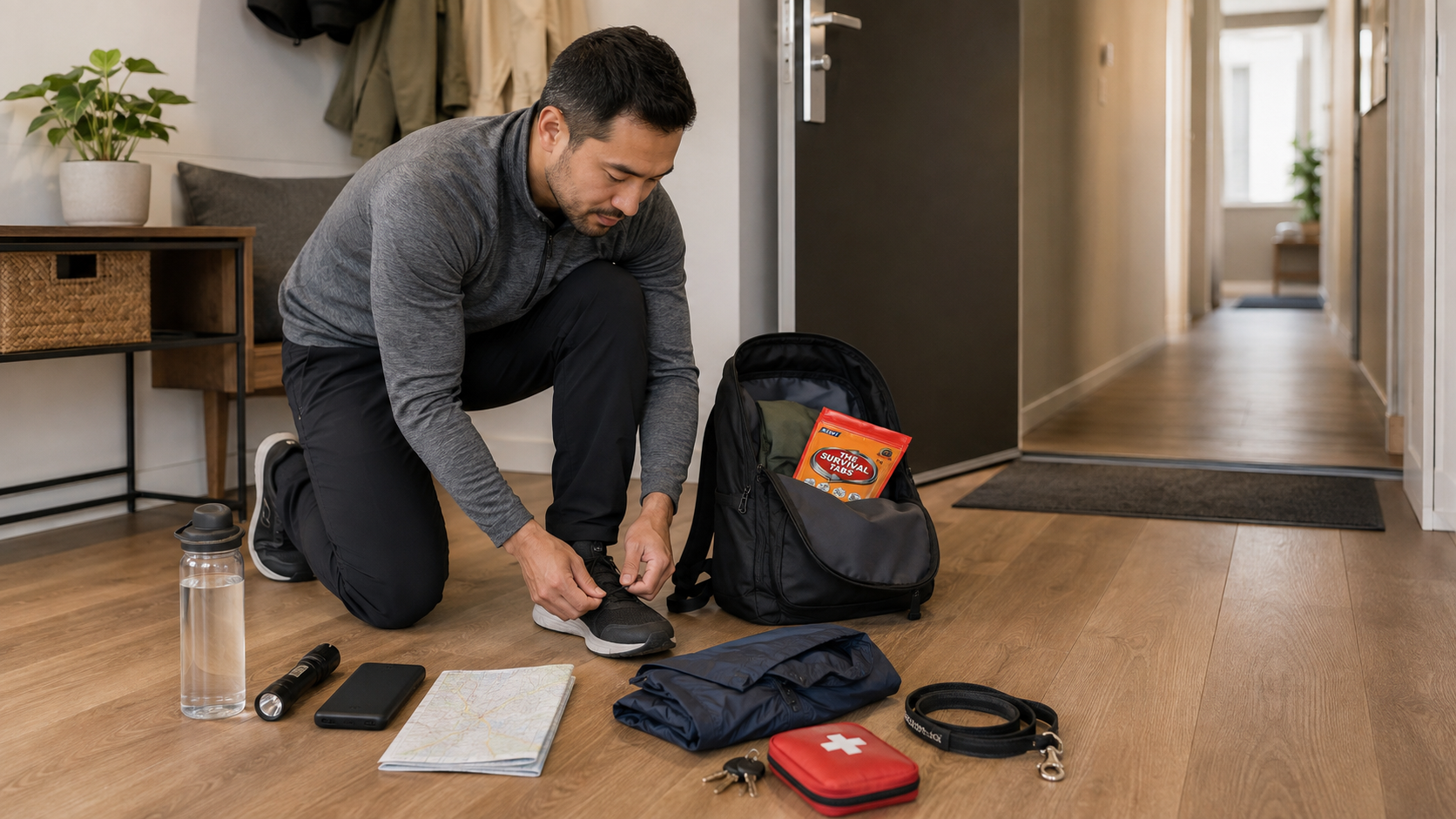
The kit should support movement, communication, medication continuity, and a short stay. It should not be so heavy that it prevents evacuation.
Adapt contents to local weather, household needs, and the distance to a safe destination.
* Water and compact, familiar food.
* Essential medications and copies of prescriptions where lawful.
* Identification, emergency contacts, insurance information, and key records.
* Phone, charging cable, power bank, and battery radio if practical.
* Flashlight or headlamp with safe spare batteries.
* Weather-appropriate layers, rain protection, sturdy shoes, and work gloves.
* Basic first-aid supplies and hygiene items.
* Keys, transit card, small cash reserve, and paper map.
* Respiratory protection appropriate to public-health guidance, without treating it as protection from every hazard.
* Child, older-adult, disability, service-animal, and pet supplies.
Documents and privacy
Carry enough information to obtain help, not an unnecessary archive of sensitive records. Protect paper and digital copies from loss and unauthorized access.
Do not publicly post your empty-home status, route, shelter location, medication list, or identity documents.
* Use a waterproof pouch for essential paper copies.
* Keep encrypted digital backups when practical.
* Record emergency contacts separately from the phone.
* Carry only necessary account and insurance details.
* Mark devices with a safe return contact rather than excessive personal data.
* Know how to remotely lock or erase lost devices.
* Share live location only with trusted people and only when useful.
* Report lost identification or medication promptly.
Household communication and reunification
Networks may be overloaded and family members may be at work, school, appointments, or transit stops when an incident begins.
Short text messages may work when calls do not, but no single technology is guaranteed.
* Choose one local and one out-of-area contact.
* Write a simple status format: name, location, condition, next destination, and next check-in time.
* Assign who will contact schools, care providers, and employers.
* Set meeting places at building, neighborhood, and city scales.
* Teach children whom they may safely leave with.
* Keep current photos and essential identification information for dependents.
* Do not delay evacuation waiting for a missing person; report their last known location to responders.
* Record when the group was last counted.
Accessibility and functional needs
An equitable plan starts with the person’s actual needs, choices, equipment, communication method, and support network.
Do not lift, carry, transfer, guide, or operate another person’s equipment without consent and appropriate knowledge unless an immediate life threat leaves no safer option.
* Create an individual assistance plan with the person involved.
* Document communication, mobility, sensory, cognitive, dietary, and personal-care needs.
* Keep backup power and manual alternatives for essential equipment where feasible.
* Label equipment with operating instructions and contact information.
* Identify accessible exits, refuge areas, vehicles, routes, and destinations.
* Arrange more than one support person.
* Include service-animal supplies and keep the animal with its handler whenever possible.
* Practice asking before helping.
* Register with voluntary local assistance programs if appropriate.
Medical needs and medication continuity
Evacuation plans must account for prescriptions, oxygen, refrigeration, dialysis, infusion, mobility equipment, and other time-sensitive care.
This guide cannot determine whether a person is medically fit to evacuate by a particular method. Discuss individualized plans with clinicians and equipment providers.
* Keep an up-to-date medication list and allergies.
* Know lawful refill and emergency-supply options.
* Ask the clinician how to handle delayed or missed treatment.
* Plan backup power for critical devices.
* Use approved storage methods for temperature-sensitive medication.
* Carry provider, pharmacy, insurer, and equipment-supplier contacts.
* Know which symptoms require emergency medical help.
* Do not share prescriptions or improvise dosing.
Children and schools
Children need short, concrete instructions and reunification plans that do not depend on them navigating the city alone.
School and childcare procedures control release during an incident. Learn them before an emergency.
* Keep authorized pickup information current.
* Name backup adults and verify their identification requirements.
* Teach the child their name, caregiver names, and one contact number as appropriate.
* Use identification information that protects privacy.
* Pack comfort, feeding, sanitation, and medical items.
* Practice alarms and meeting places without frightening the child.
* Tell children never to return for toys or pets.
* Follow official reunification procedures rather than approaching restricted school areas.
Older adults and caregivers
Plans should reflect mobility, hearing, vision, cognition, medication, temperature sensitivity, and caregiving routines without assuming that age alone determines ability.
Caregivers should plan for a disruption in staffing, transportation, power, and records access.
* Create a written daily-support summary.
* List mobility and communication assistance preferences.
* Arrange backup caregivers and transportation.
* Keep spare glasses, hearing-device supplies, and mobility-device accessories.
* Plan for continence, nutrition, and temperature needs.
* Use clear check-in times.
* Confirm that destinations can provide needed access.
* Reassess the plan after a hospitalization or change in function.
Pets and service animals
Evacuation is easier when animals are accustomed to carriers, leashes, handling, and transport. Never leave planning until an order is issued.
Service animals are not pets. Keep them with their handlers whenever possible and plan for their food, water, relief, identification, and equipment.
* Use secure carriers, leashes, or species-appropriate transport.
* Keep current identification, photos, vaccination information, and veterinary contacts.
* Identify pet-friendly destinations outside the immediate area.
* Pack food, water, medication, bowls, sanitation supplies, and familiar bedding.
* Practice loading animals calmly.
* Never release an animal outdoors during evacuation.
* Tell responders about animals that could not be evacuated.
* Do not enter an unsafe building to retrieve an animal.
Workplaces, campuses, hotels, and public venues
When away from home, follow the site emergency plan and staff or responder instructions. Note exits when entering an unfamiliar building.
Do not assume the route used to enter will remain the safest way out.
* Locate at least two exits.
* Identify the outside assembly area.
* Keep essential medication and communication items accessible.
* Ask about accessible evacuation arrangements when needed.
* Know who conducts accountability.
* Do not leave the assembly area without reporting your status when a formal accountability system is active.
* Do not block exits while waiting for others.
* Report hazards and missing people to trained personnel.
Crowds, traffic, and public safety
Evacuation can create dense crowds, uncertainty, and conflicting information. Calm movement and official instructions reduce risk.
This guide does not teach confrontation, tactical movement, disguise, surveillance avoidance, or methods for bypassing authorities.
* Move with the official flow unless responders redirect you.
* Keep children and support partners close.
* Do not push, run, stop in choke points, or climb barriers.
* Step out of the main flow only at a safe, visible location.
* Give emergency vehicles and responders room.
* Avoid arguments and do not challenge access controls.
* Report immediate threats through emergency channels.
* Leave unattended objects alone and notify authorities.
Violence and law-enforcement incidents
Active violence and law-enforcement operations require immediate, incident-specific instructions. Evacuation may be unsafe in some directions.
Follow official alerts and responder commands. Do not approach, record sensitive operations at close range, cross police lines, impersonate responders, or carry items that could be mistaken for weapons.
* Move away from the immediate threat when a safe route is apparent.
* Keep hands visible when encountering officers.
* Do not make sudden movements or argue at checkpoints.
* Provide concise information about hazards or injured people.
* Do not return to retrieve belongings.
* Use reunification locations announced by authorities.
* Seek medical and psychological support after the incident.
* Preserve relevant evidence without posting it publicly.
Hazard-specific route limits
Urban routes change by hazard. A safe route for a building fire may be unsafe during flood, wildfire smoke, chemical release, earthquake damage, or civil emergency.
Never use general preparedness content as a substitute for an evacuation order or technical hazard instruction.
* Fire: avoid smoke and use the building fire plan.
* Flood: move away from floodwater and never enter closed or submerged routes.
* Earthquake: expect falling debris, broken glass, gas leaks, and damaged bridges.
* Chemical release: follow official shelter or evacuation instructions and avoid the plume.
* Wildfire: leave when ordered and avoid smoke-obscured roads.
* Severe weather: do not begin travel through a more dangerous warning area unless officials direct evacuation.
* Power outage: expect dark stairs, failed signals, disabled elevators, and transit disruption.
* Structural damage: move away from facades, glass, unstable walls, and cordoned areas.
When to shelter instead
Sometimes the safest action is to remain inside temporarily. Authorities may direct sheltering because outside air, roads, violence, or weather are more dangerous.
Sheltering is not permission to ignore a worsening building hazard. Fire, smoke, collapse, or another immediate threat may require exit.
* Move to the location appropriate for the announced hazard.
* Close and secure openings only as officials direct.
* Turn off ventilation only when official instructions call for it.
* Monitor trusted alerts.
* Keep the group away from windows when appropriate.
* Prepare to evacuate if instructions change.
* Do not self-deploy into the affected area.
* Call emergency services for an immediate life threat.
Activation checklist
When an evacuation warning or order arrives, act from the written plan. Avoid adding last-minute tasks that delay departure.
Warnings may provide preparation time; orders may require immediate movement. Always distinguish the language used by local authorities.
* Confirm the instruction through an official channel if time permits.
* State the destination and route to the group.
* Put on shoes and protective clothing.
* Take the evacuation kit, medication, documents, keys, and communication devices.
* Secure pets and assist dependents.
* Turn off utilities only when authorities or qualified instructions direct it and doing so does not delay departure.
* Lock the home if practical, without creating a delay.
* Mark the departure time and check in with the out-of-area contact.
* Follow official routes and report changed conditions.
Go-now triggers
Some conditions do not allow time for routine packing or confirmation. Protect life first.
If you are uncertain whether a condition is immediately life-threatening, call emergency services from a safe location.
* Visible fire or smoke threatening the occupied area.
* Gas odor, hissing, explosion, or suspected dangerous release.
* Structural collapse, shifting, or falling debris.
* An official immediate evacuation order.
* Fast-rising water or a route about to be cut off.
* A direct threat of violence nearby.
* Responder instruction to leave.
* A medical emergency requiring movement to care.
What not to do
Unsafe legacy ideas have been intentionally removed from this replacement article.
Preparedness should improve lawful access to safety, not teach concealment, evasion, or hazardous improvisation.
* Do not use disguise, camouflage, or deceptive identity tactics.
* Do not trespass through private property or restricted infrastructure.
* Do not enter rail tunnels, utility corridors, sewers, rooftops, or construction sites as shortcuts.
* Do not bypass police, fire, transit, or military closures.
* Do not carry weapons or replica equipment as evacuation tools.
* Do not confront crowds, responders, property owners, or checkpoint staff.
* Do not spread unverified route or shelter information.
* Do not return for property after leaving an unsafe area.
* Do not promise that any route, kit, app, or technique guarantees survival.
At a shelter or reception center
Registration, security, animal, medical, and accessibility procedures vary. Cooperate with staff and explain needs early.
Do not assume a shelter provides every medication, dietary item, charger, caregiver, or animal supply.
* Register every group member as directed.
* Report urgent medical, communication, mobility, dietary, or personal-care needs.
* Keep essential items controlled and labeled.
* Respect privacy and photography restrictions.
* Supervise children and animals.
* Follow sanitation, quiet-hour, and safety rules.
* Tell staff before leaving or transferring.
* Use only verified information about other shelters or assistance.
If the group becomes separated
Separation plans should reduce wandering and duplicate searches.
No one should re-enter a closed area or leave a safe site solely to look for another person.
* Go to the preselected meeting place if it remains safe.
* Send the standard status message.
* Contact the out-of-area coordinator.
* Check official reunification systems.
* Report missing vulnerable people promptly.
* Record last known location, time, clothing, mobility, and destination.
* Keep one contact number available for responders.
* Update the group when the person is found.
Immediate first aid and emergency limits
Call emergency services for serious injury, breathing difficulty, chest pain, severe bleeding, burns, altered consciousness, poisoning, or other urgent symptoms.
Provide first aid only within your training and use appropriate protective barriers.
* Move to safety before treating when the scene is hazardous.
* Do not move a seriously injured person unless remaining creates greater danger.
* Control severe bleeding with direct pressure if trained and able.
* Cool a minor thermal burn with clean cool running water when available; do not apply ice or household remedies.
* Do not give food or drink to an unconscious person.
* Do not use unknown chemicals or medications.
* Tell responders what happened and what care was given.
* Seek follow-up care after smoke, chemical, or traumatic exposure.
Returning home
Return only after the appropriate authority says the area and route are open. An open road does not prove a building is safe.
Fire, gas, electrical, structural, water, mold, sewage, chemical, and security hazards may remain.
* Approach in daylight when practical.
* Obey barriers and inspection requirements.
* Do not enter if there is visible structural damage, smoke, gas odor, floodwater, sparking, or unstable debris.
* Use qualified inspectors and utility professionals where needed.
* Photograph damage from a safe location for records.
* Discard food and medicine when official safety guidance requires it.
* Use generators only outdoors and far from openings.
* Keep children and animals away from damaged areas.
* Update insurers, property managers, employers, schools, and care providers as appropriate.
Recovery and after-action review
Recovery includes safety, housing, health, documentation, emotional support, and plan improvement.
Stress reactions are common after frightening events. Seek professional support when distress is severe, persistent, or interferes with daily life.
* Account for every person and animal.
* Replace used medication, batteries, food, water, and first-aid supplies.
* Record route closures, communication failures, and accessibility barriers.
* Update contacts and destinations.
* Report building-safety problems to the responsible authority.
* Save receipts and verified assistance records.
* Watch for scams and confirm agencies before sharing information or money.
* Schedule a calm household review.
* Change the plan based on evidence from the event.
Practice and maintenance
Exercises should build familiarity without creating danger, panic, or interference with real emergency operations.
Coordinate drills with building management, workplaces, schools, caregivers, and local programs when appropriate.
* Walk the primary exit route.
* Test the alternate exit without defeating security controls.
* Send a practice check-in message.
* Pack and carry the kit for a realistic distance.
* Practice loading mobility devices, child restraints, and animals.
* Review a paper map without phone navigation.
* Check alert settings and contact numbers.
* Inspect shoes, lights, batteries, chargers, and seasonal items.
* Repeat after significant household or neighborhood changes.
Frequently asked questions
Should I leave before an order? If officials issue a warning or advise early departure for people needing extra time, follow that guidance. For an immediate life threat, leave at once if a safe route exists.
Should I always use stairs? During a fire, do not use elevators unless firefighters or the building plan specifically directs it. Other incidents may have different instructions, especially for accessibility.
What if I do not have a car? Plan walking, transit, paratransit, rides, and local evacuation-assistance options before an emergency.
Can I use an app as my plan? No. Apps can fail, lose power, or provide stale routing. Keep paper information and independent judgment tied to official instructions.
Should I hide or blend into a crowd? No. Use ordinary lawful behavior, remain visible to responders when needed, and follow public-safety directions.
What if a shelter will not accept pets? Identify pet-friendly destinations and local animal-sheltering procedures before an emergency. Service animals are treated differently from pets.
What if my route is blocked? Do not bypass a closure. Use an official alternate route, return to a safe location, or contact authorities for direction.
When can I return? Only when the relevant authority permits return and the building itself is safe.
Professional review required before publication
This guide should be reviewed against the locations and audiences it will serve. General advice cannot replace local codes, building plans, evacuation orders, medical plans, or legal requirements.
* Emergency-management review for alert, evacuation, shelter, and return language.
* Fire-safety and building-code review for apartment and high-rise procedures.
* Accessibility review led by people with disabilities and qualified specialists.
* Medical review for medication, device, oxygen, and first-aid boundaries.
* Transit and transportation review for car-free and paratransit planning.
* Child-safety, older-adult, service-animal, and veterinary review.
* Legal and privacy review for identification, records, checkpoints, and assistance programs.
* Product-compliance review for any Survival Tabs references added later.
Official sources
Ready.gov — Evacuation
Ready.gov — Make a Plan
Ready.gov — People with Disabilities
Ready.gov — Older Adults
Ready.gov — Pets and Animals
U.S. Fire Administration — Apartment Fire Safety
OSHA — Emergency Action Plan Elements