

72-Hour Emergency Food Plan for Preppers, Homesteaders & Survivalists
Simple, Reliable Meals to Survive Blackouts, Storms, and Supply Failures
Chapter 1: The First 72 Hours – Why It Matters
When disaster strikes, the first 72 hours are the most critical. Whether it’s a hurricane, wildfire, power grid failure, or sudden civil unrest, those first three days can mean the difference between calm preparedness and chaotic survival.
What Happens in the First 3 Days
History has shown that in almost every major crisis, grocery stores are emptied within hours, gas stations run dry, and emergency services become overwhelmed. In urban areas, panic buying can begin in less than 6 hours. In rural zones, roads may be blocked, communication down, and supplies limited.
Families who fail to prepare often rely on luck or outside aid—neither of which should be part of your survival plan.
Why 72 Hours Is the Survival Threshold
Government agencies like FEMA recommend that all households be able to self-sustain for at least 72 hours. That’s because emergency responders and supply chains typically take 3+ days to stabilize after a disaster.
More importantly, those first 72 hours are when:
- Panic is at its peak
- Resources are the most scarce
- Mobility may be limited (due to closed roads, fires, riots, etc.)
If your household can function confidently for three days without outside help, you’re ahead of 90% of the population.
The Hidden Risks of Food Insecurity
Lack of food during a crisis isn’t just a physical problem—it’s emotional and psychological. Hunger reduces mental clarity, increases panic, and often leads to poor decision-making. Children and elderly family members are especially vulnerable.
Having reliable, easy-to-access food options reduces fear, keeps your family calm, and gives you time to assess the situation clearly.
This guide exists to make sure your family can get through the first 72 hours with confidence and clarity. In the next chapter, we’ll break down exactly what kinds of foods you should pack—and why some traditional prepper staples are no longer good enough.
#CampingFood #HikingNutrition #BackpackingFuel #TrailReady #WildernessPrep #OutdoorEssentials #SurvivalCamping #EatToSurvive #LightweightFuel #AdventureTabs #BalancedNutrition #MealReplacement #GlutenFreeSurvival #PortableNutrition #EnergyOnTheGo #CalorieSmart #ShelfStableFood #NoRefrigerationNeeded #EatAnywhere #QuickEnergyBoost
Chapter 2: Core Principles of Survival Nutrition
In a grid-down emergency, food needs to do more than just fill your stomach—it must nourish, sustain energy, and support mental clarity under stress. That means choosing foods that combine shelf-stability, high caloric density, and essential nutrients.
Survival Food Is Not Snack Food
Too many people stockpile granola bars, crackers, or snack foods that provide quick energy but little lasting nutrition. These foods spike blood sugar, don’t last long in storage, and can leave you depleted within hours. What you need are real fuel sources that are engineered or chosen for emergency use.
Three Non-Negotiables in Emergency Food
1. Shelf Life: Your food must last at least 5–25 years without refrigeration or rotation. Look for vacuum-sealed, freeze-dried, or low-moisture products.
2. Portability: You may need to carry your food on foot. Lighter, more compact options like Survival Tabs or high-density food bars can mean the difference between freedom and fatigue.
3. Nutritional Completeness: Calories alone won’t sustain you in a high-stress event. Your body needs vitamins, minerals, fats, and proteins to maintain clarity and strength. Products like The Survival Tabs are specifically designed to cover these bases in compact form.
Fueling Your Body for Survival
In a crisis, your energy demands increase—both mentally and physically. You may be walking long distances, carrying supplies, enduring cold weather, or dealing with injuries. Without proper fuel, performance drops fast.
Unlike comfort foods or daily snacks, survival nutrition must be intentional. You’ll need about 2,000–2,500 calories per day per adult in emergency scenarios. For children, adjust by age and activity level.
In the next chapter, we’ll give you a complete checklist of survival food essentials—designed to keep you alive, alert, and mobile for a minimum of three days.
Chapter 3: The Survival Food Essentials Checklist
When it comes to survival food, simplicity and utility rule. The following checklist includes nutrient-rich, shelf-stable, and easily packable foods to last at least 72 hours.
Proteins
- Canned meats (tuna, chicken, sardines)
- Vacuum-sealed jerky
- Powdered eggs or protein powder
Carbohydrates
- Instant oats
- Rice (parboiled or pre-cooked packs)
- Crackers or hardtack
Fats & Supplements
- Nut butters (single-serve packets)
- Multivitamin tablets
- The Survival Tabs (lightweight, nutrient-complete backup)
Hydration & Support
- Water purification tablets
- Electrolyte drink powder
- Herbal tea bags for morale and warmth
Use this checklist as the core of your kit. Rotate stock annually and store in a cool, dry space. In the appendix, you’ll find a printable version of this checklist.
Chapter 4: Building Your 72-Hour Kit
The key to an effective 72-hour kit is balance: enough calories, minimal weight, and high versatility.
Calorie Planning
Each adult should aim for at least 2,000–2,500 calories per day. For children, aim for 1,200–1,800 depending on age and size.
Dividing Supplies
Pack items by individual where possible. Assign a portion of the group’s food supply to each person’s bag.
Sample Kit: Solo Prepper
- 6 protein bars
- 1 vacuum-sealed pack of jerky
- 3 servings of oats with honey packs
- 1 pack of Survival Tabs (one day’s complete nutrition)
- 3 liters of water + 6 purification tablets
Sample Kit: Family of 3
- 9 protein bars
- 2 cans of meat
- 3 packs of crackers
- 1 full bottle of Survival Tabs
- 9 liters of water
Use durable bags, label expiration dates, and place Survival Tabs at the top for rapid access.
Chapter 5: Bug-Out Ready: Compact & Mobile Food Packs
When you’re on the move, every ounce matters. The best food options are dense in calories, balanced in nutrition, and light in weight.
Travel-Ready Food Categories
- Bars: Good for short-term energy, but lack nutrients
- MREs: Complete, but bulky and heavy
- The Survival Tabs: Ideal balance of nutrition, weight, and space
Why Tabs Excel
Each serving delivers essential vitamins, protein, and slow-release carbs. They fit in a pocket and require no prep.
Packing Tips
- Store Tabs in outer pouch of your bug-out bag
- Use ziplock or vacuum-sealed pouches for portioning
- Pair with trail mix or nuts for variety
Chapter 6: Storage & Rotation Best Practices
An emergency food kit is only as good as its maintenance.
Where to Store
- Cool, dry areas: closets, under beds, inside bins
- Avoid attics, garages, and areas with large temperature swings
How to Rotate
- Use a permanent marker to label expiration dates
- Follow FIFO (first-in, first-out) practices
- Set a calendar reminder to check kits every 6 months
Using Tabs as a Backup
Survival Tabs have a shelf life of up to 25 years. Use them as your fallback reserve when everything else is exhausted.
Chapter 7: Real-World Use Cases
Blackout Scenario
A winter storm in the Midwest knocked out power for 3 days. A prepared family used Tabs, peanut butter, and rice crackers to stay fed without cooking.
Wildfire Evacuation
A family fled with only 10 minutes' notice. Survival Tabs provided full-day nutrition until they reached a shelter.
Snowstorm Survival
Trapped off-grid during a blizzard, a homesteader used Tabs and herbal tea to ration caloric intake without power.
In each case, *The Survival Tabs* enabled mobility, clarity, and reduced stress when traditional food wasn’t available.
Conclusion: Start Your 72-Hour Food Plan Today
No matter your location, income, or experience, a basic 72-hour food plan is the foundation of all emergency preparedness.
Steps to Take Today
1. Download and print the checklist
2. Buy at least 3 days of food per person
3. Add a backup supply of *The Survival Tabs*
4. Store and label your kit in a safe location
Preparedness doesn’t require paranoia—just action.
Appendix
Included:
- Printable 72-Hour Survival Food Checklist
- Sample 3-Day Meal Plan Template
- Bug-Out Bag Layout (food + gear balance)
Visit thesurvivaltabs.com for more guides, product bundles, and gear recommendations.
***Statements regarding dietary supplements have not been evaluated by the FDA and are not intended to diagnose, treat, cure, or prevent any disease or health condition.***
 |
 |
 |
 |
 |
|
|---|---|---|---|---|---|
| 720 Tabs Emergency Food Survival Gluten Free and Non-GMO 25 Years Shelf Life | Food Supply 96 Tabs Emergency Food Replacement Disaster Preparedness | Ultimate Preparedness Emergency Food Supply 25 year shelf life | Emergency Food Ration Survival MREs Food Replacement | Emergency Food Survival Food Meal Replacement MREs Gluten Free and Non-GMO | |
| Day Serving | 60 days | 8 days | 120 days | 15 days | 2 days |
| Shelf-Life | 25 years | 25 years | 25 years | 25 years | 25 years |
| Non-GMO | ✓ | ✓ | ✓ | ✓ | ✓ |
| Gluten Free | ✓ | ✓ | ✓ | ✓ | ✓ |
| Tabs Amount | 720 | 96 | 1440 | 180 | 24 |


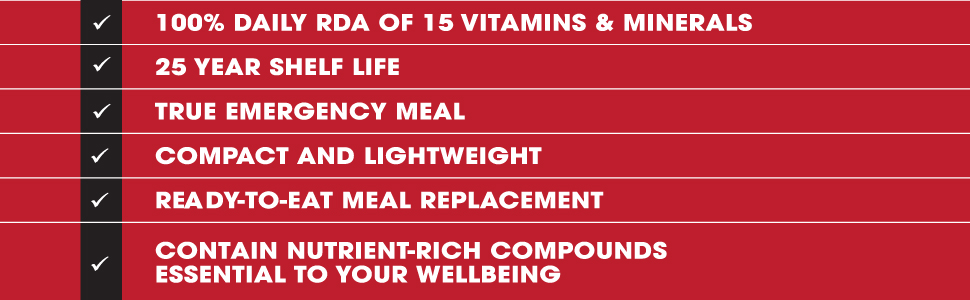
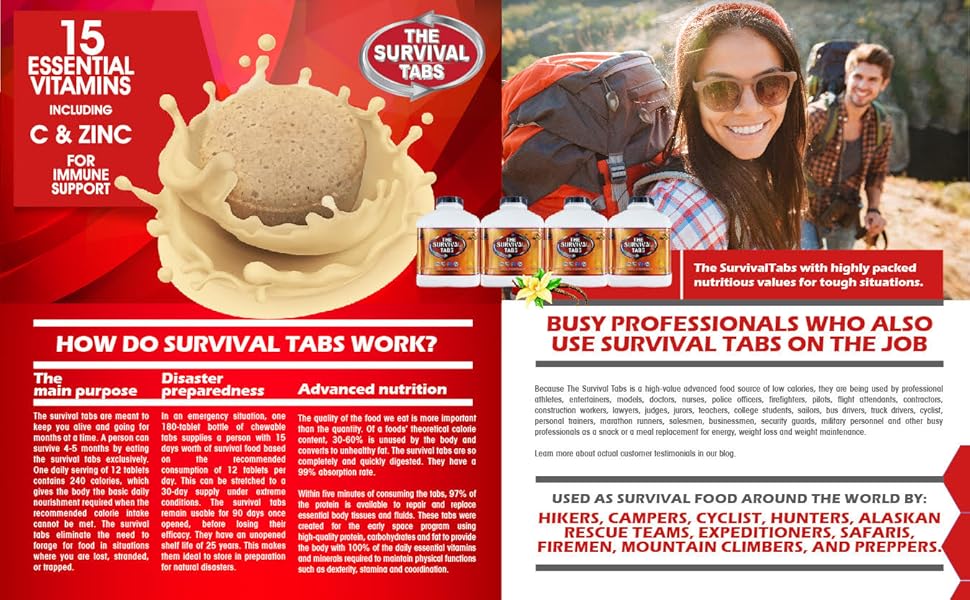
Emergency Foods contain 100% of the U.S. RDA of 15 Essential Vitamins & Minerals. Made with the highest quality protein which is essential in survival situations where your body needs to assimilate as much as possible from what you eat. With most of the food, we eat 30%-60% of the calorie content leaves the body unused. The Survival Tabs have such a highly concentrated formula that 99% of their calorie content is absorbed by the body with 97% of the protein content being available to repair or replacement of muscles, nerves, etc.